• Index
  • News
  • About

Reliquarian

~ An exploration of saints, their relics, and their iconography in art

Reliquarian

Tag Archives: relic

The Way of Saint James: Pilgrimage to the Tomb of a “Son of Thunder”

09 Saturday Mar 2013

Posted by Reliquarian in Altarpiece

≈ 4 Comments

Tags

Altar of the Holy Blood, altarpiece, church, Friedrich Herlin, Germany, martyr, pilgrimage, relic, Rothenburg, Saint James, Santiago de Compostela, tomb

Twelve Apostles Altar

Twelve Apostles Altar, Church of Saint James (St. Jakobskirche), Rothenburg ob der Tauber, Germany. Photo by Reliquarian.

The Way of Saint James

According to tradition, Saint James, one of the twelve Apostles, was martyred by beheading in the year 44.  After the rediscovery of his relics in 814, pilgrimages to his tomb in Compostela, northern Spain, became extremely popular.  Compostela even rivaled Jerusalem and Rome as a destination for pilgrim travelers during the Middle Ages.  Consequently, routes to Saint James’s shrine, including one through Rothenburg, Germany, crisscrossed Europe, marking the path to the saint’s tomb.  Today, the Way of Saint James (Camino de Santiago) continues to direct travelers to the remains of the fiery-tempered Apostle whom Jesus once called a “Son of Thunder.”

Invitation to a Beheading

Saint James was beheaded in Jerusalem during the Christian persecutions of King Herod Agrippa I.  According to Clement of Alexandria, Saint James’s accuser was so moved by the courage and conviction James showed at his trial that he subsequently repented and declared himself a Christian.  As a consequence, the man was sentenced to be beheaded alongside Saint James.  As both men were led to execution, the accuser turned to James and begged for his forgiveness.  According to Butler’s Lives of the Saints, “St James, after pausing a little, turned to him and embraced him, saying, ‘Peace be with you’.  He then kissed him, and they were both beheaded together.”[1]

A Tomb by the Sounding Sea

Saint James - Colmar

Isenheim Altarpiece, Matthias Grunewald (sculptures by Nicolas of Hagenau) (detail), 1510-1515, Colmar, France. On the carved predella of the Isenheim Altarpiece, Saint James can be seen holding a large seashell in his right hand. His pilgrim’s cap is also adorned with a shell. Photo by Reliquarian.

Early chronicles suggested that after his death, Saint James’s remains were transported from Jerusalem to the northern coast of Spain where they were buried contra mare Britannicum, “close to the British sea.”[2]  The location of the tomb, however, remained a mystery until, centuries later, in about 814, the tomb was rediscovered under miraculous circumstances.[3]  According to legend, a local monk named Pelayo was guided by a star to a secluded spot in the woods near the Galician coast.[4]  There he discovered a marble sarcophagus that contained human bones, apparently very old.[5]  Bishop Teodomir, the local bishop, proclaimed the remains to be those of Saint James, long believed to have been buried in the region.  After learning of the discovery, King Alfonso II journeyed to the site to venerate the relics and ordered that a church be built on the spot.  The modest church established by King Alfonso II later grew into the Cathedral of Santiago de Compostela, the ultimate destination of pilgrims traveling the Way of Saint James.

King Alfonso II’s journey to the tomb of Saint James is considered the first pilgrimage to Santiago de Compostela, and it set the example for subsequent generations of pilgrim travelers.  Departing from Oviedo, the location of his royal court, King Alfonso II likely took the Roman road known as the Camino Primitivo to Compostela.  As the popularity of Saint James’s shrine grew, other routes gradually came into regular use, such as the Camino del Norte, another Roman road, which skirted the coast.  By the 11th century, the pilgrimage to Santiago de Compostela had become an international phenomenon, drawing visitors from all over Christendom and establishing Santiago de Compostela as a rival to Jerusalem and Rome for pilgrims.[6]  In a paper discussing the history of the pilgrimage, Laurie Dennett opines that interest in Saint James’s relics had begun to shift the “conceptual geography of Christian Europe, giving it a new pole in the west, a new focus for popular devotion, that balanced the Byzantine east with its spiritual centre at Jerusalem.”[7]  She further notes that “Santiago de Compostela even seemed to rival the pretensions of Rome,” at least for a time.[8]

St. Jakobskirche and the Twelve Apostles Altar

The St. Jakobskirche (Saint James’s Church) in Rothenburg ob der Tauber was once an important stop on the pilgrimage road to Santiago de Compostela.  Known more widely as the home of the Altar of the Holy Blood, the church also houses the impressive Twelve Apostles Altar (Zwölfbotenaltar), a carved altarpiece with a painted predella and painted wings, which incorporates several images of Saint James.
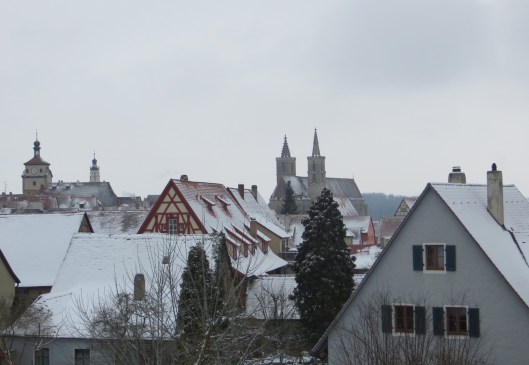
St Jakobskirche

View of St. Jakobskirche from the city walls.  Photo by Reliquarian.

Completed in 1466, the altarpiece is the work of Hans Waidenlich and Friedrich Herlin with carvings in the Multscher tradition by an unknown sculptor.[9]  Herlin, who may have been from Rothenburg, moved to Nördlingen later in his career and is closely identified with the Twelve Apostles Altar, which he signed: “This work was made by Friedrich Herlin, painter, mcccclxvi.  Saint James pray to God for him.”[10]

In Carved Splendor:  Late Gothic Altarpieces in Southern Germany, Austria, and South Tirol, Rainer Kahsnitz identifies the Twelve Apostles Altar as “one of the best-preserved altarpieces from the Late Gothic period.”[11]  Although little is known about the origins of the altarpiece, Kahsnitz speculates that it must have replaced an earlier work at St. Jakobskirche.[12]

Twelve Apostles Altar - Detail

Twelve Apostles Altar (detail).  Photo by Reliquarian.

The corpus of the altarpiece depicts the Crucifixion, with Mary (to the left) and Saint John the Evangelist (to the right) below the cross, flanking the dying Christ.  Next to Mary stands Saint James wearing a pilgrim’s hat decorated with a scallop shell, a symbol of pilgrimage.  Two other shells dangle from his wrist, and he is shown with a pilgrim’s staff, another defining attribute of the patron saint of pilgrims.[13]  The other carved figures below the cross are Saint Elizabeth (to the far left), who is carrying a loaf of bread and a pitcher; Saint Leonard (next to Saint John), the patron saint of prisoners of war; and Saint Anthony the hermit (to the far right), who is shown with a bell.  According to Kahsnitz, the altar was kept permanently closed following Rothenburg’s adoption of the Reformation.[14]  This helped preserve the sculptures and the paintings on the inner wings.[15]
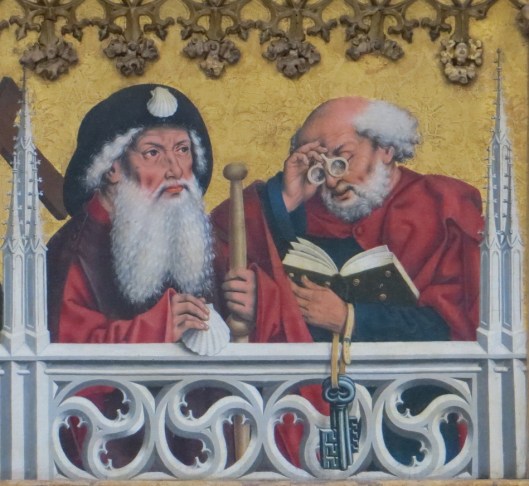
SS James and Peter

Saint James and Saint Peter. Friedrich Herlin’s predella depicts Saint James with his traditional attributes in art:  a pilgrim’s staff and a seashell.  To the right of Saint James is Saint Peter with several of his symbols:  a set of keys and a book.  Photo by Reliquarian.

Saint James appears again on Herlin’s predella with a shell in one hand and a pilgrim’s staff in the other.  To his left, Saint Peter carries two of his traditional attributes: a set of keys and a book, which he peers into with the aid of spectacles.  All twelve Apostles are represented on the predella, arranged in pairs behind a Late Gothic balustrade.[16]  In addition to other paintings, the back of the predella also features a depiction of the veil of Saint Veronica:  the image of Christ’s face with a crown of thorns imprinted on a veil or shroud.[17]

Sons of Thunder

Saint James is often known as “the Greater” to distinguish him from Saint James, son of Alphaeus, known as “the Lesser.”  He was the son of Zebedee and brother of Saint John the Evangelist, and he was the first Apostle martyred.  Saint James and his brother John apparently earned the epithet Boanerges, or “Sons of Thunder,” on account of their “impetuous spirit and fiery temper.”[18]  Nevertheless, as noted in Butler’s Lives of the Saints, James, John, and Peter, the Apostles “who from time to time acted impetuously, and had to be rebuked, were the very ones our Lord turned to on special occasions.”[19]  James, John, and Peter were the only Apostles to witness the agony in the garden of Gethsemani and were the only ones present for the Transfiguration.

Modern Pilgrims

The Way of Saint James continues to be a popular with pilgrims even today.  According to the Confraternity of Saint James, an organization founded “to bring together people interested in the medieval pilgrim routes through France and Spain to Santiago de Compostela,” the last several decades “have seen an extraordinary revival of interest in the pilgrimage to Santiago.”[20]  Once considered “one of the greatest of all Christian shrines” in the Middle Ages,[21] the route from the border of France and Spain known as the Camino Francés was inscribed as a UNESCO World Heritage Site in 1993.[22]

Twelve Apostles Altar 3

Twelve Apostles Altar, Church of Saint James (St. Jakobskirche), Rothenburg ob der Tauber, Germany. Photo by Reliquarian.

Still, some scholars question whether Saint James ever preached in Spain and whether the remains interred at Santiago de Compostela really are those of Saint James.  Butler’s Lives of the Saints states, “Outside of Spain almost all eminent scholars and critical students of history answer both questions in the negative.”[23]  Several authors have argued that Saint James’s visit to Spain is “improbable” because Saint James was martyred in Jerusalem in the year 44 and because he was “unheard of in Spain before the end of the seventh century.”[24]  Additionally, while it may be “quite possible that the relics recovered, after they had been lost, are identical with those which were venerated at Compostela in the middle ages, . . . the authenticity of medieval relics is always difficult to establish and in this case it is more than dubious.”[25]

Nevertheless, thousands of people continue to follow the Way of Saint James to Santiago de Compostela each year.  While there are “as many reasons for this revival as there are pilgrims,” the Confraternity of Saint James observes that “many people make the pilgrimage at a turning point in their lives, and . . . many are helped to come to terms with personal crisis by a period of separation from all that is familiar, and the shared hardship of the road.”[26]
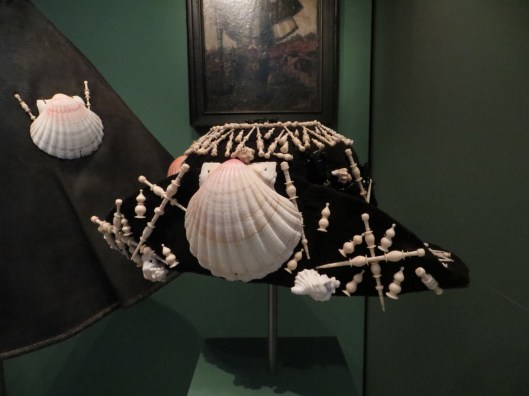
Pilgrim's Hat

Pilgrim’s Hat, felt, silk braid, shell, bone, jet (c. 1571). This pilgrim’s hat is currently on display at the Germanisches Nationalmuseum, Nuremberg, Germany, along with a matching pilgrim’s cloak and staff.  The matching set of pilgrim’s garb belonged to Stephan Praun III, a pilgrim to Santiago de Compostela.  Photo by Reliquarian.
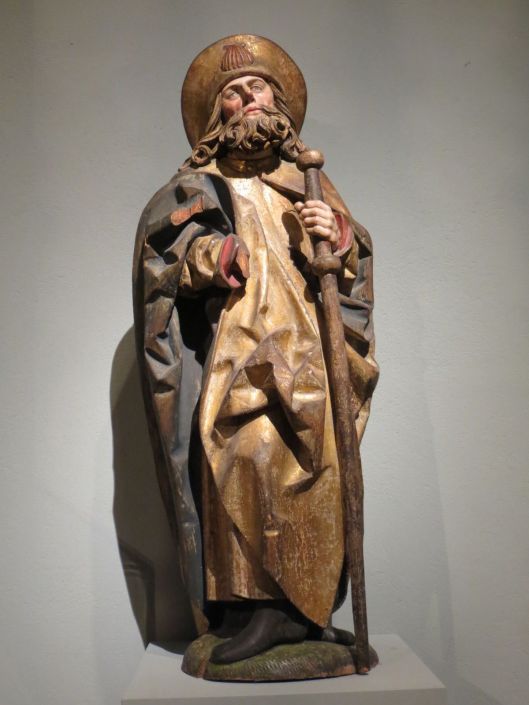
Saint James - Metropolitan Museum

Saint James the Greater, pine with paint and gilding, South German (1475-1500), Metropolitan Museum of Art, New York. The influence of Veit Stoss, who worked in Nuremberg and Krakow, is evident in the carving of the statue’s robes and face.  Photo by Reliquarian.


[1] 3 Butler’s Lives of the Saints 183 (Herbert J. Thurston, S.J. & Donald Attwater eds., 2d ed. 1956).

[2] Laurie Dennett, “2000 Years of the Camino de Santiago:  Where Did It Come From?  Where Is It Going?,” The Confraternity of Saint James, http://www.csj.org.uk/2000-years.htm (citing martyrologies by Florus of Lyons and Usuard of St. Germaine-des-Prés).  Dennett observes that “by the late 8th century, a literary tradition had developed which held that the burial place of St James lay in Spain, even if the site had not yet been identified.”  She further notes, “Interestingly, it was not until after the purported discovery of the tomb in about 814 that a corresponding tradition evolved concerning the Apostle’s return to Palestine and death, and the transportation of his mortal remains back to Spain for burial.”  Id.  The mare Britannicum is the present-day English Channel.

[3] See id.

[4] Id.

[5] Id.

[6] Id.

[7] Id.

[8] Id.

[9] See Rainer Kahsnitz, Carved Splendor:  Late Gothic Altarpieces in Southern Germany, Austria, and South Tirol 58 (2006).  Kahsnitz explains that the sculptures “were executed by a carver from the circle around the Ulm sculptor Hans Multscher (active there from 1427 until his death in 1467).  In their compact three-dimensionality they are based more strongly on Multscher’s earlier works from the 1450s, at which time the sculptor was probably Multscher’s pupil.”  Id. at 61.

[10] Id. at 58.  A clever Latin inscription on the frame of the altarpiece also dates the work to 1466.  It begins, “Bis duo c quoque sexagintaque sex quoque mille . . . .”  Id.

[11] Id.

[12] Id.

[13] See George Ferguson, Signs and Symbols in Christian Art 112 (1959).  Ferguson observes that the pilgrim’s staff is “used alone and in combination with various other objects as an attribute of numerous saints who have been noteworthy for their travels and pilgrimages.”  Id.  Other saints commonly depicted with staffs include Saints Christopher, John the Baptist, Jerome, Philip the Apostle, Ursula, and Roch.  Id.

[14] Kahsnitz, supra note 9, at 58.

[15] Id.

[16] Id. at 60.

[17] See, e.g., Rosa Giorgi, Saints in Art 119 (Stefano Zuffi ed. & Thomas Michael Hartmann trans., 2002).

[18] Butler’s Lives of the Saints, supra note 1, at 182.

[19] Id.

[20] The Confraternity of Saint James, The Confraternity of Saint James, http://www.csj.org.uk/csj.htm; The Present-Day Pilgrimage, The Confraternity of Saint James, http://www.csj.org.uk/present.htm.

[21] Butler’s Lives of the Saints, supra note 1, at 183.

[22] The Present-Day Pilgrimage, supra note 20.

[23] Butler’s Lives of the Saints, supra note 1, at 183.

[24] Id.

[25] Id.

[26] The Present-Day Pilgrimage, supra note 20.
Share this:

  • Click to share on Facebook (Opens in new window) Facebook
  • Click to share on X (Opens in new window) X
  • Click to share on Pinterest (Opens in new window) Pinterest
  • Click to share on Reddit (Opens in new window) Reddit
  • Click to share on Tumblr (Opens in new window) Tumblr
Like Loading...

Bones of Contention: Searching for Cosmas and Damian in Venice

22 Tuesday Jan 2013

Posted by Reliquarian in Tomb / Sarcophagus

≈ 1 Comment

Tags

bones, crucifix, Germany, Italy, Munich, relic, Saint Constantius, Saint Eustace, Saints Cosmas and Damian, San Giorgio Maggiore, skull, Tintoretto, Venice

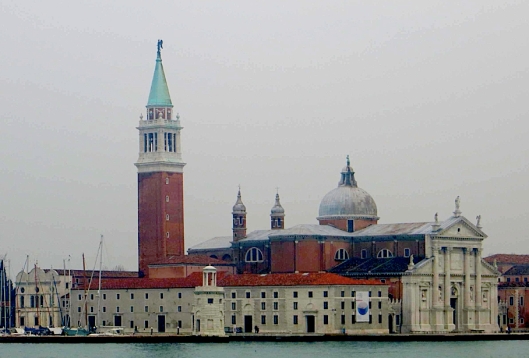
San Giorgio Maggiore 3In an earlier post, I discussed a 15th century Rhenish School-style reliquary located at the Church of Saint Michael (St. Michaelskirche) in Munich.  The reliquary purportedly contains the skulls of Saints Cosmas and Damian, although as I noted in the post, other churches are also said to possess the saints’ skulls. The Church of San Giorgio Maggiore in Venice is one, and on a recent trip to Venice, I decided to find out whether the church really did posses relics of Saints Cosmas and Damian.

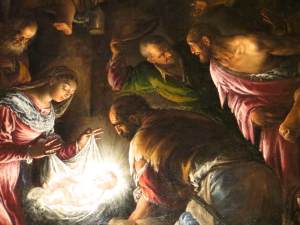
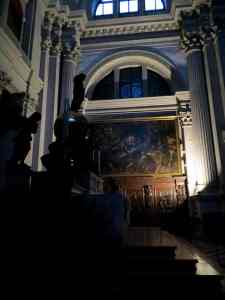
We arrived at San Giorgio Maggiore[1] by vaporetto at dusk. The church was dark and looked deserted, so we were afraid it might be closed. Nevertheless, we gave the door a Adoration of the Shepherds (detail)hopeful nudge, and it yielded freely. The church was open. Inside, a few tourists shuffled through the aisles, straining to catch a glimpse of the church’s treasures – paintings by Tintoretto,[2] Sebastiano Ricci, and Jacopo Bassano[3] – in the fading light, but it was no use. All sense of depth, line, and color seemed to dissolve in the gloaming, and the tourists quickly lost interest. Soon enough, they left, and in the sepulchral stillness of the empty church, we began our search for the skulls of Saints Cosmas and Damian in earnest.

We looked for traces of the saints in the gathering darkness. Were the skulls housed in an elaborate metal reliquary? Were they displayed in sturdy glass cases? Were they Tintoretto - Last Suppereven in the church proper rather than in a separate treasury or crypt? We hurried past fading altars, their angels and saints winking at us in the dim light of votive candles. We peered at statutes, examined chiseled writing, and contemplated the high altar. No sign of the saints.

Eventually, we stumbled upon a man striding confidently through the church. It was a priest, and we asked whether he knew about the relics of Saints Cosmas and Damian. He thought for a moment and then invited us to follow him. He led us to the rectory, where we repeated our question to one of his colleagues. “This may sound strange, but we’ve heard that the skulls of Saints Cosmas and Damian may be located here, at Chiesa di San Giorgio Maggiore. Is this true? Do you know whether the skulls of Saints Cosmas and Damian are here in the church?”

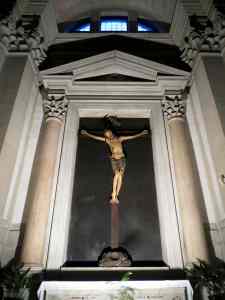
Venetian Polychrome CrucifixThe second priest looked uncertain, and he shook his head as he began to answer. “I don’t know about their skulls,” he said. “But, there is an altar of Cosmas and Damian.  Their bones are kept there.” I was elated, and I asked him excitedly where we might find the altar. “It is on the right side,” he explained. “Next to the large crucifix.”

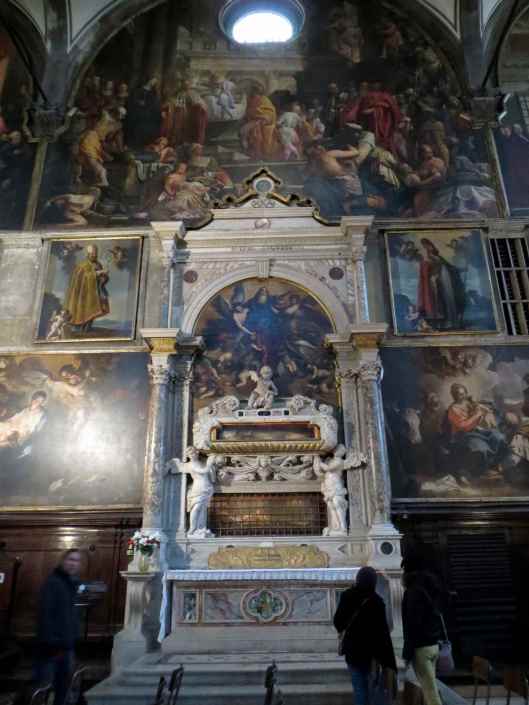
I knew exactly where he meant. Earlier, I had paused before an imposing wooden crucifix, riveted by its wrenching depiction of Christ on the cross.[4] Next to it, we found the altar of Saints Cosmas and Damian. A large painting, the Martyrdom of Saints Cosmas and Damian, attributed to the workshop of Tintoretto, hung above it. We had missed it in the darkness!  (A black and white image is available here.)

One of the saints is shown in the lower lefthand corner of the painting, his left hand outstretched but tied to a cross that is resting on the ground. One of his persecutors binds his legs to the cross while another monitors his progress. In the upper righthand corner of the painting, his brother is securely bound to another cross, which has already been raised off the ground. In the background, archers loose arrows at him while other figures appear to hurl rocks. According to tradition, the saints were unharmed by attempts to kill them with arrows, by stoning, and by crucifixion. They were eventually beheaded, along with several other brothers, who also appear in the painting, crowned with halos. An angel, tumbling into the scene from heaven, bears palm fronds in his right hand, symbols of martyrdom.

With the aid of a small flashlight – it was truly dark by now – we found a plaque secured above the altar.  It read: “OSSA SS · MAR · COSME ET DAMINI IACENT HIC” (Here Lie the Bones of Saints, Martyrs, Cosmas and Damian). We had found their bones.

Altar of Saints Cosmas and Damian


[1] The Church of San Giorgio Maggiore is located on the island of San Giorgio Maggiore, east of the Giudecca, and across the Canale di San Marco from Saint Mark’s Square.

[2] Tintoretto’s celebrated The Last Supper hangs to the right of the high altar, in the presbytery. Painted in the Mannerist style, Tintoretto’s The Last Supper differs from other depictions of the Last Supper in striking ways. For example, the table at which Jesus and the Apostles share their meal is shown at an angle rather than head-on, as in many depictions of the Last Supper (for example, Leonardo da Vinci’s famous rendition at the Convent of Santa Maria della Grazie in Milan.) Additionally, Jesus and the Apostles are not the only figures present in the scene. Although the eye naturally settles on Jesus, who is surrounded by a brilliant aureole of light, and the Apostles, who are distinguished by halos (except for Judas), some of the largest figures in the painting are ordinary men and women who have prepared and are serving the meal.

[3] Jacopo Bassano’s Adoration of the Shepherds hangs above the first altar on the right side of the nave.

[4] The crucifix is most likely one that was donated to the church in 1468.  The crucifix’s deteriorating, polychrome paint was restored in 1984 by the Venice in Peril Fund. Venice in Peril, “Church of San Giorgio Maggiore,” available at http://www.veniceinperil.org/projects/church-of-san-giorgio-maggiore. A sign below the crucifix read “HIC IACET CORPUS S · EUSTACHII PAT · CONST·” (Here Lies the Body of Saint Eustace, Father of [Saint] Constantius) indicating it hangs above the tomb of Saint Eustace.  (I briefly discussed Saint Constantius in an earlier post about the Waldauf Chapel in Austria.)  For a modest €0.50, were able to illuminate the crucifix for two minutes enabling us to capture a photograph of it.

Share this:

  • Click to share on Facebook (Opens in new window) Facebook
  • Click to share on X (Opens in new window) X
  • Click to share on Pinterest (Opens in new window) Pinterest
  • Click to share on Reddit (Opens in new window) Reddit
  • Click to share on Tumblr (Opens in new window) Tumblr
Like Loading...

Saint Zacharias, Father of John the Baptist

01 Tuesday Jan 2013

Posted by Reliquarian in Tomb / Sarcophagus

≈ Leave a comment

Tags

Bellini, church, Italy, John the Baptist, relic, Saint Athanasius, Saint Elizabeth, Saint Zacharias, Tintoretto, tomb, Venice

Altar and Tomb of Saint Zacharia

Altar and Tomb of Saint Zacharias

The Story of Saint Zacharias

All that is known of Saint Zacharias and his wife, Saint Elizabeth, is contained in chapter 1 of the Gospel of Saint Luke.  According to Saint Luke, Zacharias was a priest, and Elizabeth was a daughter of the house of Aaron.  As noted in Butler’s Lives of the Saints, “They were without children, and perhaps beyond the normal age of generation, when Zachary, while officiating in the Temple, had a vision of an angel, who told him that in response to their prayers they should have a son . . . .”[1]    The Gospel of Saint Luke states, “[T]he angel said unto him, Fear not Zacharias: for thy prayer is heard; and thy wife Elisabeth shall bear thee a son, and thou shalt call his name John.  And thou shalt have joy and gladness; and many shall rejoice at his birth.”[2]

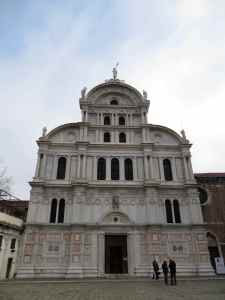
Church of San ZaccariaZacharias was skeptical and questioned the angel.  “Whereby shall I know this? for I am an old man, and my wife well stricken in years.”[3]  The angel, Gabriel, responded by striking Zacharias dumb for doubting his word.  “And, behold, thou shalt be dumb, and not able to speak, until the day that these things shall be performed, because thou believest not my words, which shall be fulfilled in their season.”[4]

Elizabeth conceived and hid for five months.  In the sixth month, the angel Gabriel appeared to Elisabeth’s cousin, Mary, with even more miraculous news.  “Fear not, Mary,” he told her, “for thou hast found favor with God.  And, behold, thou shalt conceive in thy womb, and bring forth a son, and shalt call his name Jesus.”[5]

Gabriel also told Mary that Elizabeth had conceived.  “And, behold, thy cousin Elisabeth, she hath also conceived a son in her old age: and this is the sixth month with her, who was called barren.  For with God nothing shall be impossible.”[6]

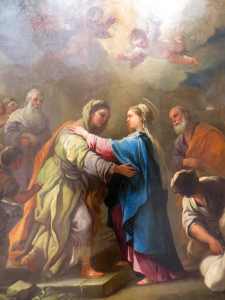
The VisitationElizabeth gave birth to a son, and when it came time to name him, her friends and family assumed he would be named Zacharias after his father.  Elizabeth objected.  “Not so,” she said, “but he shall be called John.”[7]  “There is none of thy kindred that is called by this name,” they responded,  “And they made signs to his father, how he would have him called.”[8]  Zacharias signaled for something to write with, and when writing material was brought to him he wrote simply, “His name is John.”[9]  At this, “his mouth was opened immediately, and his tongue loosed, and he spake, and praised God.”[10]

Chiesa di San Zaccaria

San Zaccaria AltarpieceThe Chiesa di San Zaccaria (Church of Saint Zacharias) in Venice is located a few meters southeast of the Basilica di San Marco (Saint Mark’s Basilica) on the Campo San Zaccaria.  The present church was designed by Antonio Gambello and Mauro Codussi and was completed between 1444 and 1515.

The interior walls of the church are decorated with paintings by some of the greatest artists of the day, including Antonio Balestra, Giuseppe Salviati, Giovanni Domenico Tiepolo, Jacopo Tintoretto, Angelo Trevisani, and Anthony Van Dyck.  The Church of Saint Zacharias also houses one of Giovanni Bellini’s most famous works, the San Zaccaria Altarpiece, which is also known as La Sacra Conversazione.  (A clearer picture of the San Zaccaria Altarpiece is available here.)

Tomb of Saint Zacharias

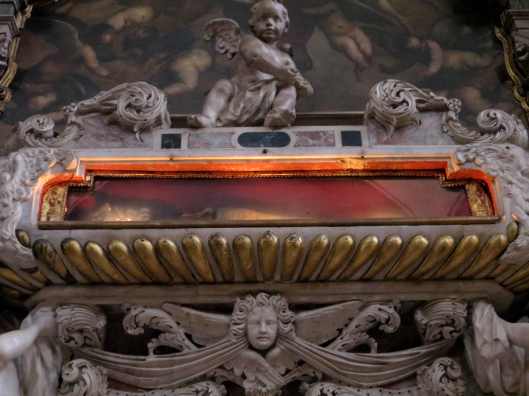
Saint ZachariaOpposite the San Zaccaria Altarpiece, in the right nave of the church, lie the remains of Saint Zacharias and Saint Athanasius of Alexandria.  (Saint Athanasius will be the subject of a future post.)  The altar and tomb of Saint Zacharias was designed by Alessandro Vittoria in 1599.  Two marble angels hold Saint Zacharias’s tomb aloft, above the tomb of Saint Athanasius.  Below, an inscription reads, “CORPUS S. ZACCARIÆ, PATRIS S. JO: BAPTISTÆ” (Body of Saint Zacharia, Father of Saint John the Baptist). The painting on the lunette directly above the altar is S. Zaccaria in Gloria by Jacopo Negretti, painted in 1599.


[1] 1 Butler’s Lives of the Saints 267 (Herbert J. Thurston, S.J. & Donald Attwater eds., 2d ed. 1956).

[2] Luke 1:13-14 (King James).

[3] Id. 1:18.

[4] Id. 1:20.

[5] Id. 1:30-31.

[6] Id. 1:36-37.

[7] Id. 1:60.

[8] Id. 1:61-62.

[9] Id. 1:63.

[10] Id. 1:64.

Share this:

  • Click to share on Facebook (Opens in new window) Facebook
  • Click to share on X (Opens in new window) X
  • Click to share on Pinterest (Opens in new window) Pinterest
  • Click to share on Reddit (Opens in new window) Reddit
  • Click to share on Tumblr (Opens in new window) Tumblr
Like Loading...
← Older posts
Newer posts →

Recent Posts

  • Ex Indumentis:  Religious Medals and Relics of Saints
  • Green Alternative: When Saint Patrick Wore Blue
  • The Great Heart Heist: The Stunning Theft of Saint Laurence O’Toole’s Preserved Heart
  • The Column of the Flagellation: Relic of the Scourging of Jesus
  • Saint Roch: The Saint “Par Excellence” Against Disease

Top Posts & Pages

  • The Great Heart Heist:  The Stunning Theft of Saint Laurence O'Toole's Preserved Heart
    The Great Heart Heist: The Stunning Theft of Saint Laurence O'Toole's Preserved Heart
  • Relic of the Holy Diaper:  The Swaddling Clothes of Jesus
    Relic of the Holy Diaper: The Swaddling Clothes of Jesus
  • The Altar of the Holy Blood
    The Altar of the Holy Blood
  • The Shrine of the Three Kings:  Grand Reliquary of the Magi
    The Shrine of the Three Kings: Grand Reliquary of the Magi
  • Winter of Discontent:  Saint Sebaldus, Protector Against Cold Weather, Takes a Sabbatical
    Winter of Discontent: Saint Sebaldus, Protector Against Cold Weather, Takes a Sabbatical
  • Saint Charles Borromeo:  A Tale from the Crypt of Milan Cathedral
    Saint Charles Borromeo: A Tale from the Crypt of Milan Cathedral
  • Saint Theodore: Warrior Saint and Dragon-Slayer
    Saint Theodore: Warrior Saint and Dragon-Slayer
  • Saint Munditia: A Holy Skeleton Near the Rindermarkt in Munich
    Saint Munditia: A Holy Skeleton Near the Rindermarkt in Munich
  • The Column of the Flagellation:  Relic of the Scourging of Jesus
    The Column of the Flagellation: Relic of the Scourging of Jesus
  • Ex Indumentis:  Religious Medals and Relics of Saints
    Ex Indumentis:  Religious Medals and Relics of Saints

Tags

Aachen altarpiece Austria basilica cathedral Charlemagne church Croatia Dubrovnik Fourteen Holy Helpers Germany Hall in Tirol Italy Krakow Magi martyr mosaic Munich pilgrim pilgrimage Poland relic reliquary Rothenburg Saint Blaise Saint Denis Saint Helena Saint James Saint Mark Saint Mary Saints Cosmas and Damian Saint Theodore Santiago de Compostela sarcophagus shrine skeleton skull Tintoretto tomb Venice

Archives

Categories

Enter your email address to subscribe to this blog and receive notifications of new posts by email.

Join 91 other subscribers

Blog at WordPress.com.

  • Subscribe Subscribed
    • Reliquarian
    • Join 91 other subscribers
    • Already have a WordPress.com account? Log in now.
    • Reliquarian
    • Subscribe Subscribed
    • Sign up
    • Log in
    • Report this content
    • View site in Reader
    • Manage subscriptions
    • Collapse this bar
%d