Tags
Bellini, church, Italy, John the Baptist, relic, Saint Athanasius, Saint Elizabeth, Saint Zacharias, Tintoretto, tomb, Venice
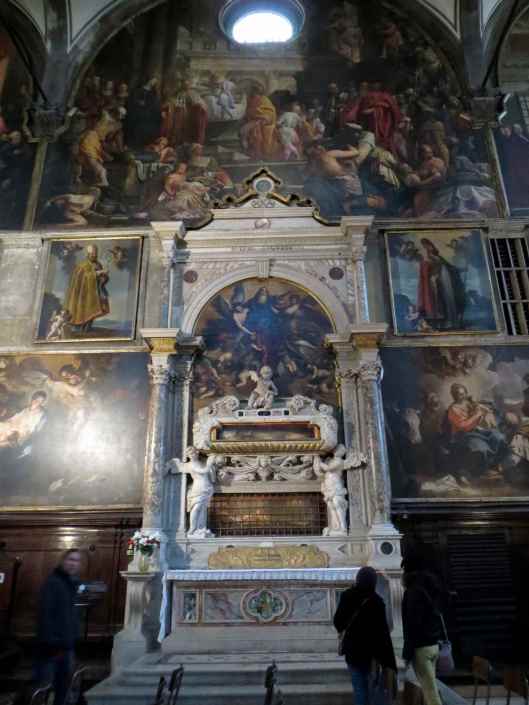
Altar and Tomb of Saint Zacharias
The Story of Saint Zacharias
All that is known of Saint Zacharias and his wife, Saint Elizabeth, is contained in chapter 1 of the Gospel of Saint Luke. According to Saint Luke, Zacharias was a priest, and Elizabeth was a daughter of the house of Aaron. As noted in Butler’s Lives of the Saints, “They were without children, and perhaps beyond the normal age of generation, when Zachary, while officiating in the Temple, had a vision of an angel, who told him that in response to their prayers they should have a son . . . .”[1] The Gospel of Saint Luke states, “[T]he angel said unto him, Fear not Zacharias: for thy prayer is heard; and thy wife Elisabeth shall bear thee a son, and thou shalt call his name John. And thou shalt have joy and gladness; and many shall rejoice at his birth.”[2]
 Zacharias was skeptical and questioned the angel. “Whereby shall I know this? for I am an old man, and my wife well stricken in years.”[3] The angel, Gabriel, responded by striking Zacharias dumb for doubting his word. “And, behold, thou shalt be dumb, and not able to speak, until the day that these things shall be performed, because thou believest not my words, which shall be fulfilled in their season.”[4]
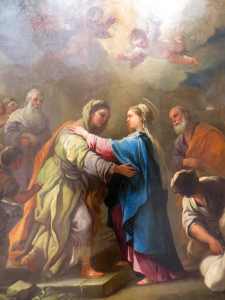
Elizabeth conceived and hid for five months. In the sixth month, the angel Gabriel appeared to Elisabeth’s cousin, Mary, with even more miraculous news. “Fear not, Mary,” he told her, “for thou hast found favor with God. And, behold, thou shalt conceive in thy womb, and bring forth a son, and shalt call his name Jesus.”[5]
Gabriel also told Mary that Elizabeth had conceived. “And, behold, thy cousin Elisabeth, she hath also conceived a son in her old age: and this is the sixth month with her, who was called barren. For with God nothing shall be impossible.”[6]
 Elizabeth gave birth to a son, and when it came time to name him, her friends and family assumed he would be named Zacharias after his father. Elizabeth objected. “Not so,” she said, “but he shall be called John.”[7] “There is none of thy kindred that is called by this name,” they responded, “And they made signs to his father, how he would have him called.”[8] Zacharias signaled for something to write with, and when writing material was brought to him he wrote simply, “His name is John.”[9] At this, “his mouth was opened immediately, and his tongue loosed, and he spake, and praised God.”[10]
Chiesa di San Zaccaria
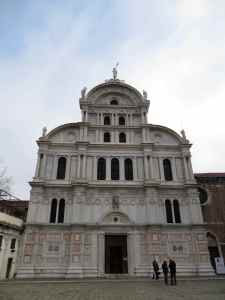
 The Chiesa di San Zaccaria (Church of Saint Zacharias) in Venice is located a few meters southeast of the Basilica di San Marco (Saint Mark’s Basilica) on the Campo San Zaccaria. The present church was designed by Antonio Gambello and Mauro Codussi and was completed between 1444 and 1515.
The interior walls of the church are decorated with paintings by some of the greatest artists of the day, including Antonio Balestra, Giuseppe Salviati, Giovanni Domenico Tiepolo, Jacopo Tintoretto, Angelo Trevisani, and Anthony Van Dyck. The Church of Saint Zacharias also houses one of Giovanni Bellini’s most famous works, the San Zaccaria Altarpiece, which is also known as La Sacra Conversazione. (A clearer picture of the San Zaccaria Altarpiece is available here.)
Tomb of Saint Zacharias
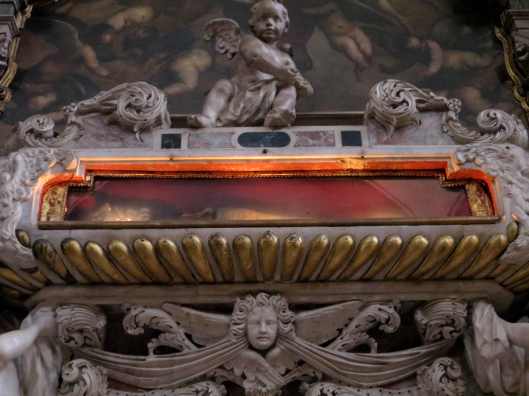 Opposite the San Zaccaria Altarpiece, in the right nave of the church, lie the remains of Saint Zacharias and Saint Athanasius of Alexandria. (Saint Athanasius will be the subject of a future post.) The altar and tomb of Saint Zacharias was designed by Alessandro Vittoria in 1599. Two marble angels hold Saint Zacharias’s tomb aloft, above the tomb of Saint Athanasius. Below, an inscription reads, “CORPUS S. ZACCARIÆ, PATRIS S. JO: BAPTISTÆ” (Body of Saint Zacharia, Father of Saint John the Baptist). The painting on the lunette directly above the altar is S. Zaccaria in Gloria by Jacopo Negretti, painted in 1599.
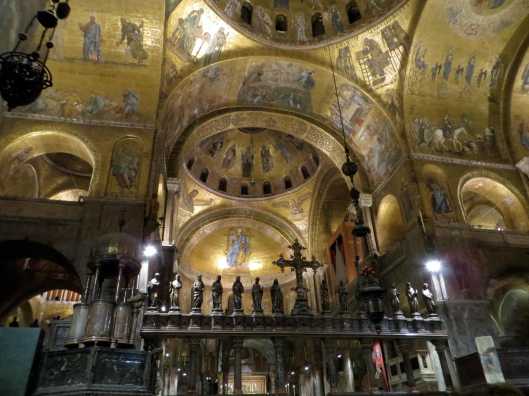
 Saint Mark, the symbol is everywhere in the city. Chiseled onto buildings, stamped onto tiles, and stitched into flags, it serves as a constant reminder of the enduring relationship between city and saint. The glorification of Saint Mark in Venetian culture, however, came at the expense of another saint, Saint Theodore of Amasea. Once Venice’s sole patron, Saint Theodore’s influence declined after Saint Mark’s arrival, although he is still afforded a place of honor atop a pillar in Saint Mark’s Square.
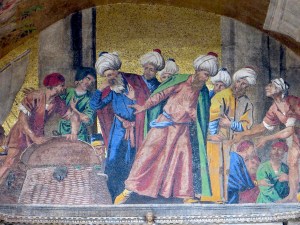 Akroyd explains, “The body of Saint Mark was taken out of the sarcophagus and unwrapped from its silk shroud, the relic being substituted by another and less eminent saint. It was then placed in a chest and taken on board the Venetian ship, the merchants first ensuring that the saint’s remains were covered by a layer of pork and cabbage. When the Muslim officials asked to inspect the chest, they cried out ‘Kanzir, kanzir’ (Oh horror) at the sight and smell of the pork. . . . Thus the evangelist was safely conveyed to Venice, but not before a number of miracles eased his passage across the Mediterranean.”
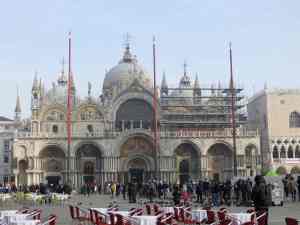 Saint Mark’s body was initially kept in a chapel at the Doge’s palace, a chapel originally dedicated to Saint Theodore, until a more suitable church could be built. Begun in 829, the year after the translation of Saint Mark’s relics, the first church of Saint Mark was completed in 832. This church was destroyed in 976 during a rebellion against Doge Pietro Candiano IV. A second church was built in 1063 but was not consecrated until 1094, after Saint Mark’s relics, which had been lost in the years following the destruction of the first church, were rediscovered.
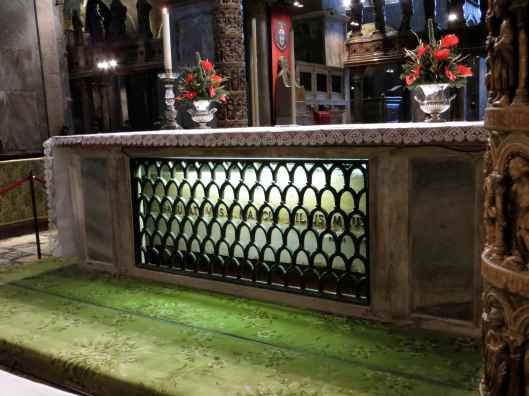 During my visit to the basilica, Saint Mark’s simple, marble sarcophagus could only be viewed from behind the high altar. The exterior of the sarcophagus was well lit and a short inscription applied to the stone in metallic letters read: “SALUTAT VOS . . . MARCUS FILIUS MEUS.” This inscription was followed by a citation in much smaller letters below the word “MEUS.” The citation read “1 Petri 5.13,” the source of the abbreviated quote on the tomb. The front of the sarcophagus apparently proclaims “CORPUS DIVI MARCI EVANGELISTAE” (Body of the Divine Mark, Evangelist).
 Pfarrkirche St. Nikolaus
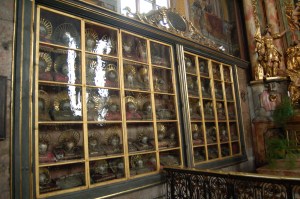
 line the interior of a large cabinet, its glass wavy with age. Each skull is veiled with a gauzy fabric, blurring its features, and each is crowned with a golden halo. The effect is grim but striking: glints of gold on ashen bones in the shadows of an ancient church.
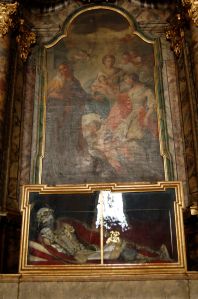 The most conspicuous display contains what appears to be a complete skeleton, recumbent, richly dressed in a red velvet cape, a heavily embroidered jacket, and white silk pants. His right arm is bent at the elbow, and his head is almost poised on his gloved right hand. The glove, probably of white silk, is decorated with jewels. A golden crown formed of loosely gathered leaves adorns his skull, and the hint of a burnished halo is just visible above his head. The case itself is not clearly labeled, so unfortunately I never discovered the identity of the skeleton.
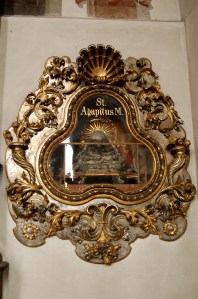 Other potential Agapituses include
  Reliquarian