• Index
  • News
  • About

Reliquarian

~ An exploration of saints, their relics, and their iconography in art

Reliquarian

Tag Archives: reliquary

Saint Munditia: A Holy Skeleton Near the Rindermarkt in Munich

15 Friday Feb 2013

Posted by Reliquarian in Tomb / Sarcophagus

≈ 5 Comments

Tags

church, Germany, martyr, Munich, reliquary, Saint Erasmus, Saint Munditia
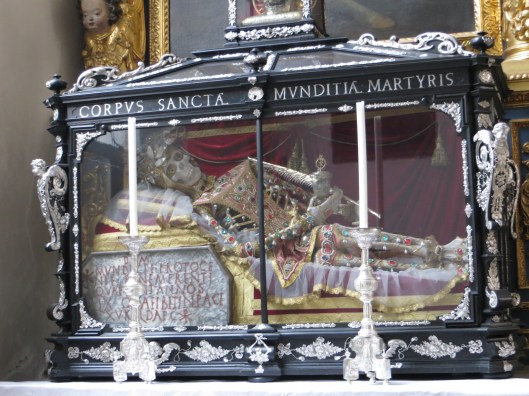
Saint MunditiaThe Skeleton of Saint Munditia

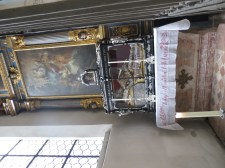
The skeleton of Saint Munditia rests in a glass ossuary, hidden in plain sight at the Peterskirche (Saint Peter’s Church) in Munich. Situated just steps from the church’s north entrance, the ossuary is ordinarily locked behind a wrought iron gate that partially Shrine of S Munditiaobscures it from view. Most visitors never notice she’s there, but those who catch a glimpse of her and pause to peer through the gate may be surprised to find a skeleton, bedecked in jewels and bound in gauze, staring back at them.
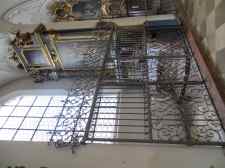
The skeleton is propped on cushions and rests at a slight angle to the viewer. Its arms and legs are adorned with alternating red and green jewels, the color of gumdrops. She holds a golden palm frond resembling a giant quill pen in her left hand, her thumb hooked around its stem. The palm frond is emblematic of martyrdom. In her right hand she holds what appears to be a small philatory with the Greek letters chi (X) and rho (P), surrounded by a radiance, extending from the lid. Chi and rho are the first two letters in the Greek word for Christ. Unfortunately, although the philatory is transparent, it is difficult to discern what it contains. Are they the relics of another saint?

The skeleton’s most striking feature are its glass eyes. Set securely in the saint’s skull, they stare out at the world in slightly different directions. The skull is also crowned with a metal laurel wreath, another symbol of martyrdom.

Who Is Saint Munditia?

Not much is known of Saint Munditia. She does not appear in the Roman Martyrology or even the Book of Saints, although the inscription above her tomb is unequivocal about her status as both a saint and martyr. The inscription reads CORPUS SANCTA MUNDITIA MARTYRIS (“Body of Saint Munditia, Martyr”). She is also purportedly the patron saint of spinsters.[1]

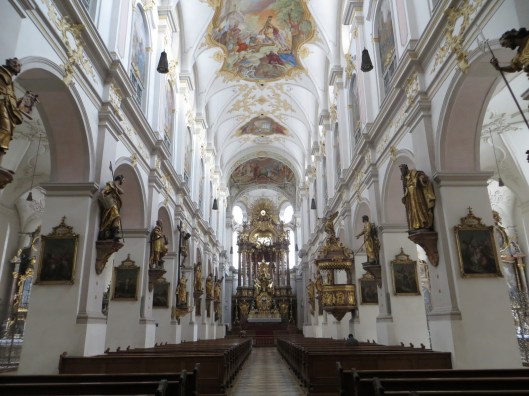
According to some sources, the relics of Saint Munditia were discovered in the Roman catacombs and were obtained by Franz Benedikt Höger, a Munich businessman, in 1675. The relics were translated to the Peterskirche on 5 September 1677, where they have remained ever since. In 1804, the skeleton was concealed behind a wooden shrine in an attempt to combat “Aberglaube” (superstition), but the relics were eventually uncovered again in 1883, which resulted in renewed interest in her cult.[2]Peterskirche - Interior
The inscription located inside the ossuary, beneath Saint Munditia’s head, is somewhat enigmatic, but it offers clues about the life and death of the mysterious saint. It reads:

DDM MUNDICIE PROTOGENIE BENEMERENTI QUAE VIXIT ANNOS LX QUAE IBIT IN PACE XV KAL D ZUM FROMMEN GEDENKEN AN MUNDITIA PROTOGENIA DIE WOHLVERDIENTE: SIE LEBTE 60 JAHRE UND GING EIN IN DEN FRIEDEN AM 15. TAG VOR DEN KALENDEN DES DEZEMBERS (17. NOVEMBER) – APC

The abbreviation “APC” appended at the end of the text is one of the most perplexing parts of the inscription. Some have interpreted it to mean “ASCIA PLEXA CAPITA,” Shrine of S Munditia 2indicating Saint Munditia had been decapitated by an ax or hatchet. Others propose that “APC” stands for “ANDRONICO PROBO CONSULIBUS,” meaning “During the counsulship of [Tatius] Andronicus and [Pompeius] Probus.” Under this interpretation, Saint Munditia would have died in the year 310.
While Saint Munditia may not have the star power of more famous saints, like Saint Mark or Saint George, she continues to be celebrated every year[3] at the Peterskirche, and she even has a following on Facebook. A contemporary poem by the Trinidadian writer Vahni Capildeo offers further evidence of Saint Munditia’s ability to provoke and inspire, even today. “St. Munditia, centuries later,” he writes, “bewigged, bolted and belted with jewels, . . . glassed off like the snake room at the zoo.”[4]

The Skull of Saint Erasmus
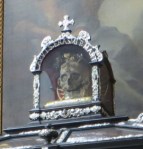
Skull of Saint ErasmusBut Saint Munditia is not the only saint to share the small enclosure that contains her shrine. Above her glass ossuary and easily overlooked amidst the visual tumult of bones, jewels, and Baroque ornamentation surrounding her skeleton rests another, much smaller, glass reliquary. Peering out of the box with unnaturally blue eyes is a skull with a halo placed on a cushion. The inscription above it declares that it is the skull of Saint Erasmus: CAPUT S. ERASMI P. MART.[5] As I’ve written before, Saint Erasmus of Formiae is a patron saint of mariners and protector against intestinal ailments. He is incorrectly believed to have been martyred by disembowelment.


[1] Die Pfarrgemeinde von St. Peter, “Eine Katakombenheilige in St. Peter,” available at http://www.alterpeter.de/frameneu/mundi_frame.htm.

[2] Id.

[3] The Munditiafest takes place every November 17th.

[4] Vahni Capildeo, No Traveller Returns 163 (2003).

[5] “MART” is a shortened form of “Martyr.”  The “P.” I believe stands for “Pius,” meaning dutiful.
Share this:

  • Click to share on Facebook (Opens in new window) Facebook
  • Click to share on X (Opens in new window) X
  • Click to share on Pinterest (Opens in new window) Pinterest
  • Click to share on Reddit (Opens in new window) Reddit
  • Click to share on Tumblr (Opens in new window) Tumblr
Like Loading...

Saint Mark, Patron Saint of Venice

27 Thursday Dec 2012

Posted by Reliquarian in Tomb / Sarcophagus

≈ 11 Comments

Tags

basilica, Italy, martyr, mosaic, relic, reliquary, Saint Claudia, Saint Mark, Saint Theodore, sarcophagus, Tintoretto, Venice

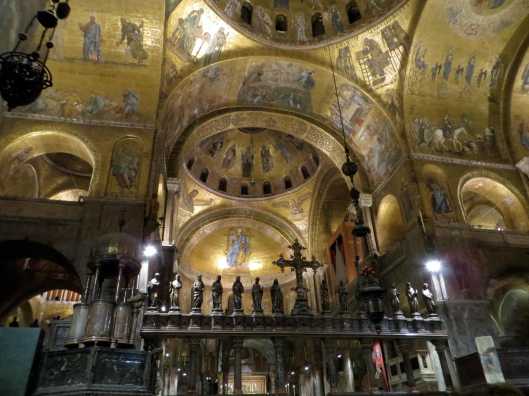
Basilica di San Marco - Interior

Basilica di San Marco – Interior Mosaics

Saint Mark and Venice

In his lush, elegant history of Venice, Venice: Pure City, Peter Ackroyd writes, “There was one great transformation in the early history of Venice.  In 828 an object was brought to this place that entirely changed its character and its status.”[1]  That object was the body of Saint Mark the Evangelist.

The association of Saint Mark with the city of Venice persists to this day.  The symbol of Saint Mark – a winged lion – is also the emblem of Venice.  Known as the Lion of Lion of Saint MarkSaint Mark, the symbol is everywhere in the city.  Chiseled onto buildings, stamped onto tiles, and stitched into flags, it serves as a constant reminder of the enduring relationship between city and saint.  The glorification of Saint Mark in Venetian culture, however, came at the expense of another saint, Saint Theodore of Amasea.  Once Venice’s sole patron, Saint Theodore’s influence declined after Saint Mark’s arrival, although he is still afforded a place of honor atop a pillar in Saint Mark’s Square.
The Translation of the Relics of Saint Mark

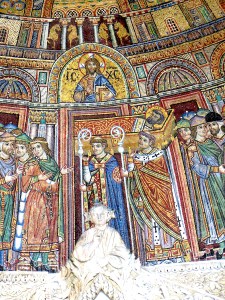
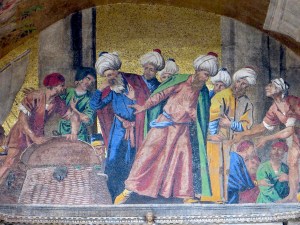
The story of how Saint Mark’s relics eventually came to Venice is a remarkable one, and it has been the subject of various works of art throughout the centuries.  Tintoretto’s Deposition Mosaic CloseupTranslation of the Body of Saint Mark, a stark, dramatic painting that has the eerie feel of a photo negative, may be one of the most recognizable.  Painted between 1562 and 1566 for the Scuola Grande di San Marco,[2] the work is part of the permanent collection of the Accademia Galleries in Venice.  (A companion painting, Discovery of the Body of Saint Mark, is located at the Brera Gallery in Milan.)  The glittering mosaics that adorn the exterior of Saint Mark’s Basilica also tell the story, in tessellated form, of the translation of Saint Mark’s relics.  For example, the mosaic located above the left doorway (the Door of Saint Alypius) of the west facade depicts Saint Mark’s body being carried into the basilica.  The mosaic, known as the Deposition mosaic, is the oldest exterior mosaic on the basilica and dates to 1260-1270.

According to legend, Saint Mark’s body was stolen from Alexandria, Egypt, in 828.  Two Venetian merchants traveling in Alexandria obtained the relics of Saint Mark from priests at the church of Saint Mark, where the saint’s body was interred.  The priests feared Saint Mark’s relics might be damaged or destroyed by the Saracens during the persecution of the Catholic community in Alexandria.  Promising to safeguard the saint’s relics, the merchants convinced the priests to allow them to return to Venice with the body of Saint Mark.

Stealing of the BodyAkroyd explains, “The body of Saint Mark was taken out of the sarcophagus and unwrapped from its silk shroud, the relic being substituted by another and less eminent saint.  It was then placed in a chest and taken on board the Venetian ship, the merchants first ensuring that the saint’s remains were covered by a layer of pork and cabbage.  When the Muslim officials asked to inspect the chest, they cried out ‘Kanzir, kanzir’ (Oh horror) at the sight and smell of the pork. . . .  Thus the evangelist was safely conveyed to Venice, but not before a number of miracles eased his passage across the Mediterranean.”[3]
Basilica di San Marco

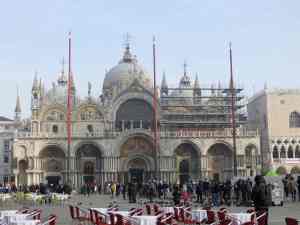
Basilica of Saint MarkSaint Mark’s body was initially kept in a chapel at the Doge’s palace, a chapel originally dedicated to Saint Theodore, until a more suitable church could be built.  Begun in 829, the year after the translation of Saint Mark’s relics, the first church of Saint Mark was completed in 832.  This church was destroyed in 976 during a rebellion against Doge Pietro Candiano IV.  A second church was built in 1063 but was not consecrated until 1094, after Saint Mark’s relics, which had been lost in the years following the destruction of the first church, were rediscovered.
Loss and Rediscovery of Saint Mark’s Relics

The Pala Feriale, an altarpiece of tempera and gold leaf on panel created by Paolo Veneziano and his sons in 1345 for Doge Andrea Dandolo, depicts the miraculous rediscovery of the relics.  Divided into two registers, the lower register of the Pala Feriale features seven panels portraying the story of Saint Mark, including the apparitio —  the self-revelation of Saint Mark’s relics in 1094.  According to tradition, the saint’s remains, which had been lost, revealed themselves to have been hidden inside a reliquary pier within the church.  Earlier depictions of the apparitio, however, seemed to suggest that despite the miracle of the apparitio, the reliquary pier itself was empty; Saint Mark’s body had turned to dust.  As one scholar has noted, “The miracle disclosed the location of the body but did not reveal the body itself.”[4]

In contrast, the Pala Feriale portrayed Saint Mark’s body as intact and physically present.  As Ana Munk explains in “The Art of Relic Cults in Trecento Venice,” “Paolo Veneziano’s shutters . . . may be the only scene among sixty-one representations of Saint Mark where the audience’s devotion to the saint in his problematic tomb within San Marco was recorded; every instance and effect of Saint Mark’s life, death, and his translation from Alexandria was documented in previous mosaics except the actual location of the body itself.”  The effect of these earlier depictions was to assure worshippers that Saint Mark was, indeed, present at the basilica – the Deposition mosaic clearly shows Saint Mark’s body entering the basilica – while leaving the exact whereabouts of his relics vague and uncertain.  As Munk observes, “the body of Saint Mark was simultaneously omnipresent and elusive.”[5]

Final Resting Place

In 1835, Giacomo Monico, Patriarch of Venice, exhumed the body of Saint Mark from the crypt beneath the basilica and placed it in the high altar.[6]  Before then, the saint’s body had apparently last been seen in the 12th century, dressed in ecclesiastical robes, when it was placed on display for five months for public veneration.[7]

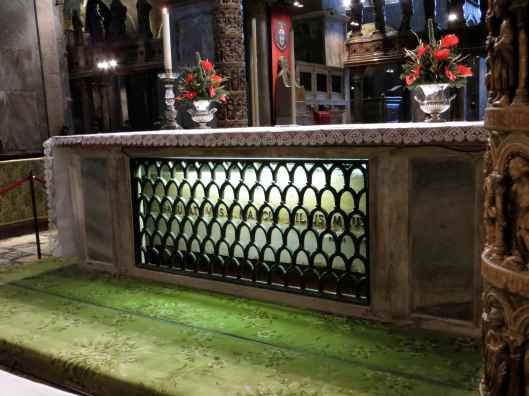
Sarcophagus of Saint MarkDuring my visit to the basilica, Saint Mark’s simple, marble sarcophagus could only be viewed from behind the high altar.  The exterior of the sarcophagus was well lit and a short inscription applied to the stone in metallic letters read: “SALUTAT VOS . . . MARCUS FILIUS MEUS.”  This inscription was followed by a citation in much smaller letters below the word “MEUS.”  The citation read “1 Petri 5.13,” the source of the abbreviated quote on the tomb.  The front of the sarcophagus apparently proclaims “CORPUS DIVI MARCI EVANGELISTAE” (Body of the Divine Mark, Evangelist).[8]  When I visited, it was Christmas Eve, and in addition to the poinsettias and other decorations installed around the basilica in preparation for Midnight Mass, someone had placed two, single red roses on top of the sarcophagus.


[1] Peter Ackroyd, Venice: Pure City 37 (2009).

[2] Giovanni Nepi Scire, The Accademia Galleries in Venice: General Catalogue 88 (2012).

[3] Akroyd at 37-38.  In his book The Secret Lives of Buildings, Edward Hollis identifies the two Venetian merchants as Buono da Malamocco and Rustico da Torcello, and he names Saint Claudia as the saint whose relics replaced those of Saint Mark in Alexandria.  Hollis writes, “At the time Alexandria was in the sway of the Fatimid caliphate; but two merchants of Venice, by the names of Buono da Malamocco and Rustico da Torcello, went to the city and found an old church dedicate to Saint Mark the Evangelist.  Saint Mark had been martyred in Alexandria, and his remains had been kept in this church ever since.  The two merchants spoke with the guardians of the saint.  They were in danger, these priests said, for the governor of Alexandria intended to demolish their church and send its marbles and columns to the caliph’s new palace in Babylon. . . . One night, under the cover of darkness, the priests let them into the church.  Torcello and Malamocco took the body of Saint Mark and substituted it with the body of another, less exalted martyr, Saint Claudia . . . .”  Edward Hollis, The Secret Lives of Buildings 50 (2009).

[4] Ana Munk, “The Art of Relic Cults in Trecento Venice: Corpi Sancti as a Pictorial Motif and Artistic Motivation,” 30 Radovi Instituta za Povijest Umjetnosti 81, 88 (2006) (citations omitted).  In Hollis’s telling, Saint Mark’s body appears, lifeless but fully formed, from the reliquary pier.  After chanting and praying intensely for the recovery of their missing saint, the Venetians at the new basilica noticed “a sweet smell began to pervade the church.  Suddenly, one of the piers to the right of the altar began to shake, and the masonry began to buckle.  With a crash and a roar, an arm appeared, then a shoulder, a torso, and a head; and then the whole body of Saint Mark fell lifeless onto the pavement of the sanctuary.  The doge Falier placed this body in a marble sarcophagus in the crypt, and the Heroon of the Venetians received its patron saint.”  Hollis, supra note 3, at 52.

[5] Id. at 87.

[6] Id. at 91 n.50.

[7] Id. at 87 (citing Bruno Bertoli, Le storie di San Marco nei mosaici e le ragioni dell’agiografia, in La Basilica di San Marco: Arte e Simbologia 114-115 (Bruno Bertoli ed.,1993)).

[8] John Nickell, Relics of the Christ 37 (2007).

Share this:

  • Click to share on Facebook (Opens in new window) Facebook
  • Click to share on X (Opens in new window) X
  • Click to share on Pinterest (Opens in new window) Pinterest
  • Click to share on Reddit (Opens in new window) Reddit
  • Click to share on Tumblr (Opens in new window) Tumblr
Like Loading...

Waldauf Chapel

04 Tuesday Dec 2012

Posted by Reliquarian in Glass Reliquary

≈ 1 Comment

Tags

Austria, chapel, Hall in Tirol, martyr, relic, reliquary, Roman Martyrology, Saint Agapitus, Saint Constantius, skeleton, skull

Pfarrkirche St. NikolausPfarrkirche St. Nikolaus

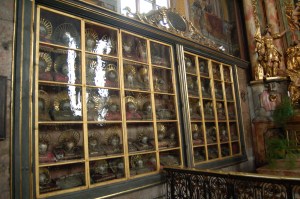
The Pfarrkirche (Parish Church) St. Nikolaus in Hall in Tirol, Austria — approximately 10 km from Innsbruck — houses an impressive display of holy relics. The Waldauf Chapel, located in the northern part of the nave, is named for Florian Waldauf zu Waldenstein, an Austrian knight who bequeathed his collection of relics to the church upon his death in 1501.

Waldauf KapellePfarrkirche St. Nikolaus was established in 1281 and was initially Gothic in style.  Over the centuries, however, enlargement of the church and the addition of increasingly elaborate ornamentation changed the character of the interior, infusing it with a distinctly Baroque appearance.  The high altar, pictured in the distance above, is the work of Erasmus Quellinus II, a student of Peter Paul Rubens.  Interior frescoes were added in 1752 by Adam Mölk, a court painter to Empress Maria Theresa.

Florian Waldauf’s collection of relics adorns the northern wall of the eponymous chapel.  Dozens of skulls and an assortment of bones carefully arranged on red velvet cushions Saint Skull Close-upline the interior of a large cabinet, its glass wavy with age.  Each skull is veiled with a gauzy fabric, blurring its features, and each is crowned with a golden halo.  The effect is grim but striking: glints of gold on ashen bones in the shadows of an ancient church.
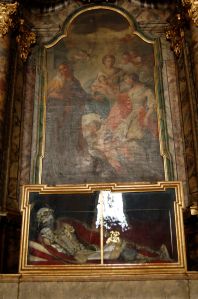
The collection of relics in the Waldauf Chapel are not the only relics on display in the church, however.  Three additional cases along the northern wall, near the center of the nave, appear to contain the remains of additional saints, two of whom are clearly identified.  I’m not sure whether these relics are part of Florian Waldauf’s original bequest, but given the prominence of the displays, they are likely the most important of the church’s collection.

A Mysterious Skeleton

Unidentified SkeletonThe most conspicuous display contains what appears to be a complete skeleton, recumbent, richly dressed in a red velvet cape, a heavily embroidered jacket, and white silk pants.  His right arm is bent at the elbow, and his head is almost poised on his gloved right hand.  The glove, probably of white silk, is decorated with jewels.  A golden crown formed of loosely gathered leaves adorns his skull, and the hint of a burnished halo is just visible above his head.  The case itself is not clearly labeled, so unfortunately I never discovered the identity of the skeleton.
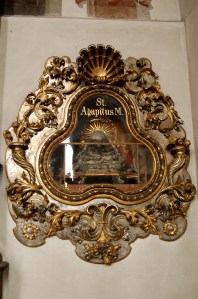
In contrast, the two other repositories flanking the skeleton case are both clearly marked.  Each is built into the wall, above eye level, and each contains a single skull atop a pyramid of bones.  The first case is labeled in large, gold letters “St. Constantius M.”  The second case, similarly marked, reads “St. Agapitus M.”  The “M” following the names Agapitus and Constantinus refers to “martyr.”

Saint Agapitus at Pfarrkirche St. Nikolaus

The Roman Martyrology lists seven saints named Agapitus.  Saint Agapitus of Palestrina, for example, was fifteen when he was arrested by order of the emperor Aurelian.  According to the Roman Martyrology, he was first scourged and then “endured more severe torments, and being delivered to the lions by the emperor’s order without receiving any injury, he was finally struck with the sword . . . .”  After his death in 274, a basilica was erected in Palestrina, Italy, at the site of his beheading.  His relics are apparently kept there, though several relics were transferred to Besançon, France.  Consequently, the bones at Pfarrkirche St. Nikolaus cannot be those of Saint Agapitus of Palestrina.

Relics of Saint AgapitusOther potential Agapituses include Saint Agapitus the Deacon, who was beheaded in Rome in 258.  Saint Agapitus of Synnada, in Phrygia, was a bishop martyred in the 3rd century.  Saint Agapitus of Rome was martyred in 188.  He was the son of Saints Eustachius and Theophistes and the brother of Saint Theophistus.  During the persecutions of Hadrian, all four members of the family were “condemned to be cast to the beasts,” but having escaped unharmed, they were then essentially cooked to death after being “shut up in a burning brazen ox.”  Pope Saint Agapitus, “whose sanctity is attested by blessed Gregory the Great,” is also listed in the Roman Martyrology, though it is unclear how he was martyred.  He may or may not be the same Pope Saint Agapitus I (or Agapetus I) who served as pope from 13 May 535 until his death on 22 April 536. The latter Pope Saint Agapitus, however, apparently died of illness rather than as a result of martyrdom.  He is interred at Saint Peter’s Basilica in Rome. Yet another Saint Agapitus was martyred in Heraclea in Thrace during the early 4th century along with Saints Bassus, Denis, and forty others.  Lastly, Saint Agapitus of Ravenna, bishop and confessor, was martyred at Ravenna in the 4th century.

Saint Constantius at Pfarrkirche St. Nikolaus

The identity of “St. Constantius M.” is equally uncertain.  The Roman Martyrology lists several Constantiuses.  Saint Constantius of Rome, a priest who opposed the Pelagians, was martyred in Rome c. 418.  Saint Constantius of Trier (also known as Trèves) was killed, along with several others, in Trier during the Diocletian persecutions, c. 287.  Saint Constantius of Perugia, the first Bishop of Perugia, Italy, was martyred along with members of his congregation during the reign of Marcus Aurelius.  He was beheaded in 170.  Another Saint Constantius, the son of Saint Simplicius and brother of Saint Victorian, was also martyred during the persecutions of Marcus Aurelius, in Marsica, Italy.  This Saint Constantius, along with his father and brother, “were first tortured in different manners, and then being struck with the axe, obtained the crown of martyrdom . . . .”  They apparently survived being thrown into a chamber with snakes and scorpions and escaped being torn apart by maddened heifers before they were eventually beheaded at Celano in 159.

In addition to these martyrs, several other Constantiuses have been recognized as saints or beati.  For example, Saint Constantius the Bishop was the Bishop of Aquino, Italy.  He died c. 520 of natural causes.  Saint Constantius of Ancona was, according to the Book of Saints, sacristan of the church of St. Stephen in Ancona, Italy.  He died in the latter part of the 6th century and his relics are reportedly kept in Ancona.  The Blessed Constantius of Fabriano, also known as Constantius Bernocchi, died of natural causes in 1481.

Share this:

  • Click to share on Facebook (Opens in new window) Facebook
  • Click to share on X (Opens in new window) X
  • Click to share on Pinterest (Opens in new window) Pinterest
  • Click to share on Reddit (Opens in new window) Reddit
  • Click to share on Tumblr (Opens in new window) Tumblr
Like Loading...
← Older posts
Newer posts →

Recent Posts

  • Ex Indumentis:  Religious Medals and Relics of Saints
  • Green Alternative: When Saint Patrick Wore Blue
  • The Great Heart Heist: The Stunning Theft of Saint Laurence O’Toole’s Preserved Heart
  • The Column of the Flagellation: Relic of the Scourging of Jesus
  • Saint Roch: The Saint “Par Excellence” Against Disease

Top Posts & Pages

  • The Shrine of the Three Kings:  Grand Reliquary of the Magi
    The Shrine of the Three Kings: Grand Reliquary of the Magi
  • The Great Heart Heist:  The Stunning Theft of Saint Laurence O'Toole's Preserved Heart
    The Great Heart Heist: The Stunning Theft of Saint Laurence O'Toole's Preserved Heart
  • Saint Matthias:  The Thirteenth Apostle
    Saint Matthias: The Thirteenth Apostle
  • Ex Indumentis:  Religious Medals and Relics of Saints
    Ex Indumentis:  Religious Medals and Relics of Saints
  • The Altar of the Holy Blood
    The Altar of the Holy Blood
  • Saint Charles Borromeo:  A Tale from the Crypt of Milan Cathedral
    Saint Charles Borromeo: A Tale from the Crypt of Milan Cathedral
  • Index
    Index
  • Saint Roch:  The Saint "Par Excellence" Against Disease
    Saint Roch: The Saint "Par Excellence" Against Disease
  • Relic of the Holy Diaper:  The Swaddling Clothes of Jesus
    Relic of the Holy Diaper: The Swaddling Clothes of Jesus
  • Winter of Discontent:  Saint Sebaldus, Protector Against Cold Weather, Takes a Sabbatical
    Winter of Discontent: Saint Sebaldus, Protector Against Cold Weather, Takes a Sabbatical

Tags

Aachen altarpiece Austria basilica cathedral Charlemagne church Croatia Dubrovnik Fourteen Holy Helpers Germany Hall in Tirol Italy Krakow Magi martyr mosaic Munich pilgrim pilgrimage Poland relic reliquary Rothenburg Saint Blaise Saint Denis Saint Helena Saint James Saint Mark Saint Mary Saints Cosmas and Damian Saint Theodore Santiago de Compostela sarcophagus shrine skeleton skull Tintoretto tomb Venice

Archives

Categories

Enter your email address to subscribe to this blog and receive notifications of new posts by email.

Join 91 other subscribers

Blog at WordPress.com.

  • Subscribe Subscribed
    • Reliquarian
    • Join 91 other subscribers
    • Already have a WordPress.com account? Log in now.
    • Reliquarian
    • Subscribe Subscribed
    • Sign up
    • Log in
    • Report this content
    • View site in Reader
    • Manage subscriptions
    • Collapse this bar
%d