Tags
Austria, Diocletian, Gemäldegalerie, Germany, Italy, martyr, Munich, physician, relic, reliquary, Saints Cosmas and Damian, skull, Venice, Vienna
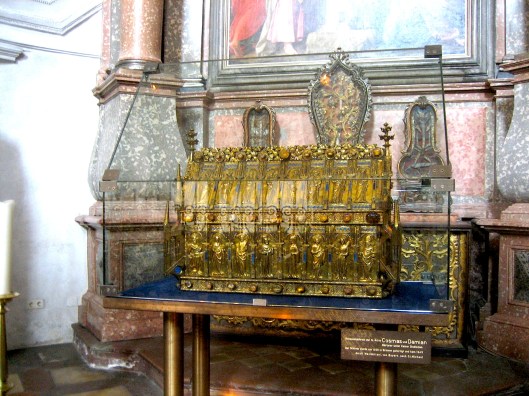
Reliquary of Saints Cosmas and Damian
The reliquary pictured above purportedly contains the skulls of Saints Cosmas and Damian, twin brothers who were martyred in Cyrrhus, Syria, around the 4th century. The Rhenish School-style reliquary, which dates to 1400, is currently located at Saint Michael’s Church in Munich, Germany. The lower portion of the reliquary, which is decorated with standing figures, contains two doors that open to display the saints’ skulls.
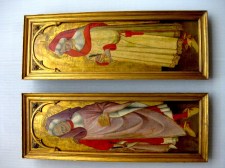
Saints Cosmas and Damian were skilled physicians who lived on the bay of Alexandretta in Cilicia in what is now modern-day Turkey. They are venerated as “moneyless ones” or holy “unmercenaries” because they refused to accept payment in return for their services. They are honored as patron saints of physicians, along with Saint Luke and Saint Pantaleon, and are often depicted with symbols of medicine or healing, including phials, boxes of ointment, and the rod of Aesculapius — a rod entwined with a serpent. In the paintings below by the Early Renaissance painter Giovanni da Modena, both saints appear to be carrying boxes of ointment. (The two works are part of the medieval sacred art collection of the Gemäldegalerie in Berlin.)
 Although the exact date of their deaths is unclear, Saints Cosmas and Damian are believed to have died between 287 and 303 A.D. during the Great Persecution of the emperor Diolcetian. Following their martyrdom, a basilica was built in their honor in Cyrrhus, north of Antioch, and from there, the cult of Saints Cosmas and Damian spread to the rest of the Christian world. According to Butler, “The cult of SS Cosmas and Damian first reached Rome during the pontificate of St Symmachus (498-514; 19 July), who introduced it into an oratory near the basilica of Santa Maria Maggiore. But it was Pope St Felix III (526-30; 22 Sept) who translated their relics and built the basilica dedicated to them.”
Saints Cosmas and Damian are explicitly invoked in the Canon of the Mass and are included in the Litany of the Saints and the Roman Martyrology. In The Holy Sacrifice of the Mass, first published in 1902, Nikolaus Gihr notes that in the Roman Canon, “only martyrs are named before and after the Consecration: this distinction is justly due to them. They have merited it by the bloody sacrifice of their life; . . .” Their younger brothers Anthimus, Leontius, and Euprepius, who also died during the Diocletian persecution, are memorialized in the Roman Martyrology as well.
In addition to being patrons of doctors, Saints Cosmas and Damian are also patron saints of nurses, surgeons, pharmacists, dentists, barbers, and oddly (at least according to Butler), confectioners. The feast day of the saints, which had been celebrated on 27 September, was moved to 26 September to accommodate the feast of Saint Vincent de Paul.
Meanwhile, the cult of Saints Cosmas and Damian appears to be alive and well. Every year, for example, thousands of people gather in Cambridge, Massachusetts, to celebrate The Italian Feast of the Healing Saints Cosmas and Damian. According to the festival’s official website, which currently features a delightful countdown clock to the next (87th) celebration, the goal of the festival is “to promote our Italian heritage, maintain a strong presence in our community, and preserve the devotion to our patrons, Saints Cosmas and Damian.” The celebration begins when statues of Saints Cosmas and Damian are removed from their chapel. Following a candlelight procession, “the festival opens as the statues are swayed down the main street of the feast. The statues are then placed in a temporary outdoor chapel as a ‘Healing Service’ is conducted with the Relic of Saints Cosmas and Damian for all in attendance.”
In addition to Saint Michael’s Church in Munich, the convent of the Clares in Madrid and Saint Stephen’s Cathedral in Vienna also lay claim to possessing the skulls of the twin saints. Other relics of Saints Cosmas and Damian are apparently kept at the Church of San Giorgio Maggiore in Venice.

 Reliquarian