• Index
  • News
  • About

Reliquarian

~ An exploration of saints, their relics, and their iconography in art

Reliquarian

Tag Archives: relic

“Santo Subito”: The Future Saint John Paul

01 Tuesday Oct 2013

Posted by Reliquarian in General

≈ Leave a comment

Tags

John Paul II, Krakow, Poland, relic, Saint Faustina, Wawel Cathedral

John Paul II PortraitPope Francis announced yesterday, 30 September, that he will formally canonize two of his predecessors, John Paul II and John XXIII, on 27 April 2014. The date falls on the first Sunday after Easter and coincides with the Feast of the Divine Mercy, a feast added to the General Roman Calendar by then-Pope John Paul II in 2000. Based on the writings of Saint Faustina Kowalska, the message of the Divine Mercy is one of mercy and forgiveness. Pope John Paul II actively promoted devotion to the Divine Mercy and is closely associated with both Divine Mercy Sunday and Saint Faustina.

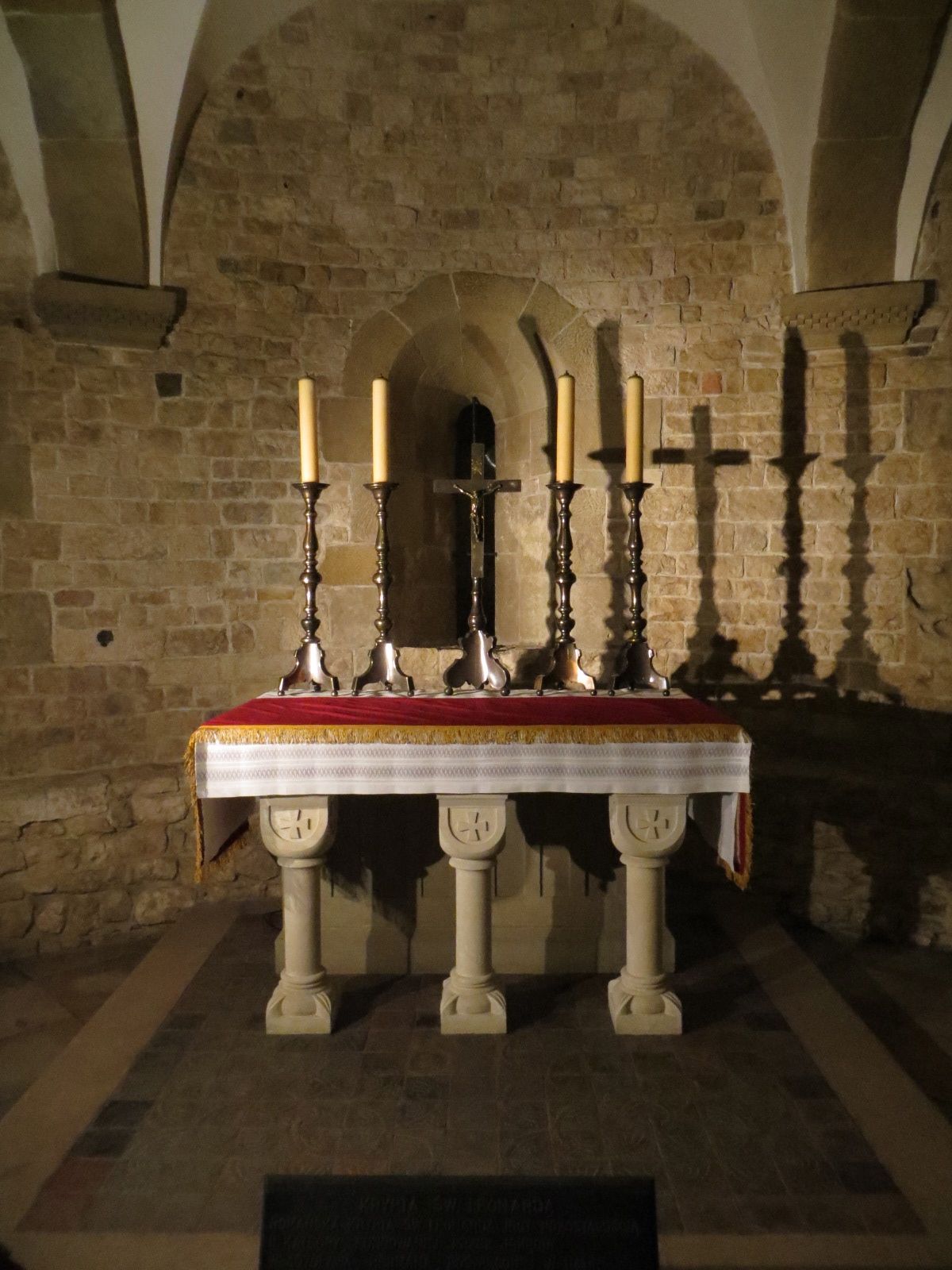
Wawel Cathedral, Krakow, Poland.  Blessed John Paul, known a Karol Wojtyla, celebrated his first Mass as a priest in the Crypt of Wawel Cathedral on 2 November 1946.

Wawel Cathedral, Krakow, Poland. Blessed John Paul, then known as Karol Wojtyla, celebrated his first Mass as a priest in the Crypt of Wawel Cathedral on 2 November 1946. A side chapel devoted to Blessed John Paul contains a few drops of the future saint’s blood, displayed in a sleek, modern reliquary.

Pope Francis’s choice of Divine Mercy Sunday is significant for a number of reasons. First, as noted above, Pope John Paul II is responsible for officially designating the first Sunday after Easter as Divine Mercy Sunday. Second, on the same day Pope John Paul II added Divine Mercy Sunday to the liturgical calendar—30 April 2000—he also canonized Saint Faustina. Pope John Paul II had previously beatified Saint Faustina on 18 April 1993. Finally, John Paul II was himself beatified on Divine Mercy Sunday, 1 May 2011, by then-Pope Benedict XVI.

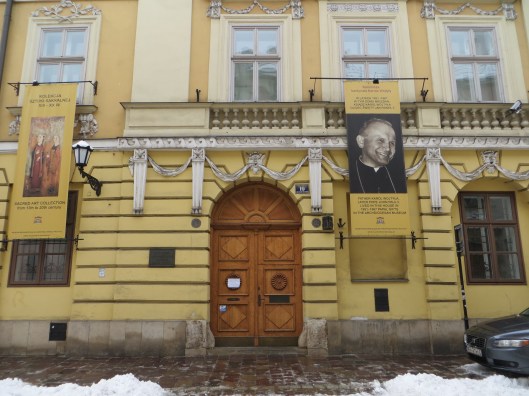
Archdiocesan Museum, Krakow, Poland

Archdiocesan Museum, Krakow, Poland

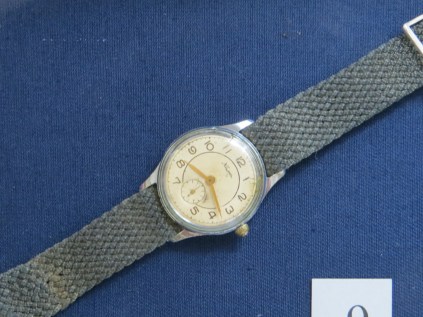
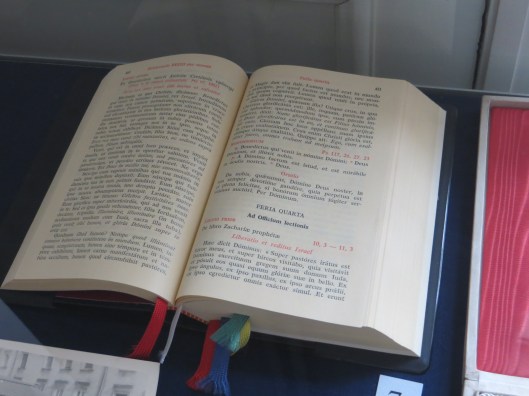
Sometimes referred to as John Paul the Great, Blessed John Paul is still wildly popular and widely revered in his native Poland. The Archdiocesan Museum (Muzeum Archidiecezjalne) in Krakow houses a number of artifacts associated with Blessed John Paul, including his skis, his watch, his personal breviary, and various liturgical vestments. The room where Blessed John Paul once lived has also been restored and contains a number of objects, including Blessed John Paul’s bed and his typewriter. The museum also possesses an assortment of sacred art and relics, primarily of Polish saints.

Blessed John Paul's Kama Watch from the 1950s, Archdiocesan Museum, Krakow, Poland

Blessed John Paul’s Kama Watch from the 1950s, Archdiocesan Museum, Krakow, Poland

Breviary used by Cardinal Karol Wojtyla circa 1975, Archdiocesan Museum, Krakow, Poland

Breviary used by Cardinal Karol Wojtyla circa 1975, Archdiocesan Museum, Krakow, Poland

Various gifts presented to Cardinal Karol Wojtyla, Archdiocesan Museum, Krakow, Poland

Various gifts presented to Cardinal Karol Wojtyla, Archdiocesan Museum, Krakow, Poland

Skull cap of Cardinal Karol Wojtyla, Archdiocesan Museum, Krakow, Poland

Red skull cap of Cardinal Karol Wojtyla, Archdiocesan Museum, Krakow, Poland

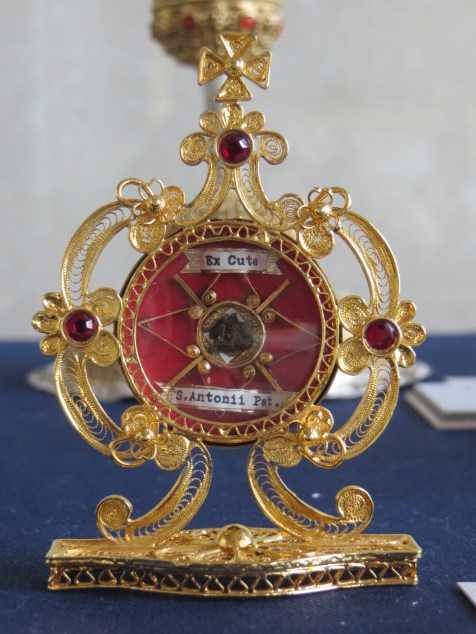
Relic of Saint Antoni Padewski, silver and gold plate, Archdiocesan Museum, Krakow, Poland

Reliquary with relic from the skin of (“Ex Cute”) Saint Anthony of Padua (Antoni Padewski), silver and gold plate, Archdiocesan Museum, Krakow, Poland

Altar of Blessed Pope John Paul II, Church of Saint Florian, Krakow, Poland.  The white skull cap at the bottom of the photo once belonged to Blessed John Paul, who served as an Associate Pastor at the church from 1949 to 1951.

Altar of Blessed Pope John Paul II, Church of Saint Florian, Krakow, Poland. The white skull cap encased in glass at the bottom of the photo once belonged to Blessed John Paul, who served as an Associate Pastor at the church from 1949 to 1951.

Interior room of the Archdiocesan Museum, Krakow, Poland

Interior room of the Archdiocesan Museum, Krakow, Poland

Saint Leonard's Crypt

Altar of Saint Leonard’s Crypt, Wawel Cathedral, Krakow, Poland. Blessed John Paul celebrated his first mass at this altar on 2 November 1946, a day after his ordination as a priest.

Share this:

  • Click to share on Facebook (Opens in new window) Facebook
  • Click to share on X (Opens in new window) X
  • Click to share on Pinterest (Opens in new window) Pinterest
  • Click to share on Reddit (Opens in new window) Reddit
  • Click to share on Tumblr (Opens in new window) Tumblr
Like Loading...

Saint Florian: Saint of Fire and Flood

27 Saturday Jul 2013

Posted by Reliquarian in General

≈ 6 Comments

Tags

Austria, bucket, burning building, church, fire, firefighter, Florian cross, Hall in Tirol, Krakow, Maltese cross, Maria Alm, martyr, millstone, Poland, relic, Saint Florian, Salzburg

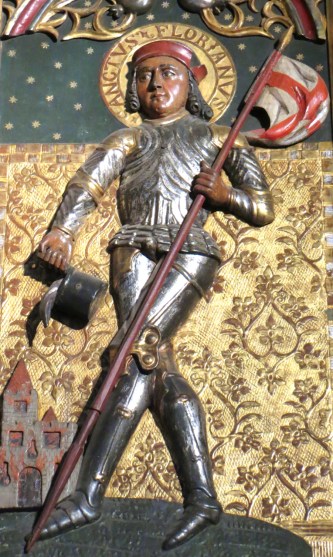
St. Florian (detail), Altarpiece, Strasbourg Cathedral

St. Florian (detail), Altarpiece, Strasbourg Cathedral

Images of a knight serenely dousing a burning building with a bucket of water have mystified generations of travelers journeying through Europe.[1]  The knight can be found atop pillars in city squares, emblazoned on buildings, and perched beside church altars.  Depictions of the knight, identifiable as Saint Florian, are particularly common in central Europe, where he continues to be honored and venerated to this day.  I have even encountered his statue in a Salzburg hotel calmly quenching a fire with a telltale bucket and have wondered at his likeness on a fire extinguisher in the sleepy town of Maria Alm, Austria.  Why does Saint Florian carry a bucket?  What is the meaning of the burning building at his feet?  And why is he so popular in central Europe?

Who Was Saint Florian?
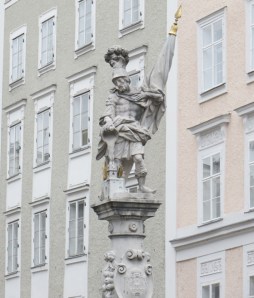
St. Florian Fountain, Salzburg, Austria

Saint Florian was a Roman army officer who held an administrative post in Noricum, a Roman province that included what is now Austria.[2]  In 304, during the Christian persecutions of the emperor Diocletian, Saint Florian publicly revealed he was a Christian and was subsequently tortured and killed for his faith.[3]  According to the Passion of Saint Florian, Florian encountered soldiers with whom he had previously served as he approached Lorch (Lauriacum).  When he asked where they were going, they responded, “Have you not heard the emperor’s commands which reached the praeses, in accordance with which he orders all men to offer libations to the gods, and that those who refuse should be put to death by various means?”[4]  Florian answered, “Brother and fellow soldiers, what else do you need seeing that I am a Christian?  Go and tell the praeses that I am a Christian and am here.”[5]

The soldiers were skeptical of Florian’s surprising confession, but they dutifully arrested him and brought him before the governor, Aquilinus, who first encouraged and then ordered Florian to offer sacrifice to the gods to prove he was not a Christian.  When Florian refused, the governor ordered him beaten with clubs.  Florian replied, “Be as angry and do as much harm as you can, since you possess power over my body which has been given to you for now.  If you want to know why I do not fear your tortures, light a fire, and I will climb upon it.”[6]

According to various sources, Florian was beaten with clubs, was “twice scourged, half-flayed alive and finally thrown into the river Enns with a stone around his neck.”[7]  Because he was martyred by drowning, Saint Florian is often invoked as a protector against drowning or against danger from water, including flooding.  He is also frequently portrayed in art with a millstone around his neck or in close proximity.

Patron Saint of Firefighters

Saint Florian is also recognized as the patron saint of firefighters, although the reason for his association with firefighting is unclear.  Some commentators have tried to link the origin of the tradition to his martyrdom, although Saint Florian was not recognized as a protector against fire until much later.  Florian’s association with firefighting likely derives from a legend that arose in the Middle Ages, a legend that also explains why he is commonly portrayed with a bucket and a burning building.
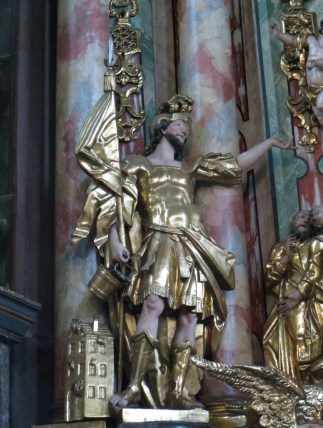
St. Florian - Hall in Tyrol

St. Florian, Waldauf Chapel, Hall in Tyrol

Explanations tracing Saint Florian’s patronage of firefighters to his martyrdom seem improbable, particularly since they involve some manipulation of the historical sources.  A number of online sources claim that Saint Florian’s executioners initially intended to burn him at the stake, but Saint Florian told them, “If you do, I will climb to heaven on the flames.”[8]  At this, they grew uneasy, and they decided to beat him instead before ultimately drowning him in the Enns.[9]  While this version of the story may sound compelling, it is not entirely consistent with earlier versions of Saint Florian’s “acts.”

As noted in the Passion of Saint Florian, above, Florian did tell Aquilinus, “light a fire, and I will climb upon it,” but he made no reference to rising to heaven either on its smoke or flames as some online sources suggest.  These sources tend to misquote the Passion and unintentionally shift the focus of Florian’s words from his faith in Christ to his faith in his own apotheosis.  Florian invoked the image of a pyre to affirm his Christian beliefs and to demonstrate his willingness to suffer torture for it, not as gasconade.  The Acta Sanctorum similarly places Florian’s statement in this context.[10]  In it, Saint Florian had already been beaten “for a long time,” when he turned to Aquilinus and said, “You have power over my body, but not over my soul.  So do whatever harm you can, since no way will I submit to your commands.  In order that you may learn that I do not fear your tortures, order a strong fire to be lit, and, in the name of my God, I will walk upon it without harm.”[11]

Modern commentators appear to be reaching for a link between Saint Florian’s martyrdom and his status as a protector against fire.  However, because Saint Florian did not become identified with firefighting until centuries after his death, during the late Middle Ages, it is unlikely the circumstances of his death precipitated the tie to firefighting.[12]

Bucket Brigade

St. Florian - Salzburg (detail)Most representations of Saint Florian depict him dressed as a Roman soldier or a medieval knight holding either a banner or sword in one hand, a bucket or pitcher in the other, with a burning building, city, or church at his feet.  Alternatively, as mentioned above, he may be shown with a millstone, the instrument of his death.  According to a catalogue published by the Metropolitan Museum of Art, Saint Florian first appeared with a bucket and a burning building in the late 15th century.[13]  According to legend, Saint Florian managed to save a burning house – sometimes it is as an entire city – with a single bucket of water.[14]  Florian’s reputation as a protector against fire earned him great devotion in medieval society, which lived in constant fear of fire and the threat of urban conflagration.

Representations of Florian as a firefighting saint quickly gained popularity, particularly in Austria and southern Germany.  In the region even today, Saint Florian has become so synonymous with firefighting that his image is readily used to identify fire stations and departments.  The exteriors of firehouses frequently feature an image of Saint Florian on a wall or a statue of Saint Florian tucked into a niche.  The name “Florian” even serves as a universal radio call sign for Feuerwehr (fire department) vehicles and stations.

The Florian Cross

Florian Cross

Beyond Austria and Germany, Saint Florian’s influence on firefighting may be less conspicuous, but it is still discernible.  Many fire departments incorporate what has come to become known as a “Florian cross” or “cross of Saint Florian” into their badges, patches, and other organizational emblems.  The cross features four triangular arms, of equal length, that are rounded at each terminus and that taper toward the center.  (An example is depicted at left, courtesy of Wikimedia Commons.)  Often confused with the Maltese cross, which has no curved lines, the origin of the Florian cross’s design remains obscure.[15]  Many commentators have argued that the Maltese cross, which the Knights of Saint John famously wore to identify members of their order, became a symbol of firefighters because firefighters, like the earlier knights, were willing to lay down their lives to protect others.[16]  While this explanation may sound plausible, it ignores the fact the Florian cross is simply not a Maltese cross.[17]

Maltese Cross

Alternatively, the Florian cross may have evolved from a Maltese cross over time.  (An example of a Maltese cross is depicted at left, courtesy of Wikimedia Commons.)  Many cross variations share similar features, and it is possible the Maltese cross gradually developed into a Florian cross over the course of several centuries.  A comparison of the two symbols – one featuring relatively thin, angular arms, the other comprised of broad, curved arms – suggests, however, that such a radical metamorphosis is unlikely to have occurred.  Another explanation is that the Florian cross is sui generis – though possibly inspired by the Maltese cross.

The various representations of Saint Florian I’ve examined, mostly from the medieval period, offer no clues to the cross’s origin.  Occasionally, Saint Florian is portrayed holding a banner emblazoned with a cross, but the cross it features is invariably a simple Latin cross.  In at least early representations of Saint Florian, the saint does not appear to wear or carry the symbol that has come to bear his name.  On the other hand, many protective medals and medallions featuring Saint Florian are shaped in variations of the Florian cross, with broad, curved arms enclosing an image of the saint.  Could the shape of early Saint Florian medallions have inspired the outline of the Florian cross?  Perhaps it’s a question of the chicken or the egg, and ultimately, I do not know how the Florian cross came to be.  My guess is the design derives from the late 19th century, since that appears to be when fire departments began to incorporate a cross into their emblems.[18]

The Relics of Saint Florian and the Royal Road

In addition to serving as the patron saint of firefighters, Saint Florian is also the patron saint of various localities, including Linz, Austria; the state of Oberösterreich (Upper Austria), Austria; and Poland.

According to legend, after Florian was drowned in the Enns, his body was recovered by a devout woman named Valeria and was buried.  His body was eventually transferred to the Augustinian Abbey of Saint Florian, near Linz.
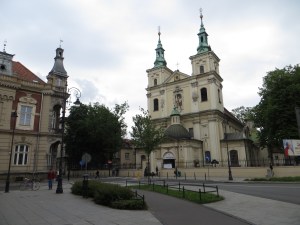
St. Florian ChurchIn 1184, Pope Lucius III sent relics of Saint Florian to Duke Kasimir the Just of Poland.  Kasimir had the relics sent to Krakow, one of Poland’s oldest and most important cities.  According to tradition, the horses carrying the relics stopped in Kleparz, a medieval suburb of the Cracow, before reaching the city gate and refused to continue any further.  Their obstinacy was interpreted as a sign, and the church of Saint Florian (pictured above) was erected on the spot to house the relics.[19]

After the capital was moved from Krakow to Warsaw, the church of Saint Florian became the receiving point for the bodies of deceased royalty, who continued to be buried at Krakow’s Wawel Cathedral.  Royal funeral processions followed what became known as the Royal Road or Royal Route, a course replete with references to Saint Florian.  The route originated at the church of Saint Florian, passed through the 14th century Florian Gate with its polychrome figure of Florian extinguishing a gilded fire, and continued along Floriańska Street before reaching the Main Market Square.  From there, the route wound through the Old Town, past the Church of Saints Peter and Paul, to Wawel Hill and its looming cathedral.
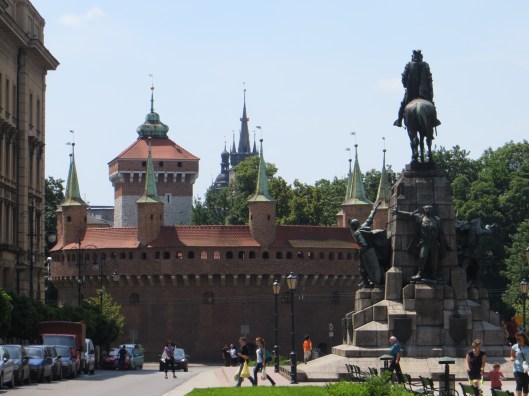
The Royal Road with the tower of the Florian Gate at left

The Royal Road with the tower of the Florian Gate at left

May I Propose a Toast . . .

Shortly after returning from a trip to southern Austria, I stumbled upon this passage from the correspondence of John Lothrop Motley, a 19th century American historian.  Written almost 179 years earlier, I was struck by how, in some ways, very little has changed since Motley’s own travels through the region.  On the other hand, I was surprised to learn of Saint Florian’s apparent standing as the patron saint of innkeepers and brewers.  Motley writes:
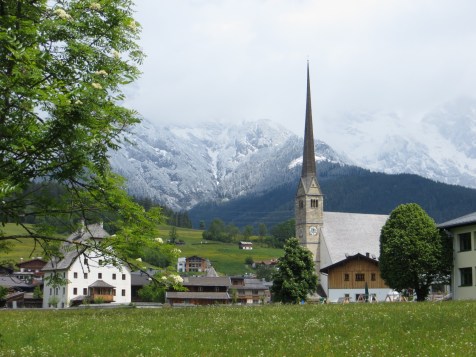
Maria Alm, Austria

Maria Alm, Austria

“Among other Catholic images which are strewed all along the roadside, one in particular puzzled me for a long time—the figure of a saint in armour with a sword in the right hand and a bucket of water in the left, which he is emptying on a burning house.  I have found that it is St. Florian, the patron saint of burning houses and firemen, and also, according to the popular legends, of innkeepers and brewers, to whom he always sends a sufficient quantity of water to temper their wine and other potations, and who in gratitude, as I have observed, have always his figure over their doorways.”[20]

While Saint Florian may also serve as a patron saint of brewers, it is as the patron saint of firefighters that he is frequently identified today.  In fact, in 1999, the date of International Firefighters Day was fixed as May 4th, the feast day of Saint Florian.  Fittingly, both Saint Florian and the heroic firefighters he is often invoked to protect, may now be celebrated and remembered on the very same day.
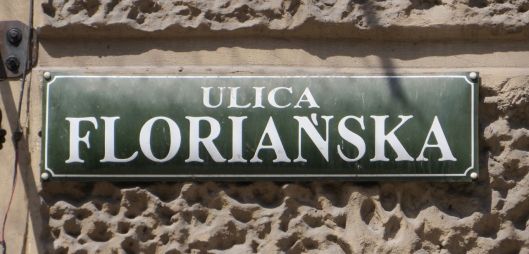
Florian Street

Florian Street, Krakow, Poland


[1] See, e.g., 1 The Correspondence of John Lothrop Motley 38 (George William Curtis ed., 1889)

[2] See, e.g., 2 Butler’s Lives of the Saints 230-31 (Herbert J. Thurston, S.J. & Donald Attwater eds., 2d ed. 1956).

[3] Id. at 230.

[4] Monumenta Germaniae Historica:  Passiones Vitaeque Sanctorum Aevi Merovingici et Antiquiorum Aliquot 65-71 (Bruno Krusch ed., 1896), available in translation at http://www.ucc.ie/milmart/BHL3054.html.

[5] Id.

[6] Id.

[7] Butler’s Lives of the Saints, supra note 2, at 230.

[8] See, “Saint Florian: The Patron Saint of the Fire Service,” The Public Safety Net, available at http://www.publicsafety.net/st_florian.htm; see also, “Saint Florian,” Saint Florian Roman Catholic Church, available at http://www.stflorianparish.org/en/history/saint-florian/; “Saint Florian History,” Brookline Firefighters Association, available at http://www.brooklinefirefighters.org/index.cfm?zone=/unionactive/view_page.cfm&page=St20Florian.

[9] See, e.g., The Public Safety Net, supra note 8; Saint Florian Roman Catholic Church, supra note 8; Brookline Firefighters Association, supra note 8.

[10] See 1 Mai 463-466, in Acta Sanctorum Quotquot Toto Orbe Coluntur (1863), available in translation at http://www.ucc.ie/milmart/BHL3058.html.

[11] Id.

[12] See Metropolitan Museum of Art, Medieval Art from Private Collections:  A Special Exhibition at the Cloisters 61 (1968) (“At the end of the Middle Ages he came to be regarded as a protector against fire.”).

[13] Id. (“The earliest representations of him with a bucket and a burning house are of the late fifteenth century.”).

[14] See, e.g., George Ferguson, Signs and Symbols in Christian Art 71 (1959).

[15] See Donald V. Engebretson, “The Firefighter’s Cross,” Northwoods Seelsorder Blog, Mar. 8, 2008, available at http://nwseelsorger.blogspot.de/2008/03/firefighters-cross.html.

[16] See, e.g., “History of the Maltese Cross,” New York City Fire Dept., available at http://www.nyc.gov/html/fdny/html/history/maltese_cross.shtml (arguing that the Knights of Saint John were “our first firefighters” because they regularly put out fires ignited by weapons during the Crusades).

[17] Some fire departments, however, do incorporate a Maltese cross, rather than a Florian cross, into their emblems.  See, for example, the Canadian Fire Service.

[18] See, e.g., Mica Calfee, “The ‘Maltese Cross’ and the Fire Service,” available at http://www.fireserviceinfo.com/maltesecross.html (citing a 1882 newspaper article describing a local NY fire department’s decision to adopt a new “Maltese cross” badge design); “Origins of the Fire Service Badge,” Hampshire (UK) Fire and Rescue Service, available at http://www.hantsfire.gov.uk/theservice/organisation/history/servicebadgesorigin.htm (“Quite when the star was first used in this country for the badge of a firefighter is not easy to establish.  The earliest example found is the brass eight pointed star adopted for use by the National Fire Brigades Association in 1887.”)  The 1887 National Fire Brigade Association badge appears to be an actual Maltese cross.  Over time, it evolved into something quite different, although the original eight points of the Maltese cross are still discernible.  Could the Florian cross have developed similarly over time?

[19] See, e.g., Teresa Czerniewicz-Umer, Eyewitness Travel:  Cracow 138 (2010)

[20] The Correspondence of John Lothrop Motley, supra note 1.
Share this:

  • Click to share on Facebook (Opens in new window) Facebook
  • Click to share on X (Opens in new window) X
  • Click to share on Pinterest (Opens in new window) Pinterest
  • Click to share on Reddit (Opens in new window) Reddit
  • Click to share on Tumblr (Opens in new window) Tumblr
Like Loading...

Saint Theodore: Warrior Saint and Dragon-Slayer

23 Saturday Mar 2013

Posted by Reliquarian in Sculpture

≈ 2 Comments

Tags

basilica, dragon, Italy, relic, reliquary, Saint George, Saint Mark, Saint Theodore, Venice


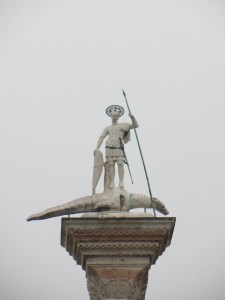
Statue of Saint TheodoreSaint Theodore Arrives in Venice

He arrived in Venice from the East in pieces: a torso and cuirass, a disembodied head, a crocodile.  The Sack of Constantinople in 1204 had devastated the city, but the Venetians, who had transported the army of the Fourth Crusade to Constantinople, managed to salvage an enormous horde of objects from the captured city. The Venetians systematically shipped these objects – statues, jeweled reliquaries, architectural columns, and marble pediments – back to Venice. Among the crates were several fragments of statuary that, when recombined, would become a statue of Saint Theodore, the great warrior-saint, dragon-slayer, and a patron saint of Venice.

Saint Theodore of Amasea

Saint Theodore of Amasea was a Roman recruit martyred in the early 4th century for professing his faith in Christianity.  As a new recruit, he is also known as Saint Theodore Tiro, tiro meaning “recruit” in Latin.[1]  Saint Theodore of Amasea is often confused with another Theodore – Saint Theodore of Stratelates, a Roman general – although most scholars believe the two Theodores were probably the same person.[2]  Butler’s Lives of the Saints notes that the stories relating to Saint Theodore of Amasea “cannot be relied on,” although they probably refer to “a real martyr who may or may not have been a soldier.”[3]  Butler’s Lives of the Saints continues, “So complicated and contradictory did his story become that, in order to make it less inconsistent, a second soldier St Theodore had to be posited and so we have the St Theodore Stratelates of February 7.”[4]  Saint Theodore of Amasea’s feast day is November 9.

Saint TheodoreThe first known mention of Saint Theodore of Amasea derives from a panegyric delivered by Saint Gregory of Nyssa near Saint Theodore’s tomb in Euchaita, modern-day Turkey.[5]  According to various legends, when Saint Theodore refused to offer sacrifices to the Roman gods along with his legion he was brought before the governor of the province to explain himself.  He declared himself to be a Christian, and when asked why he would profess faith in an outlawed religion, the worship of which was a capital offense, he responded, “I know not your gods.  Jesus Christ, the only Son of God, is my God.”[6]  He was dismissed and, according to some sources, went into the city of Amasea near the Iris River and burned down the temple of Cybele.[7]  Not surprisingly, he was captured and was again brought before the Roman authorities who questioned and cajoled him, and then tortured him.[8]  When he was returned to his prison cell, he was comforted by visions of angels.[9]  Eventually, he was condemned to death and was burned alive in a furnace.[10]
Here Be Dragons

Notably absent from these stories is any mention of dragons or dragon slaying.  Why, then, is Saint Theodore frequently depicted slaying a dragon?  Saint Theodore’s identification as an heroic dragon-slayer may be related to the belief that by his intercession “devils were expelled and distempers cured.”[11]  In The Dragon in Medieval East Christian and Islamic Art, Sara Kuehn suggests that the belief in Saint Theodore’s power to vanquish evil probably inspired the dragon-slaying motif.[12]  Kuehn writes, “Dragon-slaying riders were progressively identified as warrior saints and can conclusively be interpreted as exercising an apotropaic or protective function.”[13]

St. Michael and Dragon, Minster of the Holy Cross, Rottweil, Germany

In early Christian art, Saint Theodore is often depicted with fellow dragon-slayer Saint George, although portrayals of Saint Theodore slaying a dragon predate those of his more famous companion.  Kuehn states, “Among the military saints Theodore and George were predominantly associated with the miracle of dragon-slaying and often appear together.  In the hagiographical tradition, Saint Theodore clearly preceded Saint George in the role of dragon-slayer.”[14]  Early references to Saint Theodore slaying a dragon can be traced to the late 9th century[15] while the earliest known depiction of Saint George smiting a dragon is from the early 11th century.[16]  Before then, Saint George was sometimes shown killing a man rather than a dragon.[17]  Other saints frequently depicted with dragons include Saint Margaret, Saint Martha, Saint Sylvester, the Apostle Philip, and the Archangel Michael (pictured in the carved sculpture, above, located at the Minster of the Holy Cross, Rottweil, Germany).[18]

Saint George and the Dragon

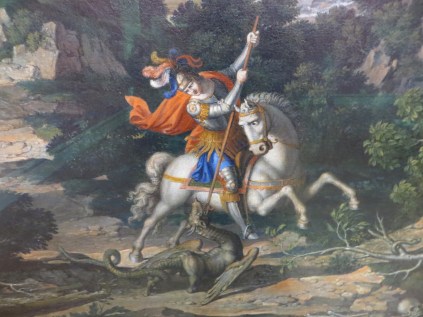
Incidentally, the celebrated story of how Saint George vanquished a dragon and rescued a princess was likely a later embellishment to the legend of Saint George the martyr – and one that clearly captured the imagination of subsequent generations.  Most famously told in the Legenda Aurea (Golden Legend), Saint George was a Christian knight born in Cappadocia who, while out riding in the province of Lybia, arrived at the city of Sylene.  The city’s inhabitants were being terrorized by a terrible dragon, which they attempted to appease by providing two sheep every day.  When the inhabitants ran out of sheep, they substituted a human victim, who was selected by lot.  On the day of Saint George’s arrival, the king’s daughter had been selected to serve as the sacrifice.  Saint George ultimately rescued the princess, but before he would slay the dragon, the saint elicited the people’s promise to convert to Christianity.  This they promised, and once the dragon was killed, four oxcarts were needed to dispose of its carcass.[19]

Heroic Landscape with St George, Joseph Anton Koch (1807).  Alte Pinakothek, Munich, German.

Joseph Anton Koch, Heroic Landscape with St. George (detail) (1807). Alte Pinakothek, Munich, German.

Butler’s Lives of the Saints observes that “the story of the dragon, though given so much prominence, was a later accretion of which we have no sure traces before the twelfth century.”[20]  The authors further comment, “There is every reason to believe that St George was a real martyr who suffered at Diospolis (i.e. Lydda) in Palestine, probably before the time of Constantine.  Beyond this there seems to be nothing which can be affirmed with any confidence.”[21]  Although Saint George is not mentioned in the Syriac Breviarium, he is mentioned in the Heironymianum, and various pilgrims of the 6th to 8th century identified Lydda or Diospolis as the site of his relics.[22]

Arm Reliquaries

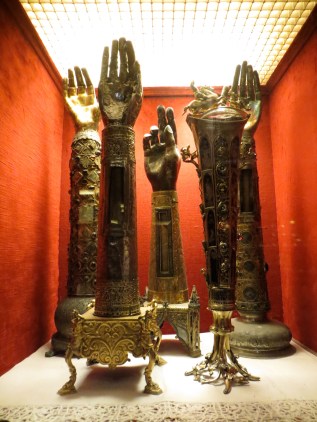
Arm Reliquaries, Basilica of Saint Mark

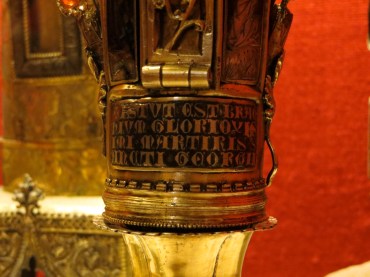
Coincidentally, the arm of Saint George was apparently one of four important relics taken from Constantinople to Venice following the sack of the city in 1204.[23]  Located today in the Treasury of Saint Mark’s Basilica, the Reliquary of the Arm of Saint George (pictured above, in the right foreground) features an unusual cone-shaped exterior, oval in cross-section, of silver gilt and enamel and a glass lid topped with a figure of Saint George on horseback spearing a dragon.[24]

Arm Reliquary of S George

Reliquary of the Arm of St. George (detail of lid)

A plaque on the lowest part of the reliquary case, above the stems and leaves that form the base, reads in reserve against niello, “ISTVT · EST · BRAC/HIVM · GLORIOXIS/IMI · MARTIRIS S/ANCTI · GEORGEII” (“This is the arm of the most glorious martyr, Saint George”).[25]  This exterior, of Venetian design, dates to before 1325.[26]  The outer reliquary holds an earlier Byzantine reliquary made of silver that dates to before 1204.[27]  While the dragon is likely original, the equestrian figure of Saint George is probably more modern, dating to the 16th century.[28]  According to some sources, Saint George became Venice’s third patron saint – after Saints Mark and Theodore – sometime following the translation of his arm to the city.[29]

Plaque of S George Reliquary

Reliquary of the Arm of St. George (plaque in reserve against niello)

He Came in Pieces

As noted above, the statue of Saint Theodore arrived in Venice in various pieces, although the pieces were not, in fact, part of a single, unified work.  Edward Hollis, who writes about the evolution and transformation of buildings over time in The Secret Life of Buildings, explains how the Venetians recombined disparate sculptural fragments pilfered from Constantinople to create a single, monumental statute of their patron saint.[30]

Saint Theodore in Saint Mark's SquareAfter the Venetians left Constantinople, some of the treasures they had appropriated were lost at sea and some were sold along the journey, but most of the objects arrived safely in Venice, where they were unloaded and unpacked at the Arsenale.[31]  After they were evaluated by various officials, they were eventually repurposed to enhance the beauty, status, and prestige of La Serenissima.  For example, building material and other decorative ornaments stripped from the churches of Constantinople were used to clothe the basilica of Saint Mark “in the borrowed raiment of vanished sanctuaries” so that “what had been an austere brick structure soon shone, and sparkled, and flashed in the sun.”[32]
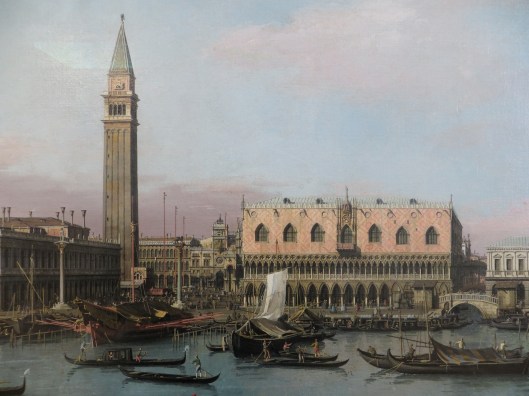
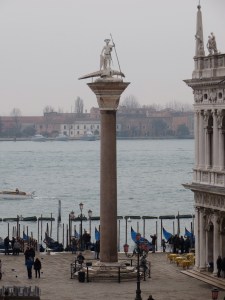
Hollis explains that a centurion’s cuirass, a crocodile, and a disembodied head “became the body of Saint Theodore.”[33]  Similarly, a pair of brazen angel’s wings and a lion were “welded together to make the emblem of Saint Mark.”[34]  Both of these new creations were hoisted atop a pair of Numidian granite columns, also taken from Constantinople, and set in Saint Mark’s Square.[35]  The two statutes, symbolizing two patron saints of Venice, remain in the square to this day.[36]

Antonio Canaletto, Piazzetta in Venice, Alte Pinakothek, Munich, German

Antonio Canaletto, Piazzetta in Venice.  Alte Pinakothek, Munich, Germany.


[1] 4 Butler’s Lives of the Saints 302, 301-303 (Herbert J. Thurston, S.J. & Donald Attwater eds., 2d ed. 1956).  Alternatively, Butler’s Lives of the Saints suggests that the surname Tiro more probably derives from his membership in the Cohors tironum.  Id.

[2] See, e.g., id.; Rosa Giorgi, Saints in Art 345 (Stefano Zuffi ed. & Thomas Michael Hartmann trans., 2002) (“Beginning in the tenth century, Theodore split into two figures in popular devotion, a general and a soldier that were really the same person.”).

[3] Butler’s Lives of the Saints, supra note 1, at 302.

[4] Id.

[5] See, e.g., id. at 301.

[6] Id. at 302.

[7] See, e.g., Giorgi, supra note 1, at 345; Butler’s Lives of the Saints, supra note 1, at 302.

[8] Butler’s Lives of the Saints, supra note 1, at 302.

[9] See, e.g., Giorgi, supra note 1, at 345; Butler’s Lives of the Saints, supra note 1, at 302.

[10] Butler’s Lives of the Saints, supra note 1, at 302

[11] Id. (citing the panegyric attributed to Saint Gregory of Nyssa).

[12] See Sara Kuehn, The Dragon in Medieval East Christian and Islamic Art 109 (2011).

[13] Id.

[14] Id. at 108.

[15] Id. at 108 n.215 (“His exploit of vanquishing a dragon with a spear only appeared in the second state of his Passio Prima (dated 890) . . . .”).  Kuehn also notes that the 7th century Passion of Marina of Antioch contains “antecedents” of Saint Theodore’s dragon-slaying.  Id.

[16] Id. at 108 n.216.  Kuehn identifies the church of Saint Barbara at Soganli as possessing the earliest identifiable portrayal of Saint George vanquishing a dragon.  Id.

[17] Id. at 108.

[18] See, e.g., George Ferguson, Signs and Symbols in Christian Art 16 (1954).

[19] See 2 Butler’s Lives of the Saints 148-50 (Herbert J. Thurston, S.J. & Donald Attwater eds., 2d ed. 1956).

[20] Id. at 149.

[21] Id.

[22] Id. at 150.

[23] See, e.g. Treasures of Heaven:  Saints, Relics, and Devotion in Medieval Europe 92 (Martina Bagnoli et al., eds., 2010).  The other three important relics were a relic of the Holy Blood, a piece of the True Cross, and the head of Saint John the Baptist.  Id.

[24] Id.  The lid was originally made of rock crystal.  Id.

[25] William D. Wixsom, Western Metalwork, in The Treasury of San Marco Venice 282 (David Buxton ed., 1984).

[26] Treasures of Heaven, supra note 23, at 92.

[27] Id.

[28] Wixsom, supra note 25, at 282.  Wixsom writes, “The horse and rider are probably directly based on Leonardo’s designs for the Sforza and Trivulzio monuments, dating respectively 1485-93 and 1506-13, even though the theme of a rearing horse goes back to the early Florentine Renaissance sculptor, Bertoldo (1420-91), to Paduan bronzes dating around 1510, and to ancient bronzes.” Id. (citations omitted).

[29] See, e.g., id.; Treasures of Heaven, supra note 23, at 92.

[30] See Edward Hollis, The Secret Lives of Buildings (2009).

[31] Id. at 55.

[32] Id.

[33] Id.

[34] Id.

[35] Id.

[36] The statute of Saint Theodore in Saint Mark’s Square, however, is a replica.  The original is now located in the Doge’s Palace.  A sign next to statue states that the marble statue “is a fourteenth-century sculpture with an ancient armoured bust and a young man’s head of different origins. . . . According to tradition, the saint’s face is a portrait of Mithradates of Pontus.”

Share this:

  • Click to share on Facebook (Opens in new window) Facebook
  • Click to share on X (Opens in new window) X
  • Click to share on Pinterest (Opens in new window) Pinterest
  • Click to share on Reddit (Opens in new window) Reddit
  • Click to share on Tumblr (Opens in new window) Tumblr
Like Loading...
← Older posts
Newer posts →

Recent Posts

  • Ex Indumentis:  Religious Medals and Relics of Saints
  • Green Alternative: When Saint Patrick Wore Blue
  • The Great Heart Heist: The Stunning Theft of Saint Laurence O’Toole’s Preserved Heart
  • The Column of the Flagellation: Relic of the Scourging of Jesus
  • Saint Roch: The Saint “Par Excellence” Against Disease

Top Posts & Pages

  • The Great Heart Heist:  The Stunning Theft of Saint Laurence O'Toole's Preserved Heart
    The Great Heart Heist: The Stunning Theft of Saint Laurence O'Toole's Preserved Heart
  • Relic of the Holy Diaper:  The Swaddling Clothes of Jesus
    Relic of the Holy Diaper: The Swaddling Clothes of Jesus
  • The Altar of the Holy Blood
    The Altar of the Holy Blood
  • The Shrine of the Three Kings:  Grand Reliquary of the Magi
    The Shrine of the Three Kings: Grand Reliquary of the Magi
  • Saint Charles Borromeo:  A Tale from the Crypt of Milan Cathedral
    Saint Charles Borromeo: A Tale from the Crypt of Milan Cathedral
  • Saint Theodore: Warrior Saint and Dragon-Slayer
    Saint Theodore: Warrior Saint and Dragon-Slayer
  • Winter of Discontent:  Saint Sebaldus, Protector Against Cold Weather, Takes a Sabbatical
    Winter of Discontent: Saint Sebaldus, Protector Against Cold Weather, Takes a Sabbatical
  • Saint Munditia: A Holy Skeleton Near the Rindermarkt in Munich
    Saint Munditia: A Holy Skeleton Near the Rindermarkt in Munich
  • The Column of the Flagellation:  Relic of the Scourging of Jesus
    The Column of the Flagellation: Relic of the Scourging of Jesus
  • Ex Indumentis:  Religious Medals and Relics of Saints
    Ex Indumentis:  Religious Medals and Relics of Saints

Tags

Aachen altarpiece Austria basilica cathedral Charlemagne church Croatia Dubrovnik Fourteen Holy Helpers Germany Hall in Tirol Italy Krakow Magi martyr mosaic Munich pilgrim pilgrimage Poland relic reliquary Rothenburg Saint Blaise Saint Denis Saint Helena Saint James Saint Mark Saint Mary Saints Cosmas and Damian Saint Theodore Santiago de Compostela sarcophagus shrine skeleton skull Tintoretto tomb Venice

Archives

Categories

Enter your email address to subscribe to this blog and receive notifications of new posts by email.

Join 91 other subscribers

Blog at WordPress.com.

  • Subscribe Subscribed
    • Reliquarian
    • Join 91 other subscribers
    • Already have a WordPress.com account? Log in now.
    • Reliquarian
    • Subscribe Subscribed
    • Sign up
    • Log in
    • Report this content
    • View site in Reader
    • Manage subscriptions
    • Collapse this bar
%d