• Index
  • News
  • About

Reliquarian

~ An exploration of saints, their relics, and their iconography in art

Reliquarian

Author Archives: Reliquarian

Charlemagne: Saint of the Holy Roman Empire?

02 Thursday May 2013

Posted by Reliquarian in Metal Reliquary

≈ 4 Comments

Tags

Aachen, anti-pope, canonization, cathedral, Charlemagne, Germany, reliquary, Saint Martin, shrine

Bust of CharlemagnePater Europae – Father of Europe

In her 2008 study of Charlemagne, Charlemagne: The Formation of a European Identity, Rosamond McKitterick observes, “Charlemagne, king of the Franks from 768 to 814, is one of the few major rulers in European history for whom there is an agreed stereotype.”[1]  Celebrated as a mighty conqueror, a pious Christian ruler, and an enlightened patron of learning, Charlemagne is memorialized throughout Europe, particularly in the lands of his former empire.  McKitterick notes, “Statues and paintings of Charlemagne abound in many of the cities of Europe, whether major capitals such as Paris or towns that have often long since lost their political pre-eminence.”[2]  His likeness “graces the market place in Aachen . . . and the cathedrals of Bremen, Frankfurt and Halberstadt.  He surveys the cities of Zurich, Dinant and Liège, and he sits astride his horse in front of Notre Dame in Paris.”[3]  Reverence for Charlemagne is, perhaps, strongest in Aachen, Germany, where Charlemagne continues to be not only honored as the first Holy Roman Emperor but also venerated as a saint.  But was Charlemagne, in fact, ever a saint?

Dome of Aachen Cathedral

Dome of Aachen Cathedral

Playing with the King of Hearts

Even those who have never seen a statue or painting of Charlemagne have probably encountered at least one portrait of the emperor before.  Charlemagne is apparently the enigmatic King of Hearts in a deck of playing cards.  Also known as the “suicide king” because he is commonly shown stabbing himself in the head with a sword, the King of Hearts may be a stylized representation of Charlemagne, but the visual depiction is flawed in at least one fundamental aspect:  the King of Hearts has no moustache.

Throne of Charlemagne, Aachen Cathedral

Throne of Charlemagne, Aachen Cathedral

Of the four kings represented in a deck of cards, only the King of Hearts sports a clean-shaven upper lip; however, as Professor Paul Freedmen has noted in his lectures on medieval history, the Carolingians, of whom Charlemagne was a member, were well-known for their moustaches.[4]  More evidence militating against this interpretation can be found at Aachen, the former imperial capital.  The famous reliquary bust of Charlemagne in the Treasury of Aachen Cathedral clearly portrays Charlemagne with a moustache, suggesting the King of Hearts cannot be the famous Holy Roman Emperor.  Notably, Charlemagne also never stabbed himself in the head, another “fatal” flaw in the historical conceit linking the two royal heads.

Vita Karoli

How do we know what Charlemagne looked like?  Einhard’s Vita Karoli, written sometime between 817 and 833, provides one of the earliest written descriptions of Charlemagne, including an account of his physical appearance.  In the preface to his work, Einhard, a Frankish courtier and contemporary of Charlemagne, explained that he had committed the story of Charlemagne to writing so that “the most glorious life of this most excellent king, the greatest of all the princes of his day, and his illustrious deeds” should not become “wrapped in the darkness of oblivion.”[5]  Elegantly written in Ciceronian Latin, Einhard’s biography has proven to be one of the most influential and enduring portraits of the ancient king.[6]
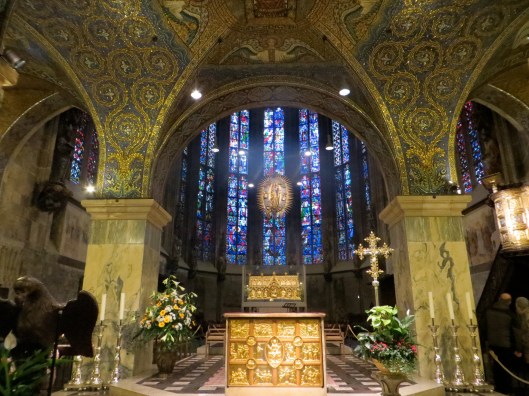
The High Altar of Aachen Cathedral

The High Altar of Aachen Cathedral

Part of Vita Karoli’s popularity may derive from its disarmingly honest depiction of Charlemagne.  Einhard tells us, for example, that Charlemagne was “large and strong, and of lofty stature, though not disproportionately tall (his height is well known to have been seven times the length of his foot) . . . .”[7]  Additionally, “the upper part of his head was round, his eyes very large and animated, nose a little long, hair fair, and face laughing and merry.”[8]  His appearance was “always stately and dignified, whether he was standing or sitting, although his neck was thick and somewhat short, and his belly rather prominent.”[9] He enjoyed red meat, and his favorite book was Saint Augustine’s The City of God.[10]

As McKitterick explains, “The scholarly reaction to Einhard’s account has ranged from uncritical acceptance to outright rejection of its historical validity.”[11]  Still, “as a reflection of perceptions of Charlemagne and knowledge available about him at the time Einhard wrote, . . . it is immensely valuable.”[12]

The Canonization of Saints

While Einhard’s admiration for Charlemagne is evident in his writing, Einhard never referred to Charlemagne, either figuratively or literally, as a saint.  From the Vita Karoli we learn that Charlemagne died on 28 January 814 at the age of seventy and that he was buried on the same day.  Because Charlemagne never indicated where he wanted to be laid to rest, confusion arose as to where he should be buried.  Eventually, “all agreed that he could nowhere be more honorably entombed than in the very basilica that he had built in the town [of Aachen] at his own expense.”[13]
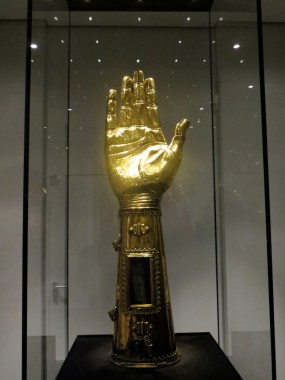
Arm Reliquary of Charlemagne

Arm Reliquary of Charlemagne

A local cultus eventually developed around the storied king; however, only the Church could officially recognize the beatification or canonization of individuals.  As Monsignor P. E. Hallett explains in his study on canonization, the Church constantly “had to guard against the extravagant and unauthorized devotion of the people.”[14]  Indeed, Charlemagne himself was the author of a synodal law designed to check the arbitrary veneration of alleged saints.[15]  The law, which prohibited the public veneration of new saints without the official sanction of the local bishop, was intended to prevent the type of mistake Saint Martin of Tours once encountered in his diocese.[16]

According to the legend, the people of Tours highly honored a shrine believed to be the tomb of a martyr.  Saint Martin, however, had his doubts.  As Rev. Alban Butler explains, “The place was much reverenced by the people; but St. Martin, who was not over credulous, would not go thither to pray, not hearing any assured account of the relics.  He asked the eldest of the clergy what they knew of them, and not receiving satisfaction, he went one day to the place with some of his brethren, and, standing over the tomb, besought God to show him who was buried there.  Then turning to the left he saw near him a pale ghost of a fierce aspect, whom he commanded to speak.  The ghost told his name, and it appeared that he had been a robber who was executed for his crimes, whom the people had honoured as a martyr.  None but St. Martin saw him; the rest only heard his voice.  He thereupon caused the altar to be removed; and freed the people from this superstition.”[17]

Until the 12th century, local bishops could beatify individuals by permitting public cultus, that is, the “erection of altars, the celebration of feasts, the offering of Holy Mass in their honour within the limits of their diocese.”[18]  Today, however, only those whose cultus has been accepted, either expressly or tacitly, by the Holy See are considered beatified, and only those whose cultus has been extended to the Universal Church are considered canonized saints.[19]

Saint Charlemagne?

The cultus of Charlemagne provides an illuminating example of this system of recognition.  Three and a half centuries after his death, in 1165, Charlemagne was canonized by the anti-pope Paschal III.[20]  The Catholic Church never officially recognized Paschal III’s canonization of the Carolingian emperor, however,[21] and in fact, all of Paschal III’s pronouncements were eventually abrogated in 1179 by the Third Lateran Council.[22]  This wholesale repudiation of Paschal III and his decisions would presumably have included his canonization of Charlemagne.[23]

View of Organ, Aachen Cathedral

View of Organ, Aachen Cathedral

Despite the rejection of Charlemagne’s canonization, a local cultus that had developed around the emperor persisted and spread to parts of Germany, Belgium, and France.[24]  No subsequent pope protested the cultus, so it endured for several centuries with the tacit permission of Rome.[25]  In the 18th century, Pope Benedict XIV confirmed the cultus, though apparently not as an official papal act.[26]  Ultimately, because the cultus continued to exist with the permission of the Church, Charlemagne is considered beatified.[27]  Charlemagne, therefore, can be referred to as Blessed Charlemagne; however, he is not Saint Charlemagne.[28]

The Shrine of Charlemagne at Aachen

Charlemagne is believed to have been initially buried in a marble sarcophagus from the 3rd century.[29]  His body was later transferred to a more ornate and impressive golden shrine commissioned by Emperor Frederick II in the late 12th century.[30]  The shrine, which is sometimes referred to as a reliquary, was created between 1182 and 1215.[31]  The “Concise Guide to Aachen Cathedral,” a tourist pamphlet available for purchase at Aachen, states that Charlemagne’s bones have been housed in the shrine since 1215.[32]  It further notes that the “Emperor’s bones are surrounded by sixteen of his successors” depicted on the shrine, and “Charlemagne himself sits at the end wall below Christ giving a blessing, flanked by Pope Leo III and Archbishop Turpin of Reims.”[33]
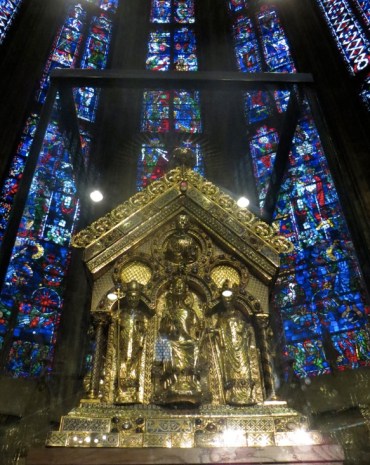
Shrine of Charlemagne

Shrine of Charlemagne

On the day we visited the cathedral, the guide who led our tour stated the sixteen kings represented on the shrine were included instead of saints because Charlemagne’s status as a saint was uncertain.  From afar, the royal figures have the aspects of saints, but on closer inspection, they wear crowns rather than mitre or halos, and they hold symbols of secular power rather than instruments of martyrdom.


[1] Rosamond McKitterick, Charlemagne: The Formation of a European Identity 1 (2008).

[2] Id. at 3.

[3] Id.

[4] Paul H. Freedman, Charlemagne, Class Lecture for The Early Middle Ages, 284-1000 at Yale University (Nov. 9, 2011).  Professor Freedman contrasts the short hair and moustaches of the Carolingians with the long hair and beards of their rivals, the Merovingians.  Freedman states, “one of the symbols of Merovingian familial prestige was this long hair. But Carolingians had short hair and wore mustaches. They kind of broke with the Merovingian look. But of course, this is not just a male fashion statement.”

[5] Einhard: The Life of Charlemagne (Samuel Epes Turner trans., Harper & Brothers 1880), available at http://www.fordham.edu/halsall/basis/einhard.asp#EINHARD’S%20PREFACE.

[6] See, e.g., McKitterick, supra note 1, at 7.

[7] Einhard: The Life of Charlemagne, supra note 5.

[8] Id.

[9] Id.

[10] Id.

[11] McKitterick, supra note 1, at 7 (citation omitted). 

[12] Id.

[13] Einhard: The Life of Charlemagne, supra note 5.

[14] P.E. Hallet, The Canonization of Saints (1952), available at http://www.ewtn.com/library/mary/canonize.htm.

[15] Id.

[16] See id.

[17] Alban Butler, 9 Lives of the Saints (1866), available at http://www.bartleby.com/210/11/111.html.

[18] Hallet, supra note 15.

[19] Id.

[20] Id.  By canonizing Charlemagne, Paschal III hoped to gain the support of the emperor, Frederick Barbarossa, in his struggle against the legitimate pope, Alexander III.  Id.

[21] Id.  Inexplicably, McKitterick erroneously avers that Pope Alexander III, not Paschal III, canonized Charlemagne in 1165.  McKitterick, supra note 1, at 2 (citing R.Folz, Etudes sur le liturgique de Charlemagne dans les églises de l’empire (1951)).  She writes, “A liturgical feast in honour of St Charlemagne was actually instituted in 1165 when Pope Alexander III canonized him and a cult of Charlemagne spread across western Europe.  Id.

[22] William Beckett, 1 A Universal Biography 116 (1834).

[23] See id.

[24] Hallet, supra note 15.

[25] Id.

[26] See id.  Hallet notes that Pope Benedict XIV confirmed the cultus “writing as a private theologian, not officially as Pope.”  Id.

[27] Id.; Benedictine Monks of St. Augustine’s Abbey, The Book of the Saints 62 (photo. reprint 2003) (1921).  In Hallet’s words, “In virtue then of this toleration, and not of course in virtue of the act of the anti-pope, which was null and void, it has been held . . . that he is to be considered as beatified.”  Hallet, supra note 15.

[28] See Benedictine Monks of St. Augustine’s Abbey, supra note 27, at 62.  The Book of the Saints lists Charlemagne as beatified though not canonized, noting that “in some churches” he has been “honoured as a Saint.”  Id.

[29] See, e.g., McKitterick, supra note 1, at 3.

[30] See id.; Dom Schatz Kammer Aachen, “Concise Guide to Aachen Cathedral.”

[31] Dom Schatz Kammer Aachen.

[32] Id.

[33] Id.

Share this:

  • Share on Facebook (Opens in new window) Facebook
  • Share on X (Opens in new window) X
  • Share on Pinterest (Opens in new window) Pinterest
  • Share on Reddit (Opens in new window) Reddit
  • Share on Tumblr (Opens in new window) Tumblr
Like Loading...

Winter of Discontent: Saint Sebaldus, Protector Against Cold Weather, Takes a Sabbatical

07 Sunday Apr 2013

Posted by Reliquarian in Tomb / Sarcophagus

≈ 4 Comments

Tags

Albrecht Durer, Bamberg, Germany, Nuremberg, pilgrim, Saint James, Saint Sebaldus

IMG_3624

Statue of St. Sebaldus, Church of Saint Sebaldus, Nuremberg, Germany

This winter has been unusually cold, dark, and damp in Germany.  A recent article in Spiegel Online proclaimed it the “darkest winter in 43 years,”[1] and the German weather service (Deutscher Wetterdienst) reported that this past March was the 6th coldest since 1881, when official records began to be kept.[2]  One headline expressed what many Germans have been thinking.  It read, “Just Kill Us Now: German Spring Kicks Off With More Snow.”[3]

In past centuries, unrelenting winter weather like this might have elicited prayers and entreaties to a saint.  In Germany, that saint might have been Saint Sebaldus, a protector against cold weather, who is also the patron saint of Nuremberg.

Patron Saint of Nuremberg

St. Sebaldus KircheSaint Sebaldus (or Sebald), was a hermit who lived in the Reichswald around the 8th century.[4]  Little is definitively known about Saint Sebaldus, although by 1072, he was already recognized as the patron saint of Nuremberg.[5]  Sigismund Meisterlin’s Life of Saint Sebald, completed in 1484, provides some background on the saint, although even Meisterlin acknowledged that his vita was imperfect.[6]  David Collins, in his book Reforming Saints:  Saints’ Lives and Their Authors in Germany 1470-1530, notes that Meisterlin “fixed certain inaccuracies and contradictions in the older legends” about Saint Sebaldus, although Meisterlin realized his corrections “might offend popular sensibilities.”[7]  According to Collins, “Meisterlin’s concern about the changes he had made indicates his familiarity with Sebald’s rich hagiographical tradition.”[8]

Meisterlin wrote the Life of Saint Sebald at the request of the Nuremburg city council.[9]  Collins states, “The city fathers sought a new life of Sebald apparently because the earlier ones were not inspiring the reverence for Sebald outside of Nuremberg in the diocese of Bamberg . . . that the city fathers believed he (and, derivatively, they themselves) deserved.”[10]  At the time, Bamberg was a rival of Nuremberg, and jokes about Saint Sebaldus, especially ones that characterized the saint as rustic and simpleminded, offended the people of Nuremberg, who imagined the jokes implicated them by extension.[11]  Meisterlin’s new vita, it was hoped, would restore the dignity and prestige of Saint Sebaldus, as well as of the city of Nuremberg.

The Life of Saint Sebaldus

St Sebaldus - Reformation of NurembergAccording to Meisterlin’s account, Sebaldus was a Danish prince who felt called to serve God from an early age.  Upon reaching adulthood, he left Denmark and joined three children of the king of Brittany:  Willibald, Wunibald, and Walpurgis.  The group dedicated itself to religious asceticism and elected Willibald, the eldest, as their leader.  The four chose to serve God as itinerants, and they vowed to travel to Rome as pilgrims.  When they arrived in Rome, the pope appointed Willibald a bishop and eventually sent the group back to Germany.  Sebaldus made his way to Regensburg and then to the forests of Franconia, where he lived in solitude, praying and fasting, until his death.  When the locals discovered his body, they placed it on a bier and yoked it to several untamed oxen, which brought the body to a deserted place in the woods, the future site of Nuremberg.[12]

Miracle of the Icicles

Saint Sebaldus is credited with having performed several miracles during his lifetime.  One of his more famous miracles involved the transformation of icicles into fuel for a warm fire.  The story, as recounted in Butler’s Lives of the Saints, goes like this:  “[O]ne snowy night [Saint Sebald] took shelter in a peasant’s cottage, but found it was almost as cold within as without, for the fire was low and small.  Sebald suggested that more fuel might be put on, but the man answered that he was too poor to keep up a decent fire, so Sebald turned to the housewife and asked her to bring in a bundle of long icicles hanging from the eaves; this she did, Sebald threw them on the fire, and they blazed up merrily.”[13]  The miracle of the icicles is depicted in relief on the base of Saint Sebaldus’s shrine at the church of Saint Sebaldus in Nuremberg.  The bronze shrine (below), which was made between 1508 and 1519, is one of the best-known works of Peter Vischer the Elder.

Shrine of Saint Sebaldus by Peter Vischer the Elder, Church of St. Sebaldus, Nuremberg, Germany

Shrine of Saint Sebaldus by Peter Vischer the Elder, Church of St. Sebaldus, Nuremberg, Germany

Another miracle, included in earlier hagiographies but omitted from Meisterlin’s 1484 vita, describes the experience of an unfortunate Scottish monk who, for some unexplained reason, was plucking the beard of Saint Sebaldus’s corpse.  Apparently annoyed by this, the dead saint’s right hand shot up and poked out the monk’s eye.  This story is not depicted on the saint’s tomb.

Attributes in Art

Depictions of Saint Sebaldus are not as ubiquitous as depictions of more popular saints, such as Saint Christopher or the four Evangelists, even in Germany.  In the few representations I have seen, the saint is frequently depicted as a pilgrim, replete with a pilgrim’s hat, cloak, and staff.  Albrecht Dürer, a native of Nuremburg, executed a number of woodcuts of Saint Sebaldus dressed as a pilgrim, including Saint Sebald on the Column (c. 1501) in the collection of the Albertina Museum in Vienna.  Another woodcut by Dürer, entitled Saint Sebald in the Niche (c. 1518), similarly shows Saint Sebaldus as a pilgrim holding his namesake church in his right hand.

St. Sebald in the Niche (1518) by Albrecht Durer, courtesy Wikimedia Commons

St. Sebald in the Niche (1518) by Albrecht Durer, courtesy Wikimedia Commons

When depicted as a pilgrim, it is easy to confuse Saint Sebaldus for Saint James, the patron saint of pilgrims.  For example, the statue shown at the beginning of this post, located inside the church of Saint Sebaldus in Nuremberg, could be mistaken for Saint James, although the miniature church in the figure’s hand – and, importantly, the location of the statue itself – would suggest it is actually Saint Sebaldus.

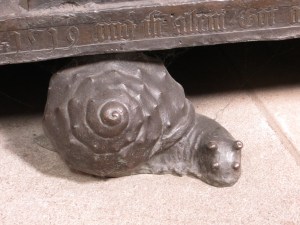
IMG_3631Interestingly, Peter Vischer the Elder’s shrine of Saint Sebaldus is supported by several plump snails, which I was not aware were associated with Saint Sebaldus.  Whether the snails are symbolic or whether they were included for purely aesthetic reasons, I am not sure.  In Christian art, snails do not have the best of reputations.[14]  Snails were believed to have been born from mud and were thought to feed on mud.[15]  Consequently, they were seen as symbols of laziness because they did not seek food but merely ate what was available.[16]
On the other hand, the snail is an apt symbol for this long German winter, which has passed at a snail’s pace and threatens to linger while Saint Sebaldus takes a sabbatical.

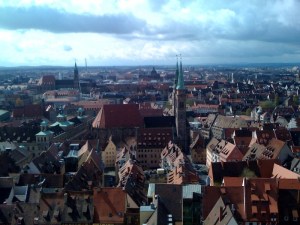
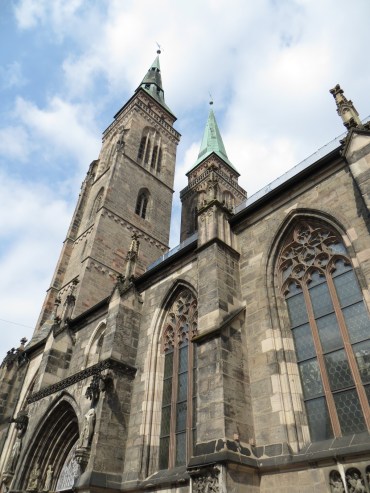
Exterior of the Church of St. Sebaldus, Nuremberg, Germany

Exterior of the Church of St. Sebaldus, Nuremberg, Germany


[1] Overly Overcast: Germany Weathers Darkest Winter in 43 Years, Spiegel Online, Feb. 26, 2013, available at http://www.spiegel.de/international/germany/germany-weathers-darkest-winter-in-43-years-a-885608.html.  According to Spiegel Online, Germany receives an “already measly” average of 160 hours of sunshine each winter.  As of late February, Germany had received less than 100 hours of sunshine over the course of the meteorological winter, which begins in December and ends in February.  Id.

[2] Press Release, Deutscher Wetterdienst, “Deutschlandwetter im März 2013,” March 28, 2013

[3] Just Kill Us Now:  German Spring Kicks Off With More Snow, Spiegel Online, Mar. 21, 2013, available at http://www.spiegel.de/international/germany/winter-weather-plagues-germany-as-spring-begins-a-890166.html.  The article remarks, “The calendar says spring started Wednesday, but a look outside tells sun-starved Germans otherwise. Snow has blanketed large parts of the country in recent days, and forecasts predict yet more wintry weather to come. Super.”

[4] See 3 Butler’s Lives of the Saints 357 (Herbert J. Thurston, S.J. & Donald Attwater eds., 2d ed. 1956).

[5] Id.

[6] See David J. Collins, Reforming Saints: Saints’ Lives and Their Authors in Germany 1470-1530 at 56-64 (2008).

[7] Id. at 57.

[8] Id.

[9] Id. at 57-58.

[10] Id. at 57.

[11] Id.

[12] Id. at 59.

[13] Butler’s Lives of the Saints, supra note 4, at 357.

[14] See Rosa Giorgi, Saints in Art 25 (Stefano Zuffi ed. & Thomas Michael Hartmann trans., 2002).

[15] Id.

[16] Id.

Share this:

  • Share on Facebook (Opens in new window) Facebook
  • Share on X (Opens in new window) X
  • Share on Pinterest (Opens in new window) Pinterest
  • Share on Reddit (Opens in new window) Reddit
  • Share on Tumblr (Opens in new window) Tumblr
Like Loading...

Saint Theodore: Warrior Saint and Dragon-Slayer

23 Saturday Mar 2013

Posted by Reliquarian in Sculpture

≈ 2 Comments

Tags

basilica, dragon, Italy, relic, reliquary, Saint George, Saint Mark, Saint Theodore, Venice


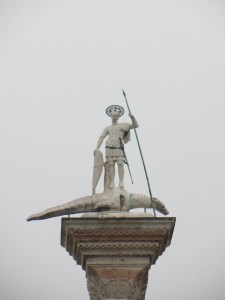
Statue of Saint TheodoreSaint Theodore Arrives in Venice

He arrived in Venice from the East in pieces: a torso and cuirass, a disembodied head, a crocodile.  The Sack of Constantinople in 1204 had devastated the city, but the Venetians, who had transported the army of the Fourth Crusade to Constantinople, managed to salvage an enormous horde of objects from the captured city. The Venetians systematically shipped these objects – statues, jeweled reliquaries, architectural columns, and marble pediments – back to Venice. Among the crates were several fragments of statuary that, when recombined, would become a statue of Saint Theodore, the great warrior-saint, dragon-slayer, and a patron saint of Venice.

Saint Theodore of Amasea

Saint Theodore of Amasea was a Roman recruit martyred in the early 4th century for professing his faith in Christianity.  As a new recruit, he is also known as Saint Theodore Tiro, tiro meaning “recruit” in Latin.[1]  Saint Theodore of Amasea is often confused with another Theodore – Saint Theodore of Stratelates, a Roman general – although most scholars believe the two Theodores were probably the same person.[2]  Butler’s Lives of the Saints notes that the stories relating to Saint Theodore of Amasea “cannot be relied on,” although they probably refer to “a real martyr who may or may not have been a soldier.”[3]  Butler’s Lives of the Saints continues, “So complicated and contradictory did his story become that, in order to make it less inconsistent, a second soldier St Theodore had to be posited and so we have the St Theodore Stratelates of February 7.”[4]  Saint Theodore of Amasea’s feast day is November 9.

Saint TheodoreThe first known mention of Saint Theodore of Amasea derives from a panegyric delivered by Saint Gregory of Nyssa near Saint Theodore’s tomb in Euchaita, modern-day Turkey.[5]  According to various legends, when Saint Theodore refused to offer sacrifices to the Roman gods along with his legion he was brought before the governor of the province to explain himself.  He declared himself to be a Christian, and when asked why he would profess faith in an outlawed religion, the worship of which was a capital offense, he responded, “I know not your gods.  Jesus Christ, the only Son of God, is my God.”[6]  He was dismissed and, according to some sources, went into the city of Amasea near the Iris River and burned down the temple of Cybele.[7]  Not surprisingly, he was captured and was again brought before the Roman authorities who questioned and cajoled him, and then tortured him.[8]  When he was returned to his prison cell, he was comforted by visions of angels.[9]  Eventually, he was condemned to death and was burned alive in a furnace.[10]
Here Be Dragons

Notably absent from these stories is any mention of dragons or dragon slaying.  Why, then, is Saint Theodore frequently depicted slaying a dragon?  Saint Theodore’s identification as an heroic dragon-slayer may be related to the belief that by his intercession “devils were expelled and distempers cured.”[11]  In The Dragon in Medieval East Christian and Islamic Art, Sara Kuehn suggests that the belief in Saint Theodore’s power to vanquish evil probably inspired the dragon-slaying motif.[12]  Kuehn writes, “Dragon-slaying riders were progressively identified as warrior saints and can conclusively be interpreted as exercising an apotropaic or protective function.”[13]

St. Michael and Dragon, Minster of the Holy Cross, Rottweil, Germany

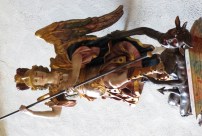
In early Christian art, Saint Theodore is often depicted with fellow dragon-slayer Saint George, although portrayals of Saint Theodore slaying a dragon predate those of his more famous companion.  Kuehn states, “Among the military saints Theodore and George were predominantly associated with the miracle of dragon-slaying and often appear together.  In the hagiographical tradition, Saint Theodore clearly preceded Saint George in the role of dragon-slayer.”[14]  Early references to Saint Theodore slaying a dragon can be traced to the late 9th century[15] while the earliest known depiction of Saint George smiting a dragon is from the early 11th century.[16]  Before then, Saint George was sometimes shown killing a man rather than a dragon.[17]  Other saints frequently depicted with dragons include Saint Margaret, Saint Martha, Saint Sylvester, the Apostle Philip, and the Archangel Michael (pictured in the carved sculpture, above, located at the Minster of the Holy Cross, Rottweil, Germany).[18]

Saint George and the Dragon

Incidentally, the celebrated story of how Saint George vanquished a dragon and rescued a princess was likely a later embellishment to the legend of Saint George the martyr – and one that clearly captured the imagination of subsequent generations.  Most famously told in the Legenda Aurea (Golden Legend), Saint George was a Christian knight born in Cappadocia who, while out riding in the province of Lybia, arrived at the city of Sylene.  The city’s inhabitants were being terrorized by a terrible dragon, which they attempted to appease by providing two sheep every day.  When the inhabitants ran out of sheep, they substituted a human victim, who was selected by lot.  On the day of Saint George’s arrival, the king’s daughter had been selected to serve as the sacrifice.  Saint George ultimately rescued the princess, but before he would slay the dragon, the saint elicited the people’s promise to convert to Christianity.  This they promised, and once the dragon was killed, four oxcarts were needed to dispose of its carcass.[19]

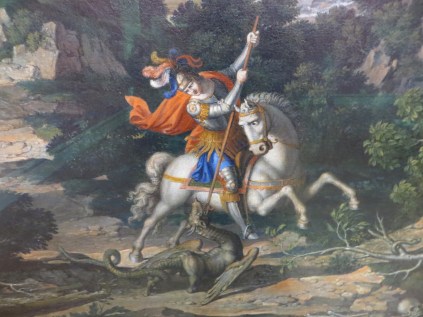
Heroic Landscape with St George, Joseph Anton Koch (1807).  Alte Pinakothek, Munich, German.

Joseph Anton Koch, Heroic Landscape with St. George (detail) (1807). Alte Pinakothek, Munich, German.

Butler’s Lives of the Saints observes that “the story of the dragon, though given so much prominence, was a later accretion of which we have no sure traces before the twelfth century.”[20]  The authors further comment, “There is every reason to believe that St George was a real martyr who suffered at Diospolis (i.e. Lydda) in Palestine, probably before the time of Constantine.  Beyond this there seems to be nothing which can be affirmed with any confidence.”[21]  Although Saint George is not mentioned in the Syriac Breviarium, he is mentioned in the Heironymianum, and various pilgrims of the 6th to 8th century identified Lydda or Diospolis as the site of his relics.[22]

Arm Reliquaries

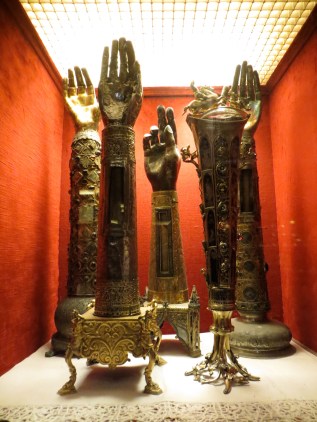
Arm Reliquaries, Basilica of Saint Mark

Coincidentally, the arm of Saint George was apparently one of four important relics taken from Constantinople to Venice following the sack of the city in 1204.[23]  Located today in the Treasury of Saint Mark’s Basilica, the Reliquary of the Arm of Saint George (pictured above, in the right foreground) features an unusual cone-shaped exterior, oval in cross-section, of silver gilt and enamel and a glass lid topped with a figure of Saint George on horseback spearing a dragon.[24]

Arm Reliquary of S George

Reliquary of the Arm of St. George (detail of lid)

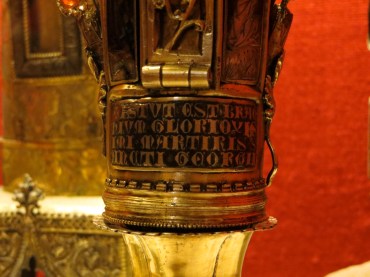
A plaque on the lowest part of the reliquary case, above the stems and leaves that form the base, reads in reserve against niello, “ISTVT · EST · BRAC/HIVM · GLORIOXIS/IMI · MARTIRIS S/ANCTI · GEORGEII” (“This is the arm of the most glorious martyr, Saint George”).[25]  This exterior, of Venetian design, dates to before 1325.[26]  The outer reliquary holds an earlier Byzantine reliquary made of silver that dates to before 1204.[27]  While the dragon is likely original, the equestrian figure of Saint George is probably more modern, dating to the 16th century.[28]  According to some sources, Saint George became Venice’s third patron saint – after Saints Mark and Theodore – sometime following the translation of his arm to the city.[29]

Plaque of S George Reliquary

Reliquary of the Arm of St. George (plaque in reserve against niello)

He Came in Pieces

As noted above, the statue of Saint Theodore arrived in Venice in various pieces, although the pieces were not, in fact, part of a single, unified work.  Edward Hollis, who writes about the evolution and transformation of buildings over time in The Secret Life of Buildings, explains how the Venetians recombined disparate sculptural fragments pilfered from Constantinople to create a single, monumental statute of their patron saint.[30]

Saint Theodore in Saint Mark's SquareAfter the Venetians left Constantinople, some of the treasures they had appropriated were lost at sea and some were sold along the journey, but most of the objects arrived safely in Venice, where they were unloaded and unpacked at the Arsenale.[31]  After they were evaluated by various officials, they were eventually repurposed to enhance the beauty, status, and prestige of La Serenissima.  For example, building material and other decorative ornaments stripped from the churches of Constantinople were used to clothe the basilica of Saint Mark “in the borrowed raiment of vanished sanctuaries” so that “what had been an austere brick structure soon shone, and sparkled, and flashed in the sun.”[32]
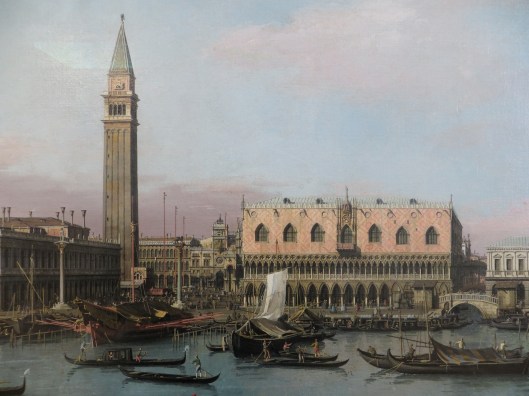
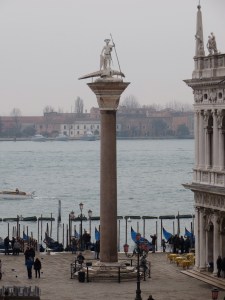
Hollis explains that a centurion’s cuirass, a crocodile, and a disembodied head “became the body of Saint Theodore.”[33]  Similarly, a pair of brazen angel’s wings and a lion were “welded together to make the emblem of Saint Mark.”[34]  Both of these new creations were hoisted atop a pair of Numidian granite columns, also taken from Constantinople, and set in Saint Mark’s Square.[35]  The two statutes, symbolizing two patron saints of Venice, remain in the square to this day.[36]

Antonio Canaletto, Piazzetta in Venice, Alte Pinakothek, Munich, German

Antonio Canaletto, Piazzetta in Venice.  Alte Pinakothek, Munich, Germany.


[1] 4 Butler’s Lives of the Saints 302, 301-303 (Herbert J. Thurston, S.J. & Donald Attwater eds., 2d ed. 1956).  Alternatively, Butler’s Lives of the Saints suggests that the surname Tiro more probably derives from his membership in the Cohors tironum.  Id.

[2] See, e.g., id.; Rosa Giorgi, Saints in Art 345 (Stefano Zuffi ed. & Thomas Michael Hartmann trans., 2002) (“Beginning in the tenth century, Theodore split into two figures in popular devotion, a general and a soldier that were really the same person.”).

[3] Butler’s Lives of the Saints, supra note 1, at 302.

[4] Id.

[5] See, e.g., id. at 301.

[6] Id. at 302.

[7] See, e.g., Giorgi, supra note 1, at 345; Butler’s Lives of the Saints, supra note 1, at 302.

[8] Butler’s Lives of the Saints, supra note 1, at 302.

[9] See, e.g., Giorgi, supra note 1, at 345; Butler’s Lives of the Saints, supra note 1, at 302.

[10] Butler’s Lives of the Saints, supra note 1, at 302

[11] Id. (citing the panegyric attributed to Saint Gregory of Nyssa).

[12] See Sara Kuehn, The Dragon in Medieval East Christian and Islamic Art 109 (2011).

[13] Id.

[14] Id. at 108.

[15] Id. at 108 n.215 (“His exploit of vanquishing a dragon with a spear only appeared in the second state of his Passio Prima (dated 890) . . . .”).  Kuehn also notes that the 7th century Passion of Marina of Antioch contains “antecedents” of Saint Theodore’s dragon-slaying.  Id.

[16] Id. at 108 n.216.  Kuehn identifies the church of Saint Barbara at Soganli as possessing the earliest identifiable portrayal of Saint George vanquishing a dragon.  Id.

[17] Id. at 108.

[18] See, e.g., George Ferguson, Signs and Symbols in Christian Art 16 (1954).

[19] See 2 Butler’s Lives of the Saints 148-50 (Herbert J. Thurston, S.J. & Donald Attwater eds., 2d ed. 1956).

[20] Id. at 149.

[21] Id.

[22] Id. at 150.

[23] See, e.g. Treasures of Heaven:  Saints, Relics, and Devotion in Medieval Europe 92 (Martina Bagnoli et al., eds., 2010).  The other three important relics were a relic of the Holy Blood, a piece of the True Cross, and the head of Saint John the Baptist.  Id.

[24] Id.  The lid was originally made of rock crystal.  Id.

[25] William D. Wixsom, Western Metalwork, in The Treasury of San Marco Venice 282 (David Buxton ed., 1984).

[26] Treasures of Heaven, supra note 23, at 92.

[27] Id.

[28] Wixsom, supra note 25, at 282.  Wixsom writes, “The horse and rider are probably directly based on Leonardo’s designs for the Sforza and Trivulzio monuments, dating respectively 1485-93 and 1506-13, even though the theme of a rearing horse goes back to the early Florentine Renaissance sculptor, Bertoldo (1420-91), to Paduan bronzes dating around 1510, and to ancient bronzes.” Id. (citations omitted).

[29] See, e.g., id.; Treasures of Heaven, supra note 23, at 92.

[30] See Edward Hollis, The Secret Lives of Buildings (2009).

[31] Id. at 55.

[32] Id.

[33] Id.

[34] Id.

[35] Id.

[36] The statute of Saint Theodore in Saint Mark’s Square, however, is a replica.  The original is now located in the Doge’s Palace.  A sign next to statue states that the marble statue “is a fourteenth-century sculpture with an ancient armoured bust and a young man’s head of different origins. . . . According to tradition, the saint’s face is a portrait of Mithradates of Pontus.”

Share this:

  • Share on Facebook (Opens in new window) Facebook
  • Share on X (Opens in new window) X
  • Share on Pinterest (Opens in new window) Pinterest
  • Share on Reddit (Opens in new window) Reddit
  • Share on Tumblr (Opens in new window) Tumblr
Like Loading...
← Older posts
Newer posts →

Recent Posts

  • Ex Indumentis:  Religious Medals and Relics of Saints
  • Green Alternative: When Saint Patrick Wore Blue
  • The Great Heart Heist: The Stunning Theft of Saint Laurence O’Toole’s Preserved Heart
  • The Column of the Flagellation: Relic of the Scourging of Jesus
  • Saint Roch: The Saint “Par Excellence” Against Disease

Top Posts & Pages

  • The Altar of the Holy Blood
    The Altar of the Holy Blood
  • Saint Charles Borromeo:  A Tale from the Crypt of Milan Cathedral
    Saint Charles Borromeo: A Tale from the Crypt of Milan Cathedral
  • Relic of the Holy Diaper:  The Swaddling Clothes of Jesus
    Relic of the Holy Diaper: The Swaddling Clothes of Jesus
  • The Shrine of the Three Kings:  Grand Reliquary of the Magi
    The Shrine of the Three Kings: Grand Reliquary of the Magi
  • The Great Heart Heist:  The Stunning Theft of Saint Laurence O'Toole's Preserved Heart
    The Great Heart Heist: The Stunning Theft of Saint Laurence O'Toole's Preserved Heart
  • Ex Indumentis:  Religious Medals and Relics of Saints
    Ex Indumentis:  Religious Medals and Relics of Saints
  • Saint Theodore: Warrior Saint and Dragon-Slayer
    Saint Theodore: Warrior Saint and Dragon-Slayer
  • The Catacomb Saints:  Bedazzled Skeletons of the Counter-Reformation
    The Catacomb Saints: Bedazzled Skeletons of the Counter-Reformation
  • Saint Innocent and the Massacre of the Innocents
    Saint Innocent and the Massacre of the Innocents
  • Saint Florian:  Saint of Fire and Flood
    Saint Florian: Saint of Fire and Flood

Tags

Aachen altarpiece Austria basilica cathedral Charlemagne church Croatia Dubrovnik Fourteen Holy Helpers Germany Hall in Tirol Italy Krakow Magi martyr mosaic Munich pilgrim pilgrimage Poland relic reliquary Rothenburg Saint Blaise Saint Denis Saint Helena Saint James Saint Mark Saint Mary Saints Cosmas and Damian Saint Theodore Santiago de Compostela sarcophagus shrine skeleton skull Tintoretto tomb Venice

Archives

Categories

Enter your email address to subscribe to this blog and receive notifications of new posts by email.

Join 91 other subscribers

Blog at WordPress.com.

  • Subscribe Subscribed
    • Reliquarian
    • Join 91 other subscribers
    • Already have a WordPress.com account? Log in now.
    • Reliquarian
    • Subscribe Subscribed
    • Sign up
    • Log in
    • Report this content
    • View site in Reader
    • Manage subscriptions
    • Collapse this bar
%d