• Index
  • News
  • About

Reliquarian

~ An exploration of saints, their relics, and their iconography in art

Reliquarian

Tag Archives: Germany

Saint Matthias: The Thirteenth Apostle

11 Sunday Aug 2013

Posted by Reliquarian in Altarpiece, Stone Reliquary

≈ 3 Comments

Tags

altarpiece, basilica, Germany, Krakow, Poland, reliquary, Saint Helena, Saint James, Saint Mary, Saint Matthias, Saint Peter, Trier, Veit Stoss
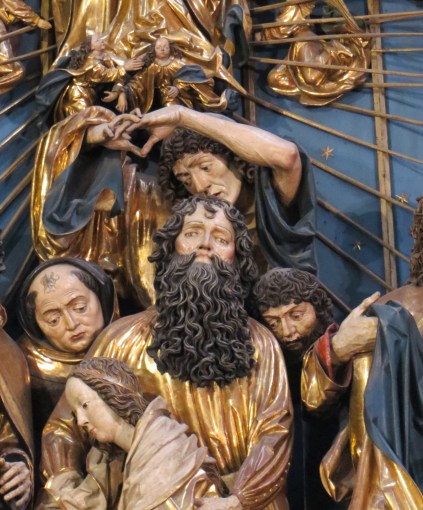
Saint Matthias on Mary's Altar (detail)

Veit Stoss, Saint Mary’s Altar (detail with Saint Matthias), Saint Mary’s Basilica, Krakow, Poland

The Kiss of Judas

Judas Iscariot, one of the original Twelve Apostles of Jesus, infamously betrayed Christ with a kiss in exchange for thirty pieces of silver.  Following the Last Supper, Judas led the priests and Temple guards of the Sanhedrin to the Garden of Gethsemane, where he identified Jesus to the gathering crowd with a kiss.  His treachery set in motion the events leading to the arrest, trial, and crucifixion of Jesus.
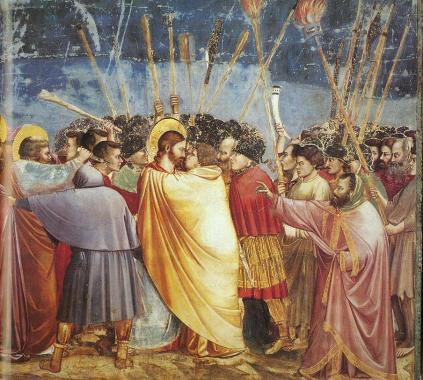
Giotto Scrovegni, Kiss of Judas (courtesy Wikimedia Commons)

Giotto, The Kiss of Judas (1304-06), Scrovegni Chapel, Padua, Italy (courtesy Wikimedia Commons)

Upon learning that Jesus had been sentenced to death, Judas repented.  According to the Gospel of Saint Matthew, “Then Judas, which had betrayed him, when he saw that he was condemned, repented himself, and brought again the thirty pieces of silver to the chief priests and elders, saying, I have sinned in that I have betrayed the innocent blood.”[1]  Judas’s plea fell on deaf ears.  “What is that to us?” the chief priests and elders responded.[2]  Judas then “cast down the pieces of silver in the temple, and departed, and went and hanged himself.”[3]  In a conflicting account, retold in the Acts of the Apostles, Peter states that Judas “purchased a field with the reward of iniquity; and falling headlong, he burst asunder in the midst, and all his bowels gushed out.”[4]

Whatever the manner of his death, Judas’s betrayal opened a void in the ranks of the Apostles.  At a gathering of Jesus’ followers, which met shortly after the Ascension, Peter proposed that the vacancy in the Apostolate be filled.  Two disciples were nominated:  Joseph, who was known as Barsabas, and Matthias.

Once Barsabas and Matthias had been singled out, the group prayed for guidance.  “Thou, Lord, which knowest the hearts of all men, shew whether of these two thou hast chosen, that he may take part of this ministry and apostleship, from which Judas by transgression fell, that he might go to his own place.”[5]  They then drew lots to select Judas’s replacement.  The lot fell on Matthias, “and he was numbered with the eleven apostles.”[6]

Not much is known of Matthias’s life following his election to the Apostolate.[7]  Some sources claim he preached first in Judea and then Ethiopia before he was eventually crucified for his faith.[8]  Others state he traveled to Ethiopia, where he preached near the sea of Hyssus, and died at Sebastopolis.[9]  Still others declare he was stoned and then beheaded in Jerusalem.[10]
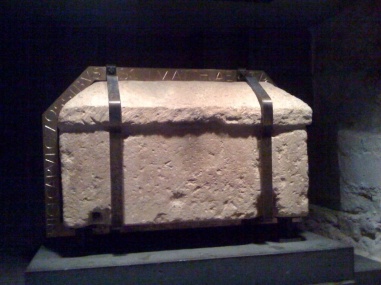
Reliquary of St. Mattias

Reliquary of Saint Matthias, Trier, Germany

Ultimately, Saint Matthias’s relics were purportedly brought to Rome by Saint Helena – although some speculate that the relics in Rome are those of a different Matthias:  Saint Matthias, Bishop of Jerusalem, who died in 120.[11]  Some of Saint Matthias the Apostle’s relics were also translated to Trier, where they are currently kept in the crypt of the abbey church of Saint Matthias.
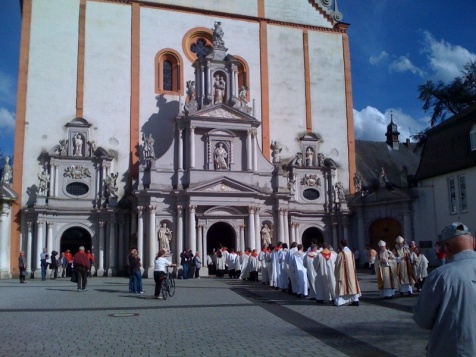
St. Matthias Church

Abbey Church of Saint Matthias, Trier, Germany, prior to Mass

Depictions In Art

Compared with the other Apostles, including Judas, Saint Matthias is infrequently portrayed in works of art.  His iconography is also less well-defined.  For example, while keys are a sign of Saint Peter and seashells are a common attribute of Saint James, no single symbol has come to distinguish Saint Matthias in the visual shorthand of Christian art.

Veit Stoss and Saint Mary’s Altar

Veit Stoss’s magnificent Saint Mary’s Altar, located at the Basilica of Saint Mary in Krakow, Poland, includes one of the few depictions of Saint Matthias I’ve encountered.  Carved in the late 15th century, Saint Mary’s Altar is the largest gothic altar in the world, measuring approximately 11 m (36 ft) long and 13 m (42.65 ft) high.[12]  The altar, or retable, is constructed as a pentaptych consisting of a large central cabinet and two pairs of wings: an inner pair that is hinged and can be used to close the cabinet, and an outer pair that is fixed.[13]  The altar is further supported by a predella and is surmounted by a finial of carved baldachins spread between thinly carved pillars.[14]

Saint Mary's Altar

Veit Stoss, Saint Mary’s Altar, Saint Mary’s Basilica, Krakow, Poland

According to multiple sources, the doors of the altar are ordinarily kept closed during the liturgical year and are only opened for important feasts.[15]  On several recent visits to Krakow, however, I noted that the doors were generally opened for a few hours each day to allow visitor’s to view the central scene of Stoss’s masterpiece.  The central scene of the open retable depicts two important events in the life of Mary – the Death of the Virgin (or Dormition) and the Assumption – while a variety of Biblical episodes are represented on the wings of the altar.[16]

The Dormition depicts a youthful Mary falling to her knees at the moment of her passing.[17]  Unlike more traditional depictions of Mary’s passing (such as the one pictured below), Stoss’s Dormition purposely omits references to death or dying to emphasize the extraordinary nature of Mary’s passage from earthly life.[18]  There is no deathbed in Stoss’s scene, although Mary continues to be surrounded by Apostles, including Saint Peter and Saint John.[19]

A traditional depiction of the Death of the Virgin (detail), Alte Pinakothek, Munich, Germany

Joos van Cleve, The Death of the Virgin (detail) (1520), Alte Pinakothek, Munich, Germany

In my opinion, in addition to Mary herself, three figures in particular stand out in Stoss’s portrayal of the Dormition.  The first is Saint James.[20]  Because of his central position and his dark, generous beard, the eye is naturally drawn to James, who stands above Mary, supporting her as she sinks to her knees.  He is also one of the few figures that stares out towards to the viewer, seemingly making contact with the world outside the altar.  The second is Saint John (pictured below), who stands to the right of Saint James, behind Mary.[21]  John is holding a blue cloak or cape, which he is raising in an enigmatic gesture.  Some suggest he is lifting it to his face to dry a tear while others argue he is extending it to Mary.[22]  The third figure that stands out is purportedly Saint Matthias, whose unusual pose is noteworthy.[23]
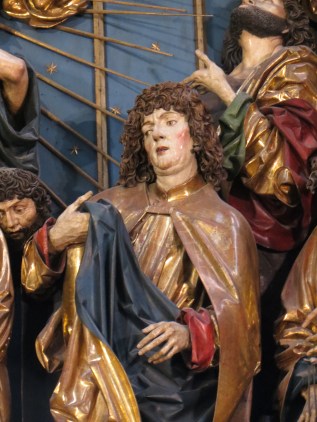
Saint John (detail)

Saint John (detail), from Saint Mary’s Altar

Like the representation of Saint James, the figure of Saint Matthias is also centrally located in the scene, although he is arranged even closer to the center of the composition.  His position serves as a visual link between Mary and the saints of the Dormition, and the Assumption, which takes place in the sky above his head.[24]  Matthias holds his hands outspread, his fingers interlaced, just above Mary’s head in a gesture some have described as one of protection.[25]  To me, however, Matthias’s interlaced fingers are reminiscent of a crown, and his gesture is suggestive of a coronation.  Matthias almost appears ready to place a crown on the kneeling Mary’s head.  Could the arrangement have been intended to evoke Mary’s imminent coronation as Queen of Heaven?

It is interesting to speculate why Veit Stoss might have chosen to place Saint Matthias in so prominent a position on Saint Mary’s Altar.  Alternatively, Saint Matthias may be the Apostle whose face, carved in profile, is just visible at the left of the composition.  All twelve Apostles are present for Stoss’s Dormition, so Saint Matthias must be among them.  In the absence of a clear pictorial tradition, however, identifying Matthias from among Stoss’s crowd of carved Apostles must remain a matter of conjecture.  Nevertheless, as Rainer Kahsnitz notes in Carved Splendor: Late Gothic Altarpieces in Southern Germany, Austria, and South Tirol, “Presenting twelve apostles in a single scene—one or two of them young, the rest old and with flowing beards, was a notoriously difficult task for a Late Gothic artist.  Only a very few carvers and painters proved themselves up to it.”[26]  Of those, Veit Stoss may have been the best.
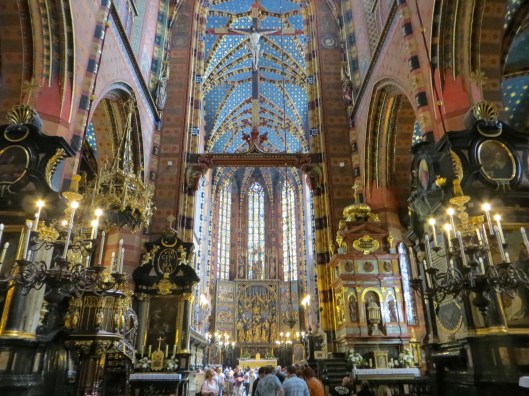
Interior of Saint Mary's Basilica, Krakow, Poland, with Veit Stoss's Saint Mary's Altar in background

Interior of Saint Mary’s Basilica, Krakow, Poland, with Veit Stoss’s Saint Mary’s Altar in background


[1] Matthew 27:3 (King James Bible).

[2] Matthew 27:4.

[3] Matthew 27:5.

[4] Acts 1:18 (King James Bible).

[5] Acts 1:24-25.

[6] Acts 1:26.

[7] See “St. Matthias,” New Catholic Encyclopedia, available at http://www.newadvent.org/cathen/10066a.htm (providing a general overview of sources describing the ministry of Saint Matthias).

[8] Id. (citing Nicephorus, 2 Church History 40, in 1 Nicene and Post-Nicene Fathers (Philip Schaff ed., Arthur Cushman McGiffert trans, 1890)).

[9] Id. (citing the The Synopsis of Dorotheus).

[10] Id. (citing Louis-Sébastien Le Nain de Tillemont, 1 Mémoire pour servir à l’histoire ecclésiastique des six premiers siècle 406-7).

[11] Id. (citing Jean Bolland, Acta Sanctorum, Maii, III (1680)).

[12] Krzysztof Czyzewski, Veit Stoss: Mary’s Altar 10 (Aleksander Ptak et. al, trans. 2007).

[13] See id. at 10-11.

[14] Id. at 11.

[15] See, e.g., Czyzewski, supra note 12, at 11; Teresa Czerniewicz-Umer, Eyewitness Travel:  Cracow 96 (2010).

[16] The following scenes are depicted on the internal wings of the altar and are visible when the doors are open:  the Annunciation, the Nativity, the Adoration of the Magi, the Resurrection, the Ascension, and Pentecost.  The following scenes are visible when the doors of the altar are closed:  the Meeting of Saint Anne and Saint Joachim, the Birth of the Virgin, the Presentation of the Virgin in the Temple, the Presentation of Christ in the Temple, Christ Among the Doctors, the Capture of Christ, the Crucifixion, the Lamentation, the Entombment, Christ Appearing to Mary Magdalene (Noli me tangere), the Three Marys at the Sepulcher, and the Descent into Hell.

[17] Czyzewski, supra note 12, at 12.  In her travel guide to Krakow, Teresa Czerniewicz-Umer opines that the “figure of the youthful Mary is one of the greatest sculptures ever made in Poland.” Czerniewicz-Umer, supra note 15, at 97.

[18] Czyzewski, supra note 12, at 12.  In Carved Splendor: Late Gothic Altarpieces in Southern Germany, Austria, and South Tirol, Rainer Kahsnitz states, “In accordance with legendary tradition going back more than five hundred years—the Gospels say nothing about the death of the Virgin—the standard Dormition shows the apostles, miraculously transported from their far-flung missions, convened around Mary’s deathbed . . . .” Rainer Kahsnitz, Carved Splendor: Late Gothic Altarpieces in Southern Germany, Austria, and South Tirol 137 (2006).

[19] Rainer notes that portrayals of Mary kneeling in prayer before her death was a form that “spread from Bohemia to southeast Germany, Austria, and adjacent territories in the late fourteenth century.” Rainer, supra note 19, at 137.

[20] Rainer identifies this figure as possibly being Saint Paul rather than Saint James.  Id. at 139.

[21] Rainer identifies this figure as possibly being Saint Philip rather than Saint John.  Id. at 140.

[22] See, e.g., Czyzewski, supra note 12, at 29 (featuring a caption reading “St. John raises the rim of his coat to dry a tear,” which accompanies a detail of The Dormition); Czerniewicz-Umer, supra note 15, at 97 (featuring a caption beneath a detail of Saint John stating “the saint is about to put a cape on the fainting Mary”).

[23] Rainer identifies this figure as possibly being Saint John rather than Saint Matthias.  Rainer, supra note 19, at 139.

[24] In the Assumption, Christ and Mary are being raised to heaven by angels.

[25] Czyzewski, supra note 12, at 12 (noting that one of the Apostles “protects” Mary with his “hands above Her”).

[26] Rainer, supra note 19, at 140.

Share this:

  • Click to share on Facebook (Opens in new window) Facebook
  • Click to share on X (Opens in new window) X
  • Click to share on Pinterest (Opens in new window) Pinterest
  • Click to share on Reddit (Opens in new window) Reddit
  • Click to share on Tumblr (Opens in new window) Tumblr
Like Loading...

Charlemagne: Saint of the Holy Roman Empire?

02 Thursday May 2013

Posted by Reliquarian in Metal Reliquary

≈ 4 Comments

Tags

Aachen, anti-pope, canonization, cathedral, Charlemagne, Germany, reliquary, Saint Martin, shrine

Bust of CharlemagnePater Europae – Father of Europe

In her 2008 study of Charlemagne, Charlemagne: The Formation of a European Identity, Rosamond McKitterick observes, “Charlemagne, king of the Franks from 768 to 814, is one of the few major rulers in European history for whom there is an agreed stereotype.”[1]  Celebrated as a mighty conqueror, a pious Christian ruler, and an enlightened patron of learning, Charlemagne is memorialized throughout Europe, particularly in the lands of his former empire.  McKitterick notes, “Statues and paintings of Charlemagne abound in many of the cities of Europe, whether major capitals such as Paris or towns that have often long since lost their political pre-eminence.”[2]  His likeness “graces the market place in Aachen . . . and the cathedrals of Bremen, Frankfurt and Halberstadt.  He surveys the cities of Zurich, Dinant and Liège, and he sits astride his horse in front of Notre Dame in Paris.”[3]  Reverence for Charlemagne is, perhaps, strongest in Aachen, Germany, where Charlemagne continues to be not only honored as the first Holy Roman Emperor but also venerated as a saint.  But was Charlemagne, in fact, ever a saint?

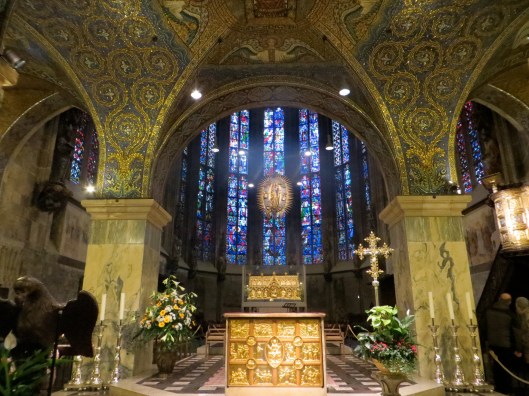
Dome of Aachen Cathedral

Dome of Aachen Cathedral

Playing with the King of Hearts

Even those who have never seen a statue or painting of Charlemagne have probably encountered at least one portrait of the emperor before.  Charlemagne is apparently the enigmatic King of Hearts in a deck of playing cards.  Also known as the “suicide king” because he is commonly shown stabbing himself in the head with a sword, the King of Hearts may be a stylized representation of Charlemagne, but the visual depiction is flawed in at least one fundamental aspect:  the King of Hearts has no moustache.

Throne of Charlemagne, Aachen Cathedral

Throne of Charlemagne, Aachen Cathedral

Of the four kings represented in a deck of cards, only the King of Hearts sports a clean-shaven upper lip; however, as Professor Paul Freedmen has noted in his lectures on medieval history, the Carolingians, of whom Charlemagne was a member, were well-known for their moustaches.[4]  More evidence militating against this interpretation can be found at Aachen, the former imperial capital.  The famous reliquary bust of Charlemagne in the Treasury of Aachen Cathedral clearly portrays Charlemagne with a moustache, suggesting the King of Hearts cannot be the famous Holy Roman Emperor.  Notably, Charlemagne also never stabbed himself in the head, another “fatal” flaw in the historical conceit linking the two royal heads.

Vita Karoli

How do we know what Charlemagne looked like?  Einhard’s Vita Karoli, written sometime between 817 and 833, provides one of the earliest written descriptions of Charlemagne, including an account of his physical appearance.  In the preface to his work, Einhard, a Frankish courtier and contemporary of Charlemagne, explained that he had committed the story of Charlemagne to writing so that “the most glorious life of this most excellent king, the greatest of all the princes of his day, and his illustrious deeds” should not become “wrapped in the darkness of oblivion.”[5]  Elegantly written in Ciceronian Latin, Einhard’s biography has proven to be one of the most influential and enduring portraits of the ancient king.[6]

The High Altar of Aachen Cathedral

The High Altar of Aachen Cathedral

Part of Vita Karoli’s popularity may derive from its disarmingly honest depiction of Charlemagne.  Einhard tells us, for example, that Charlemagne was “large and strong, and of lofty stature, though not disproportionately tall (his height is well known to have been seven times the length of his foot) . . . .”[7]  Additionally, “the upper part of his head was round, his eyes very large and animated, nose a little long, hair fair, and face laughing and merry.”[8]  His appearance was “always stately and dignified, whether he was standing or sitting, although his neck was thick and somewhat short, and his belly rather prominent.”[9] He enjoyed red meat, and his favorite book was Saint Augustine’s The City of God.[10]

As McKitterick explains, “The scholarly reaction to Einhard’s account has ranged from uncritical acceptance to outright rejection of its historical validity.”[11]  Still, “as a reflection of perceptions of Charlemagne and knowledge available about him at the time Einhard wrote, . . . it is immensely valuable.”[12]

The Canonization of Saints

While Einhard’s admiration for Charlemagne is evident in his writing, Einhard never referred to Charlemagne, either figuratively or literally, as a saint.  From the Vita Karoli we learn that Charlemagne died on 28 January 814 at the age of seventy and that he was buried on the same day.  Because Charlemagne never indicated where he wanted to be laid to rest, confusion arose as to where he should be buried.  Eventually, “all agreed that he could nowhere be more honorably entombed than in the very basilica that he had built in the town [of Aachen] at his own expense.”[13]

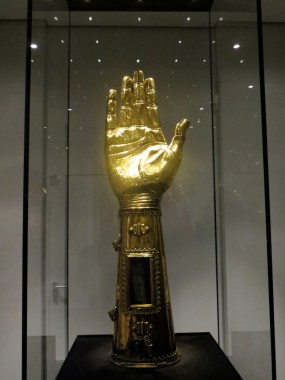
Arm Reliquary of Charlemagne

Arm Reliquary of Charlemagne

A local cultus eventually developed around the storied king; however, only the Church could officially recognize the beatification or canonization of individuals.  As Monsignor P. E. Hallett explains in his study on canonization, the Church constantly “had to guard against the extravagant and unauthorized devotion of the people.”[14]  Indeed, Charlemagne himself was the author of a synodal law designed to check the arbitrary veneration of alleged saints.[15]  The law, which prohibited the public veneration of new saints without the official sanction of the local bishop, was intended to prevent the type of mistake Saint Martin of Tours once encountered in his diocese.[16]

According to the legend, the people of Tours highly honored a shrine believed to be the tomb of a martyr.  Saint Martin, however, had his doubts.  As Rev. Alban Butler explains, “The place was much reverenced by the people; but St. Martin, who was not over credulous, would not go thither to pray, not hearing any assured account of the relics.  He asked the eldest of the clergy what they knew of them, and not receiving satisfaction, he went one day to the place with some of his brethren, and, standing over the tomb, besought God to show him who was buried there.  Then turning to the left he saw near him a pale ghost of a fierce aspect, whom he commanded to speak.  The ghost told his name, and it appeared that he had been a robber who was executed for his crimes, whom the people had honoured as a martyr.  None but St. Martin saw him; the rest only heard his voice.  He thereupon caused the altar to be removed; and freed the people from this superstition.”[17]

Until the 12th century, local bishops could beatify individuals by permitting public cultus, that is, the “erection of altars, the celebration of feasts, the offering of Holy Mass in their honour within the limits of their diocese.”[18]  Today, however, only those whose cultus has been accepted, either expressly or tacitly, by the Holy See are considered beatified, and only those whose cultus has been extended to the Universal Church are considered canonized saints.[19]

Saint Charlemagne?

The cultus of Charlemagne provides an illuminating example of this system of recognition.  Three and a half centuries after his death, in 1165, Charlemagne was canonized by the anti-pope Paschal III.[20]  The Catholic Church never officially recognized Paschal III’s canonization of the Carolingian emperor, however,[21] and in fact, all of Paschal III’s pronouncements were eventually abrogated in 1179 by the Third Lateran Council.[22]  This wholesale repudiation of Paschal III and his decisions would presumably have included his canonization of Charlemagne.[23]

View of Organ, Aachen Cathedral

View of Organ, Aachen Cathedral

Despite the rejection of Charlemagne’s canonization, a local cultus that had developed around the emperor persisted and spread to parts of Germany, Belgium, and France.[24]  No subsequent pope protested the cultus, so it endured for several centuries with the tacit permission of Rome.[25]  In the 18th century, Pope Benedict XIV confirmed the cultus, though apparently not as an official papal act.[26]  Ultimately, because the cultus continued to exist with the permission of the Church, Charlemagne is considered beatified.[27]  Charlemagne, therefore, can be referred to as Blessed Charlemagne; however, he is not Saint Charlemagne.[28]

The Shrine of Charlemagne at Aachen

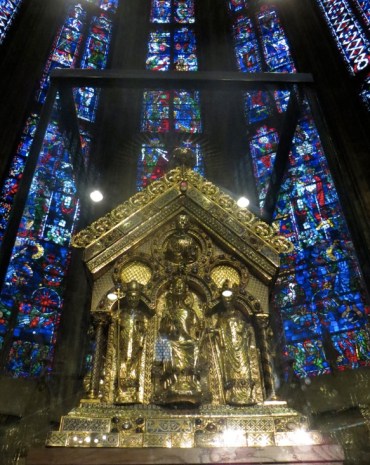
Charlemagne is believed to have been initially buried in a marble sarcophagus from the 3rd century.[29]  His body was later transferred to a more ornate and impressive golden shrine commissioned by Emperor Frederick II in the late 12th century.[30]  The shrine, which is sometimes referred to as a reliquary, was created between 1182 and 1215.[31]  The “Concise Guide to Aachen Cathedral,” a tourist pamphlet available for purchase at Aachen, states that Charlemagne’s bones have been housed in the shrine since 1215.[32]  It further notes that the “Emperor’s bones are surrounded by sixteen of his successors” depicted on the shrine, and “Charlemagne himself sits at the end wall below Christ giving a blessing, flanked by Pope Leo III and Archbishop Turpin of Reims.”[33]

Shrine of Charlemagne

Shrine of Charlemagne

On the day we visited the cathedral, the guide who led our tour stated the sixteen kings represented on the shrine were included instead of saints because Charlemagne’s status as a saint was uncertain.  From afar, the royal figures have the aspects of saints, but on closer inspection, they wear crowns rather than mitre or halos, and they hold symbols of secular power rather than instruments of martyrdom.


[1] Rosamond McKitterick, Charlemagne: The Formation of a European Identity 1 (2008).

[2] Id. at 3.

[3] Id.

[4] Paul H. Freedman, Charlemagne, Class Lecture for The Early Middle Ages, 284-1000 at Yale University (Nov. 9, 2011).  Professor Freedman contrasts the short hair and moustaches of the Carolingians with the long hair and beards of their rivals, the Merovingians.  Freedman states, “one of the symbols of Merovingian familial prestige was this long hair. But Carolingians had short hair and wore mustaches. They kind of broke with the Merovingian look. But of course, this is not just a male fashion statement.”

[5] Einhard: The Life of Charlemagne (Samuel Epes Turner trans., Harper & Brothers 1880), available at http://www.fordham.edu/halsall/basis/einhard.asp#EINHARD’S%20PREFACE.

[6] See, e.g., McKitterick, supra note 1, at 7.

[7] Einhard: The Life of Charlemagne, supra note 5.

[8] Id.

[9] Id.

[10] Id.

[11] McKitterick, supra note 1, at 7 (citation omitted). 

[12] Id.

[13] Einhard: The Life of Charlemagne, supra note 5.

[14] P.E. Hallet, The Canonization of Saints (1952), available at http://www.ewtn.com/library/mary/canonize.htm.

[15] Id.

[16] See id.

[17] Alban Butler, 9 Lives of the Saints (1866), available at http://www.bartleby.com/210/11/111.html.

[18] Hallet, supra note 15.

[19] Id.

[20] Id.  By canonizing Charlemagne, Paschal III hoped to gain the support of the emperor, Frederick Barbarossa, in his struggle against the legitimate pope, Alexander III.  Id.

[21] Id.  Inexplicably, McKitterick erroneously avers that Pope Alexander III, not Paschal III, canonized Charlemagne in 1165.  McKitterick, supra note 1, at 2 (citing R.Folz, Etudes sur le liturgique de Charlemagne dans les églises de l’empire (1951)).  She writes, “A liturgical feast in honour of St Charlemagne was actually instituted in 1165 when Pope Alexander III canonized him and a cult of Charlemagne spread across western Europe.  Id.

[22] William Beckett, 1 A Universal Biography 116 (1834).

[23] See id.

[24] Hallet, supra note 15.

[25] Id.

[26] See id.  Hallet notes that Pope Benedict XIV confirmed the cultus “writing as a private theologian, not officially as Pope.”  Id.

[27] Id.; Benedictine Monks of St. Augustine’s Abbey, The Book of the Saints 62 (photo. reprint 2003) (1921).  In Hallet’s words, “In virtue then of this toleration, and not of course in virtue of the act of the anti-pope, which was null and void, it has been held . . . that he is to be considered as beatified.”  Hallet, supra note 15.

[28] See Benedictine Monks of St. Augustine’s Abbey, supra note 27, at 62.  The Book of the Saints lists Charlemagne as beatified though not canonized, noting that “in some churches” he has been “honoured as a Saint.”  Id.

[29] See, e.g., McKitterick, supra note 1, at 3.

[30] See id.; Dom Schatz Kammer Aachen, “Concise Guide to Aachen Cathedral.”

[31] Dom Schatz Kammer Aachen.

[32] Id.

[33] Id.

Share this:

  • Click to share on Facebook (Opens in new window) Facebook
  • Click to share on X (Opens in new window) X
  • Click to share on Pinterest (Opens in new window) Pinterest
  • Click to share on Reddit (Opens in new window) Reddit
  • Click to share on Tumblr (Opens in new window) Tumblr
Like Loading...

Winter of Discontent: Saint Sebaldus, Protector Against Cold Weather, Takes a Sabbatical

07 Sunday Apr 2013

Posted by Reliquarian in Tomb / Sarcophagus

≈ 4 Comments

Tags

Albrecht Durer, Bamberg, Germany, Nuremberg, pilgrim, Saint James, Saint Sebaldus

IMG_3624

Statue of St. Sebaldus, Church of Saint Sebaldus, Nuremberg, Germany

This winter has been unusually cold, dark, and damp in Germany.  A recent article in Spiegel Online proclaimed it the “darkest winter in 43 years,”[1] and the German weather service (Deutscher Wetterdienst) reported that this past March was the 6th coldest since 1881, when official records began to be kept.[2]  One headline expressed what many Germans have been thinking.  It read, “Just Kill Us Now: German Spring Kicks Off With More Snow.”[3]

In past centuries, unrelenting winter weather like this might have elicited prayers and entreaties to a saint.  In Germany, that saint might have been Saint Sebaldus, a protector against cold weather, who is also the patron saint of Nuremberg.

Patron Saint of Nuremberg

St. Sebaldus KircheSaint Sebaldus (or Sebald), was a hermit who lived in the Reichswald around the 8th century.[4]  Little is definitively known about Saint Sebaldus, although by 1072, he was already recognized as the patron saint of Nuremberg.[5]  Sigismund Meisterlin’s Life of Saint Sebald, completed in 1484, provides some background on the saint, although even Meisterlin acknowledged that his vita was imperfect.[6]  David Collins, in his book Reforming Saints:  Saints’ Lives and Their Authors in Germany 1470-1530, notes that Meisterlin “fixed certain inaccuracies and contradictions in the older legends” about Saint Sebaldus, although Meisterlin realized his corrections “might offend popular sensibilities.”[7]  According to Collins, “Meisterlin’s concern about the changes he had made indicates his familiarity with Sebald’s rich hagiographical tradition.”[8]

Meisterlin wrote the Life of Saint Sebald at the request of the Nuremburg city council.[9]  Collins states, “The city fathers sought a new life of Sebald apparently because the earlier ones were not inspiring the reverence for Sebald outside of Nuremberg in the diocese of Bamberg . . . that the city fathers believed he (and, derivatively, they themselves) deserved.”[10]  At the time, Bamberg was a rival of Nuremberg, and jokes about Saint Sebaldus, especially ones that characterized the saint as rustic and simpleminded, offended the people of Nuremberg, who imagined the jokes implicated them by extension.[11]  Meisterlin’s new vita, it was hoped, would restore the dignity and prestige of Saint Sebaldus, as well as of the city of Nuremberg.

The Life of Saint Sebaldus

St Sebaldus - Reformation of NurembergAccording to Meisterlin’s account, Sebaldus was a Danish prince who felt called to serve God from an early age.  Upon reaching adulthood, he left Denmark and joined three children of the king of Brittany:  Willibald, Wunibald, and Walpurgis.  The group dedicated itself to religious asceticism and elected Willibald, the eldest, as their leader.  The four chose to serve God as itinerants, and they vowed to travel to Rome as pilgrims.  When they arrived in Rome, the pope appointed Willibald a bishop and eventually sent the group back to Germany.  Sebaldus made his way to Regensburg and then to the forests of Franconia, where he lived in solitude, praying and fasting, until his death.  When the locals discovered his body, they placed it on a bier and yoked it to several untamed oxen, which brought the body to a deserted place in the woods, the future site of Nuremberg.[12]

Miracle of the Icicles

Saint Sebaldus is credited with having performed several miracles during his lifetime.  One of his more famous miracles involved the transformation of icicles into fuel for a warm fire.  The story, as recounted in Butler’s Lives of the Saints, goes like this:  “[O]ne snowy night [Saint Sebald] took shelter in a peasant’s cottage, but found it was almost as cold within as without, for the fire was low and small.  Sebald suggested that more fuel might be put on, but the man answered that he was too poor to keep up a decent fire, so Sebald turned to the housewife and asked her to bring in a bundle of long icicles hanging from the eaves; this she did, Sebald threw them on the fire, and they blazed up merrily.”[13]  The miracle of the icicles is depicted in relief on the base of Saint Sebaldus’s shrine at the church of Saint Sebaldus in Nuremberg.  The bronze shrine (below), which was made between 1508 and 1519, is one of the best-known works of Peter Vischer the Elder.

Shrine of Saint Sebaldus by Peter Vischer the Elder, Church of St. Sebaldus, Nuremberg, Germany

Shrine of Saint Sebaldus by Peter Vischer the Elder, Church of St. Sebaldus, Nuremberg, Germany

Another miracle, included in earlier hagiographies but omitted from Meisterlin’s 1484 vita, describes the experience of an unfortunate Scottish monk who, for some unexplained reason, was plucking the beard of Saint Sebaldus’s corpse.  Apparently annoyed by this, the dead saint’s right hand shot up and poked out the monk’s eye.  This story is not depicted on the saint’s tomb.

Attributes in Art

Depictions of Saint Sebaldus are not as ubiquitous as depictions of more popular saints, such as Saint Christopher or the four Evangelists, even in Germany.  In the few representations I have seen, the saint is frequently depicted as a pilgrim, replete with a pilgrim’s hat, cloak, and staff.  Albrecht Dürer, a native of Nuremburg, executed a number of woodcuts of Saint Sebaldus dressed as a pilgrim, including Saint Sebald on the Column (c. 1501) in the collection of the Albertina Museum in Vienna.  Another woodcut by Dürer, entitled Saint Sebald in the Niche (c. 1518), similarly shows Saint Sebaldus as a pilgrim holding his namesake church in his right hand.

St. Sebald in the Niche (1518) by Albrecht Durer, courtesy Wikimedia Commons

St. Sebald in the Niche (1518) by Albrecht Durer, courtesy Wikimedia Commons

When depicted as a pilgrim, it is easy to confuse Saint Sebaldus for Saint James, the patron saint of pilgrims.  For example, the statue shown at the beginning of this post, located inside the church of Saint Sebaldus in Nuremberg, could be mistaken for Saint James, although the miniature church in the figure’s hand – and, importantly, the location of the statue itself – would suggest it is actually Saint Sebaldus.

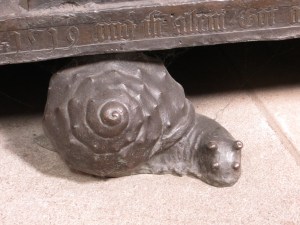
IMG_3631Interestingly, Peter Vischer the Elder’s shrine of Saint Sebaldus is supported by several plump snails, which I was not aware were associated with Saint Sebaldus.  Whether the snails are symbolic or whether they were included for purely aesthetic reasons, I am not sure.  In Christian art, snails do not have the best of reputations.[14]  Snails were believed to have been born from mud and were thought to feed on mud.[15]  Consequently, they were seen as symbols of laziness because they did not seek food but merely ate what was available.[16]
On the other hand, the snail is an apt symbol for this long German winter, which has passed at a snail’s pace and threatens to linger while Saint Sebaldus takes a sabbatical.

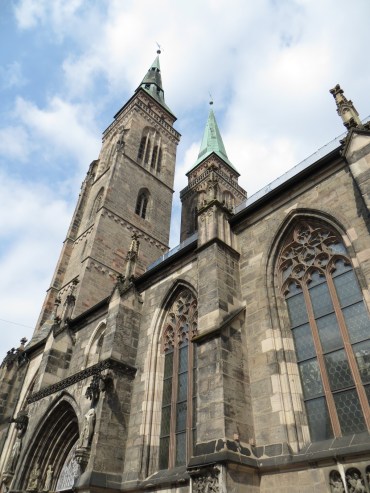
Exterior of the Church of St. Sebaldus, Nuremberg, Germany

Exterior of the Church of St. Sebaldus, Nuremberg, Germany


[1] Overly Overcast: Germany Weathers Darkest Winter in 43 Years, Spiegel Online, Feb. 26, 2013, available at http://www.spiegel.de/international/germany/germany-weathers-darkest-winter-in-43-years-a-885608.html.  According to Spiegel Online, Germany receives an “already measly” average of 160 hours of sunshine each winter.  As of late February, Germany had received less than 100 hours of sunshine over the course of the meteorological winter, which begins in December and ends in February.  Id.

[2] Press Release, Deutscher Wetterdienst, “Deutschlandwetter im März 2013,” March 28, 2013

[3] Just Kill Us Now:  German Spring Kicks Off With More Snow, Spiegel Online, Mar. 21, 2013, available at http://www.spiegel.de/international/germany/winter-weather-plagues-germany-as-spring-begins-a-890166.html.  The article remarks, “The calendar says spring started Wednesday, but a look outside tells sun-starved Germans otherwise. Snow has blanketed large parts of the country in recent days, and forecasts predict yet more wintry weather to come. Super.”

[4] See 3 Butler’s Lives of the Saints 357 (Herbert J. Thurston, S.J. & Donald Attwater eds., 2d ed. 1956).

[5] Id.

[6] See David J. Collins, Reforming Saints: Saints’ Lives and Their Authors in Germany 1470-1530 at 56-64 (2008).

[7] Id. at 57.

[8] Id.

[9] Id. at 57-58.

[10] Id. at 57.

[11] Id.

[12] Id. at 59.

[13] Butler’s Lives of the Saints, supra note 4, at 357.

[14] See Rosa Giorgi, Saints in Art 25 (Stefano Zuffi ed. & Thomas Michael Hartmann trans., 2002).

[15] Id.

[16] Id.

Share this:

  • Click to share on Facebook (Opens in new window) Facebook
  • Click to share on X (Opens in new window) X
  • Click to share on Pinterest (Opens in new window) Pinterest
  • Click to share on Reddit (Opens in new window) Reddit
  • Click to share on Tumblr (Opens in new window) Tumblr
Like Loading...
← Older posts
Newer posts →

Recent Posts

  • Ex Indumentis:  Religious Medals and Relics of Saints
  • Green Alternative: When Saint Patrick Wore Blue
  • The Great Heart Heist: The Stunning Theft of Saint Laurence O’Toole’s Preserved Heart
  • The Column of the Flagellation: Relic of the Scourging of Jesus
  • Saint Roch: The Saint “Par Excellence” Against Disease

Top Posts & Pages

  • The Shrine of the Three Kings:  Grand Reliquary of the Magi
    The Shrine of the Three Kings: Grand Reliquary of the Magi
  • The Great Heart Heist:  The Stunning Theft of Saint Laurence O'Toole's Preserved Heart
    The Great Heart Heist: The Stunning Theft of Saint Laurence O'Toole's Preserved Heart
  • The Head-Carriers:  Headless Saints from Saint Denis to Saint Nicasius
    The Head-Carriers: Headless Saints from Saint Denis to Saint Nicasius
  • The Altar of the Holy Blood
    The Altar of the Holy Blood
  • Saint Munditia: A Holy Skeleton Near the Rindermarkt in Munich
    Saint Munditia: A Holy Skeleton Near the Rindermarkt in Munich
  • Relic of the Holy Diaper:  The Swaddling Clothes of Jesus
    Relic of the Holy Diaper: The Swaddling Clothes of Jesus
  • The Column of the Flagellation:  Relic of the Scourging of Jesus
    The Column of the Flagellation: Relic of the Scourging of Jesus
  • Saint Charles Borromeo:  A Tale from the Crypt of Milan Cathedral
    Saint Charles Borromeo: A Tale from the Crypt of Milan Cathedral
  • Saint Florian:  Saint of Fire and Flood
    Saint Florian: Saint of Fire and Flood
  • Ex Indumentis:  Religious Medals and Relics of Saints
    Ex Indumentis:  Religious Medals and Relics of Saints

Tags

Aachen altarpiece Austria basilica cathedral Charlemagne church Croatia Dubrovnik Fourteen Holy Helpers Germany Hall in Tirol Italy Krakow Magi martyr mosaic Munich pilgrim pilgrimage Poland relic reliquary Rothenburg Saint Blaise Saint Denis Saint Helena Saint James Saint Mark Saint Mary Saints Cosmas and Damian Saint Theodore Santiago de Compostela sarcophagus shrine skeleton skull Tintoretto tomb Venice

Archives

Categories

Enter your email address to subscribe to this blog and receive notifications of new posts by email.

Join 91 other subscribers

Blog at WordPress.com.

  • Subscribe Subscribed
    • Reliquarian
    • Join 91 other subscribers
    • Already have a WordPress.com account? Log in now.
    • Reliquarian
    • Subscribe Subscribed
    • Sign up
    • Log in
    • Report this content
    • View site in Reader
    • Manage subscriptions
    • Collapse this bar
%d