Saint Bernward of Hildesheim: Medieval Patron of the Arts

Tags

, , , , , , , , , , , , , , , ,

Baptismal Font Hildesheim Cathedral

Baptismal Font (detail), copper alloy (c. 1226), Hildesheim Cathedral, Hildesheim, Germany.  Photo by Reliquarian.

Saint Bernward of Hildesheim

During the Middle Ages, few individuals did more to support and develop the arts than Saint Bernward of Hildesheim. Considered one the era’s greatest patrons of the arts,1 Saint Bernward’s legacy included the commissioning of Hildesheim Cathedral’s monumental bronze doors2 and the construction of the abbey church of Saint Michael in Hildesheim.3 At a recent exhibition at the Metropolitan Museum of Art in New York, a number of objects commissioned by Saint Bernward, as well as other important objects from the treasury of Hildesheim Cathedral, were on display. The exhibition included several reliquaries, including a skillfully fashioned reliquary containing the skull of Saint Oswald and an arm reliquary that once held relics of Saint Bernward himself.

Saint Bernward was born to a noble Saxon family and served as the tutor of the future emperor Otto III before his appointment as Bishop of Hildesheim in 993. Hildesheim is one of the oldest cities in northern Germany, and the bishopric of Hildesheim was established by Louis the Pious, Charlemagne’s heir and successor, in 815.4 During the Middle Ages, Hildesheim was renowned for its metalworking, and many of Saint Bernward’s commissions would not have been possible if not for the extraordinary skill of the region’s metalsmiths. As noted in Medieval Treasures from Hildesheim, the proximity of nearby mines, which provided easy access to raw materials, “gave rise to a tradition of metalworking expertise that reached its peak during Bernward’s era.”5

The Golden Madonna (Virgin and Child Enthroned)

Golden Madonna

Golden Madonna, gold over linden wood, (c. 1022), Hildesheim Cathedral, Hildesheim, Germany.  Photo by Reliquarian.

Neither Bernward’s Doors from Hildesheim Cathedral nor Bernward’s Column, an imposing bronze column circa 1015 representing “the first triumphal column since antiquity,” were on display at the Metropolitan Museum of Art, but the exhibition did include other impressive examples of the metalworkers’ art. The Golden Madonna, which dates to before 1022, has been attributed to Saint Bernward’s patronage.6 Sheathed in gold over a linden wood core, the depiction of the Virgin and Child enthroned is one of the oldest sculptures in the round from the Latin West.7

Reliquary of the Holy Cross
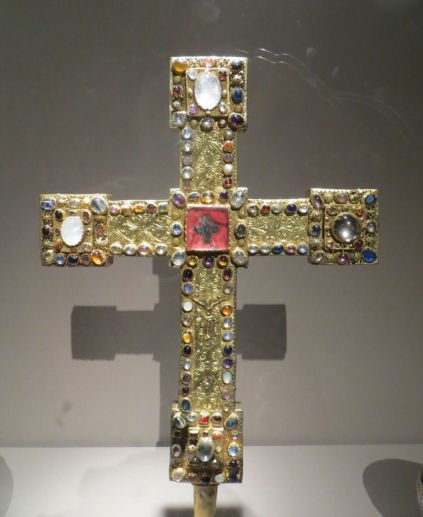
Cross Reliquary

Cross Reliquary, gilded silver, rock crystal, and semiprecious stones, Hildesheim, Germany (c. 1180-1190), Hildesheim Cathedral, Hildesheim, Germany.  Photo by Reliquarian.

A reliquary cross containing relics of the Holy Cross was also on display. According to legend, Henry the Lion, duke of Saxony and Bavaria obtained the relics from the Byzantine emperor in Constantinople during a pilgrimage to Jerusalem. On his safe return to Saxony in 1173, Henry allegedly donated the relics to the Church of the Holy Cross in Hildesheim, although no records supporting this story appear to exist.8 Nevertheless, the reliquary cross’s opulent gilding and intricately hammered ornamentation, as well as its impressive array of colored gems and rock crystal, attest to the significance of the darkened slivers of wood nestled at the center of the cross.

The Ringelheim Crucifix and Hidden Relics of Saints Cosmas and Damian
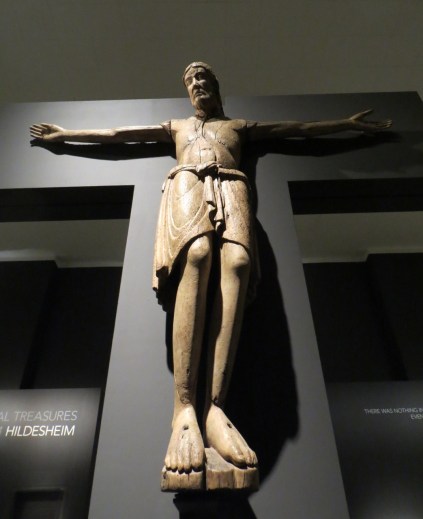
Ringelheim Crucifix

Ringelheim Crucifix, linden wood and oak (c. 1000).  Photo by Reliquarian.

In addition to the Golden Madonna, Saint Bernward commissioned other large sculptures during his reign as bishop, including a striking wooden crucifix known as the Ringelheim Crucifix. Carved from linden wood and oak, the crucifix stands at over five feet tall and represents one of the most significant monumental wooden sculptures from the Ottonian period in existence today.9 Though carved as an object of devotion, conservation work conducted in the mid-20th century revealed that the crucifix also served as an inconspicuous reliquary. Concealed in a small cavity in Christ’s head, conservators discovered several relics, including two stones from the Holy Sepulcher and two bone fragments, wrapped in silk, of the twin saints Cosmas and Damian.10

Reliquary of Saint Oswald and the Story of His Skull
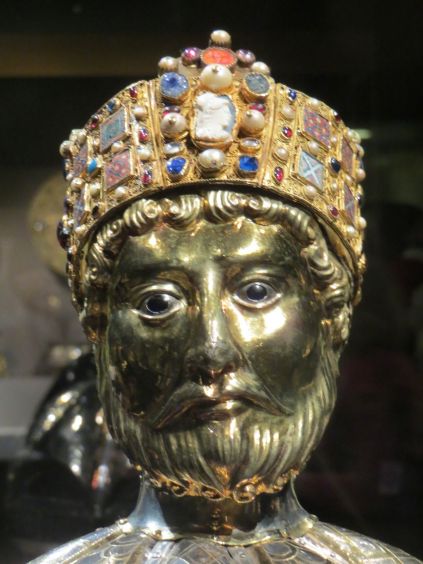
Reliquary of Saint Oswald

Reliquary of Saint Oswald, gold, silver, pearls, and gemstones over wood core (c. 1185-1189), Hildesheim Cathedral, Hildesheim, Germany.  Photo by Reliquarian.

A more traditional reliquary, the Reliquary of Saint Oswald, was also on display at the exhibition. Richly crafted from gold and silver and embellished with niello, cloisonné, pearls, gemstones, and recycled Roman cameos and intaglios, the reliquary is regarded as a masterpiece of medieval goldsmithing.11 The reliquary’s most obvious and most striking feature is undoubtedly the gold bust of Saint Oswald placed atop the reliquary’s octagonal base. The saint’s eyes, finished in niello, were eerie and arresting, their blackened pupils eternally transfixed on the middle distance. Meanwhile, the saint’s crown seemed remarkable for its odd fit. I later learned that the crown and its decoration were cobbled together from earlier components, including a Roman cameo prominently displayed at the crown’s center.12 Apparently, sovereigns occasionally donated their own crowns to churches for reuse on bust reliquaries, although whether this happened to be the case with the Reliquary of Saint Oswald is unclear.13
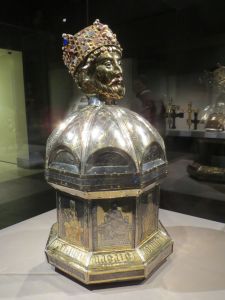
Reliquary of Saint Oswald 2The Reliquary of Saint Oswald was designed to carry the skull of Saint Oswald, and the relic is evidently still enclosed within the reliquary, wrapped in silk. Saint Oswald was a King of Northumbria who lived in the early 7th century.14 According to the Venerable Bede, Saint Oswald was killed in battle by the pagan king of the Mercians at a place called Maserfield in 642.15 The Venerable Bede observes that the extent of Saint Oswald’s faith and devotion were made evident by the miracles that occurred at the spot where he died in battle.16 “[I]nfirm men and cattle are healed to this day,” he reports, and as a consequence, “many took up the very dust of the place where his body fell, and putting it into water, did much good with it to their friends who were sick.”17 In their enthusiasm for this holy dust, the people eventually carried away so much dirt that “there remained a hole as deep as the height of a man.”18

The Venerable Bede further explains that Saint Oswald’s head was originally buried in Lindisfarne. The Venerable Bede writes that after the Battle of Maserfield, the king of the Mercians commanded that Saint Oswald’s head, hands, and arms “be cut off from the body, and set upon stakes.”19 Returning with an army the next year, Saint Oswald’s successor, Oswy, removed the slain king’s body parts from their stakes and eventually buried Saint Oswald’s head at Lindisfarne Abbey. A century later, Saint Oswald’s head was translated to Durham Cathedral, where it was reburied with the body of Saint Cuthbert and the Venerable Bede himself.20 In 1538, however, under the authority of King Henry VIII, the relics of Saint Cuthbert and Saint Oswald were removed from their shrine and were deposited in an unmarked grave behind the high altar of Durham Cathedral.21 According to some sources, the relics of Saint Oswald were eventually destroyed during the Reformation—though perhaps his skull survived, cosseted away in an opulent reliquary.22

Arm Reliquary of Saint Bernward
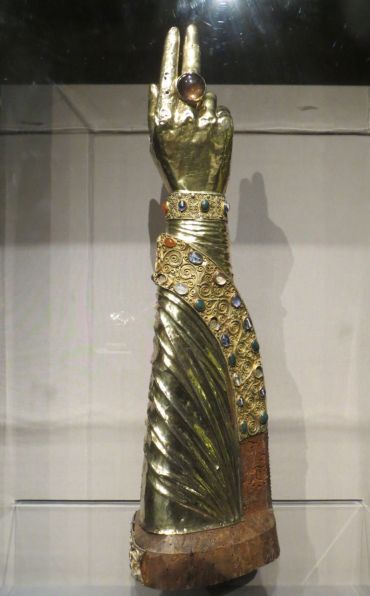
Arm Reliquary of Saint Bernward

Army Reliquary of Saint Bernward, silver, gold, and semiprecious stones over wood core (c. 1194), Hildesheim Cathedral, Hildesheim, Germany.  Photo by Reliquarian.

The exhibition also included an arm reliquary that once held the relics of Saint Bernward. Reliquaries in the shape of body parts, also called “speaking reliquaries” (redende Reliquiare), first gained popularity in the 11th century and were intended to evoke the character of the relics they contained.23 So, for example, leg reliquaries held leg bones, and foot reliquaries held foot bones. In the Permanent Exhibition of Religious Art in Zadar, Croatia I even encountered a shoulder blade reliquary, shaped somewhat like a baby grand piano, that allegedly contained the shoulder blade of Saint Mark.24
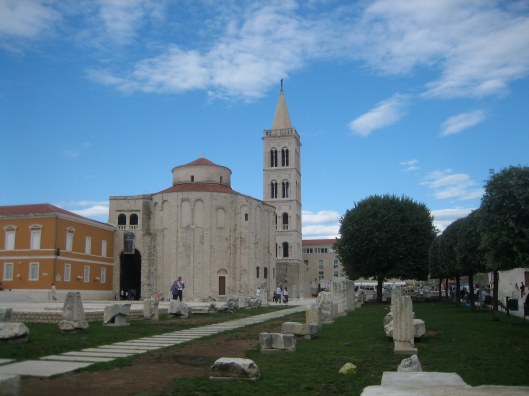
Church of Saint Donatus, Zadar, Croatia

Church of Saint Donatus, Zadar, Croatia. The church of Saint Donatus is located across the street from the convent of Saint Mary and the Permanent Exhibition of Religious Art.  Photo by Reliquarian.

In his superb study on relics, Holy Bones, Holy Dust, Charles Freeman argues that arm reliquaries sometimes served an additional purpose beyond that of mere identification. Freeman notes that after Mass, celebrants traditionally blessed their congregations before they departed.25 Freeman writes that a blessing given by a bishop “was of a much higher status [than] that by a mere priest, and congregations often felt they had been badly done by. Yet if a priest held up an arm reliquary and blessed the congregation with that, it was believed to have the same effect as if the bishop himself had been there.”26 The posture of the Arm Reliquary of Saint Bernward—its right index finger and middle finger extended to heaven, its thumb curled slightly inward—suggests that it may occasionally have been used for this purpose, to deliver the final blessing. Another arm reliquary in the permanent collection of the Metropolitan Museum of Art, the Arm Reliquary of Saint Valentine, likely served a similar function.
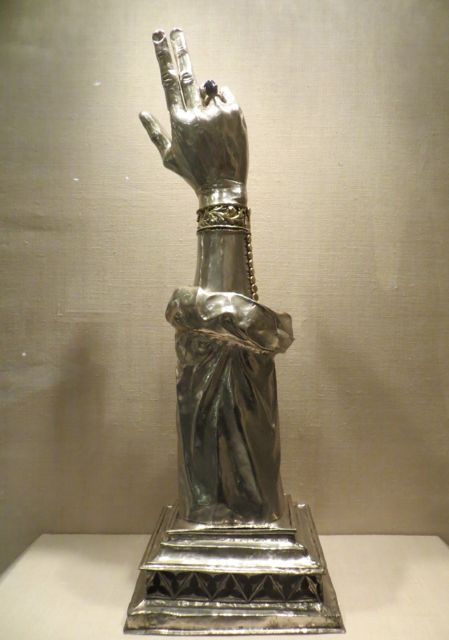
Army Reliquary of Saint Valentine

Army Reliquary of Saint Valentine, silver, gilded silver, and blue cabochon, Basel, Switzerland (c. 1380-1400), Metropolitan Museum of Art, New York.  Photo by Reliquarian.

Because of his patronage of the arts and his own reputed skill as an architect and artist, Saint Bernward is recognized today as a patron saint of architects, goldsmiths, painters, and sculptors. While the church he helped build, the abbey church of Saint Michael, may be his most conspicuous achievement, he accomplished so much more as a bishop and patron of the arts.27 As Medieval Treasures from Hildesheim states, “While many of Hildesheim’s bishops endowed its institutions with extraordinary works of art, no donor was more prolific or had a more significant impact on Hildesheim’s production than Bernward, the thirteenth bishop of Hildesheim.”28
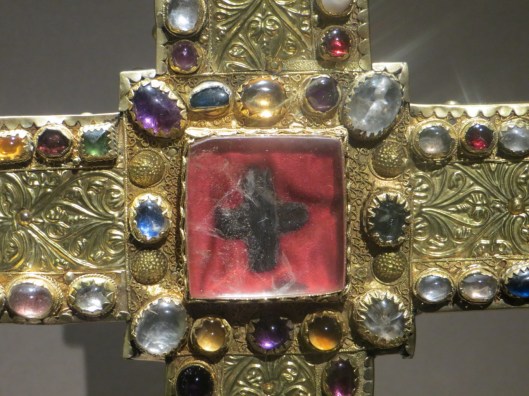
Cross Reliquary

Cross Reliquary (detail), gilded silver, rock crystal, and semiprecious stones, Hildesheim, Germany (c. 1180-1190), Hildesheim Cathedral, Hildesheim, Germany.  Photo by Reliquarian.
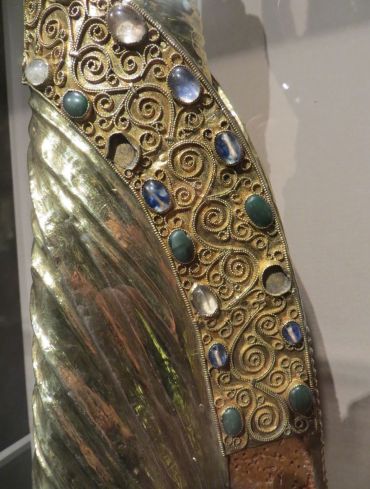
Arm Reliquary of Saint Bernward

Arm Reliquary of Saint Bernward (detail), silver, gold, and semiprecious stones over wood core (c. 1194), Hildesheim Cathedral, Hildesheim, Germany.  Photo by Reliquarian.
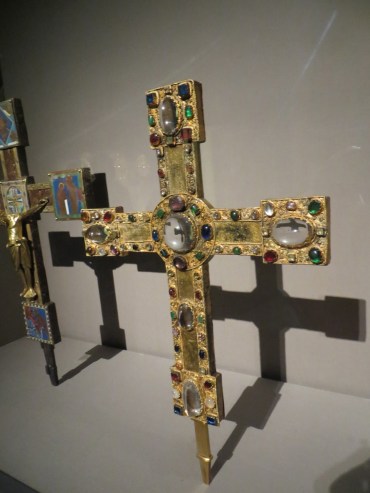
Small Bernward Cross

Small Bernward Cross, copper alloy, gilding, and semiprecious stones, Hildesheim, Germany (c. 1170-1180), Hildesheim Cathedral, Hildesheim, Germany.  Photo by Reliquarian.

Italian Reliquary Cross

Reliquary Cross (detail), silver, gilded silver, enamel, coral, and rock crystal, Italy (the Marches), c. 1375-1400, Metropolitan Museum of Art, New York. This reliquary cross from the late 14th century is part of the permanent collection of the Metropolitan Museum of Art. Slivers of wood can still be seen encased at the center of the cross.  Photo by Reliquarian.
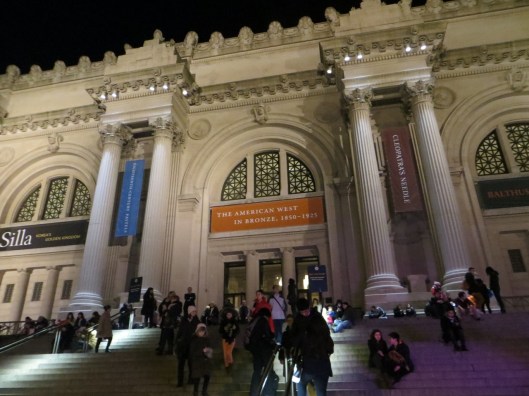
Metropolitan Museum of Art

Metropolitan Museum of Art, New York, New York.  Photo by Reliquarian.

1 Metropolitan Museum of Art, Medieval Treasures from Hildesheim 6 (Peter Barnet et al. eds., 2013).

2 Id. at 11. According to Medieval Treasures from Hildesheim, the casting of Bernward’s enormous and highly decorated bronze doors, now known as Bernward’s Doors, was “a technological breakthrough for the Middle Ages and a milestone in the history of art.” Id.

3 Id. at 7.

4 Id. at 3.

5 Id. at 14, 16.

6 Id. 42.

7 Id.

8 Id. at 86.

9 Id. at 44.

10 Id. Medieval Treasures from Hildesheim further notes that other monumental crucifixes similarly served as reliquaries.

11 Id. at 88.

12 Id.

13 Id. Examples of this reuse can be found at Prague Cathedral and Saint-Denis in Paris.

14 Charles Freeman, Holy Bones, Holy Dust 63 (2011).

15 Saint Bede, The Venerable Bede’s Ecclesiastical History of England 123 (J. A. Giles ed., 1847).

16 Id. at 123–24.

17 Id. at 124.

18 Id.

19 Id. at 129.

20 Saint Bede, 1 The Complete Works of Venerable Bede: Life, Poems, Letters, Etc. at xcviii, xciii (J. A. Giles trans., 1843); Thomas J. Craughwell, Saints Preserved 228–29 (2011).

21 Craughwell, supra note 20, at 229.

22 Id.

23 Freeman, supra note 14, at 82.

24 The Permanent Exhibition of Religious Art is also more informally known as the “Gold and Silver of Zadar.” Located in the Benedictine convent next to the church of Saint Mary, the exhibition includes an overwhelming and truly extraordinary collection of relics and other sacred objects, the oldest of which—a small pectoral cross—dates from the 8th century. See Ivo Petricioli, The Permanent Exhibition of Religious Art in Zadar at VIII (2004). According to Michelin, the museum itself is “[o]ne of the best museums in Croatia.” Sacred Art Museum, Michelin Travel, http://travel.michelin.com/web/destination/Croatia-Zadar/tourist_site-Sacred_Art_Museum-Trg_Opatice_Cike. The Reliquary of the Shoulder Blade of Saint Mark, which is fashioned of embossed gilded copper metal plate, is estimated to date to the 13th century.

25 Id.

26 Id.

27 Medieval Treasures from Hildesheim suggests that the original structure of the church may have been preserved over the centuries “because Bernward’s sainthood and supposed involvement as an architect and artist gave St. Michael’s itself the status of a relic.” Metropolitan Museum of Art, supra note 1, at 7.

28 Id. at 6.
The Shrine of the Three Kings: Grand Reliquary of the Magi

Tags

, , , , , , , , , , , , , , , , , ,

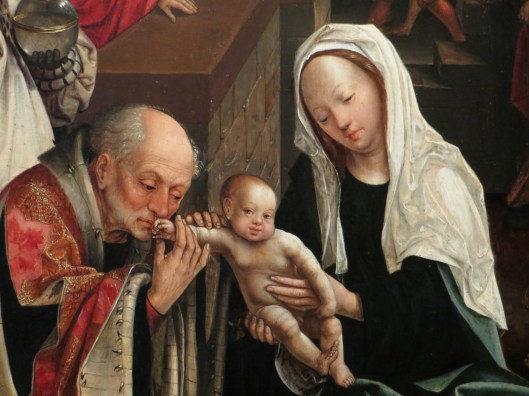
Adoration of the Magi (detail), Jacob Cornelisz van Oostsanen, oil on panel (1517), Rijksmuseum, Amsterdam

Adoration of the Magi (detail), Jacob Cornelisz van Oostsanen, oil on panel (1517), Rijksmuseum, Amsterdam

The story of the Magi, or the three kings, is a celebrated part of the Christmas story and a popular motif in Western culture. The story can be found in the Gospel of Matthew, though most details of the Magi’s visit derive from a more obscure fourteenth-century source known as the Historia Trium Regum. Matthew’s gospel describes the mysterious star of Bethlehem; the arrival of “wise men from the East”; the Magi’s reception with King Herod; the Magi’s visit to the infant Jesus; their gifts of gold, frankincense, and myrrh; and the warning the wise men received to return home by another way.1 Other details, however, are omitted from Matthew’s Christmas tale. Exactly how many wise men arrived from the East? Who were they? What were their names? And what happened to them after they returned from Bethlehem? Ultimately, although clearly outside the scope of Matthew’s gospel, how did the bodies of the three kings come to be laid to rest in Cologne, Germany?

The Historia Trium Regum, or History of the Three Kings, by John of Hildesheim elaborates on Saint Matthew’s story and provides an intriguing coda to the narrative, one that explains how the relics of the three kings were brought to the ancient city of Cologne.2 From the Historia we learn that there were three wise men and that the three men were actually kings from the East—from the lands of Ind, Chaldea, and Persia. The three kings, named Melchior, Balthazar, and Jasper,3 did not initially know each other before individually setting out to “seek and worship the Lord and King of the Jews.”

Window of the Adoration of the Magi, Cologne Cathedral

Window of the Adoration of the Magi, stained glass (1846), Cologne Cathedral (Kölner Dom), Cologne, Germany. The Adoration Window actually combines two events related to the birth of Jesus: the Adoration of the Magi and the Adoration of the Shepherds.

The Star of Bethlehem and the Journey of the Magi

According to the Historia, the star that heralded the birth of Jesus had long been prophesied and watched for by the people of Ind. The Historia states, “Now, in the time when Balaam prophesied of the Star that should betoken the birth of Christ, all the great lords and the people of Ind and in the East desired greatly to see this Star of which he spake.”4 Consequently, the people gave gifts to the keepers of the Hill of Vaws, a tall hill in the Kingdom of Ind that was used as a lookout point, and bade the sentinels, “if they saw by night or by day any star in the air, that had not been seen aforetime,” to send word to the people of Ind.5

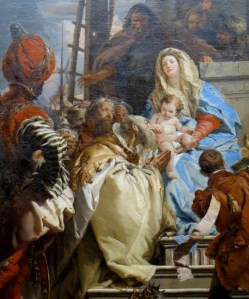
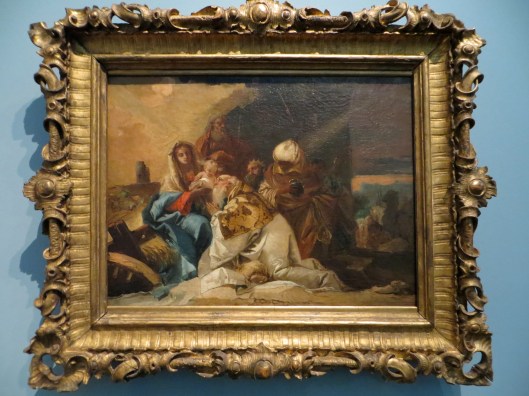
Adoration - Tiepolo (detail) 2Eventually, the star appeared. “When Christ was born in Bethlehem, His Star began to rise in the manner of the sun, bright shining. It ascended above the Hill of Vaws, and all that day in the highest air it abode without moving, insomuch that when the sun was hot and most high there was no difference in shining betwixt them.” Following the day of the nativity, “the Star ascended up into the firmament, and it had right many long streaks and beams, more burning and brighter than a brand of fire; and, as an eagle flying and beating the air with his wings, right so the streaks and beams of the Star stirred about.”6
The star guided each of the kings from his native land. We are told that “[w]hen they stood still and rested, the Star stood still; and when they went forward again, the Star always went before them . . . and gave light all the way.” As the three kings and their retinues converged on Jerusalem, they finally met. “[N]otwithstanding that none of them ever before had seen the other, nor knew him, nor had heard of his coming, yet at their meeting each one with great reverence and joy kissed the other.” They continued as a group into Jerusalem and then to Bethlehem, which they entered on “the sixth hour of the day.” Together they rode through the streets until they came to a little house. There, “the Star stood still, and then descended and shone with so great a light that the little house was full of radiance, till anon the Star went upward again into the air, and stood still always above the same place.”7

The Adoration of the Magi and the Feast of the Epiphany

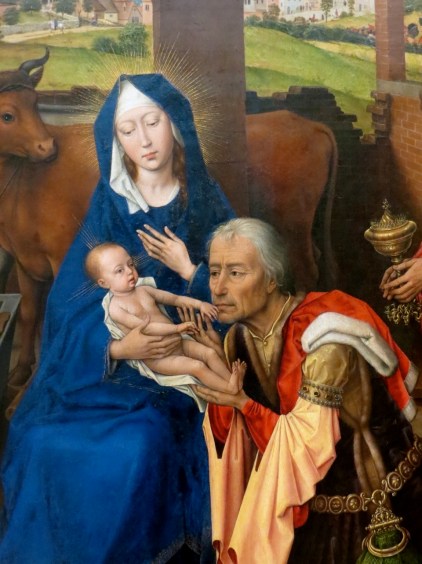
The kings “fell down and worshipped” Jesus at the house and offered him magnificent gifts.8 In addition to silver, jewels, and precious stones, Melchior gave Jesus “a round apple of gold” and thirty gilt pennies; Balthazar gave Christ incense; and Jaspar gave him myrrh, which he offered “with weeping and tears.”9 In art, this event is often referred to as the “Adoration of the Magi,” while their visitation to the infant Jesus is celebrated as the Feast of the Epiphany, or “manifestation.”10

Adoration - Munich (detail) 2

Columba Altar (detail), Rogier van der Weyden, oil on panel (c. 1455), Alte Pinakothek, Munich, Germany

The Magi remained in Bethlehem for some time before preparing to return home. In a dream, the three kings were told not to return to Herod, so they chose to return to their homes by another route. When they left Bethlehem, “the Star that had gone before appeared no more.” Journeying together for many days, they eventually came to the Hill of Vaws, where they built a chapel “in worship of the Child they had sought.” They agreed to meet at the chapel once a year and “ordained that the Hill of Vaws should be their place of burial.”11

The Death of the Wise Men

Many years later, “a little before the feast of Christmas, there appeared a wonderful Star above the cities where these three kings dwelt, and they knew thereby that their time was come when they should pass from earth.” Together, they agreed to build “a fair and large tomb” at the Hill of Vaws, “and there the three Holy Kings, Melchior, Balthazar, and Jasper died, and were buried in the same tomb by their sorrowing people.”12 As Mark Rose observed in an article for Archeology, “If we were to assume that this actually happened, that all three died at the same place at the same time, it might have been in the mid-first century (since the kings were adults already in Bethlehem).”13

Two centuries later, the Historia explains that Saint Helena, the mother of the Emperor Constantine, journeyed to Ind and recovered the bodies of the three kings from their tomb on the Hill of Vaws. She put them into a single chest ornamented with great riches and brought the relics to Constantinople and the church of Saint Sophia, also known as the Hagia Sophia. In the late sixth century, under the Emperor Mauricius, the relics were translated to Italy, where “they were laid in a fair church in the city of Milan.”

Shrine of the Three Kings (detail), Cologne Cathedral, Cologne, Germany

Shrine of the Three Kings (detail), Nicholas of Verdun, gold, silver, and semi-precious stones (1190-1220), Cologne Cathedral, Cologne, Germany

The relics of the three kings remained in Milan until the twelfth century when the city of Milan rebelled against the Holy Roman Emperor, Frederick I, also known as Frederick Barbarossa. In need of assistance against the Milanese, the emperor appealed to Rainald von Dassel, Archbishop of Cologne, who recaptured Milan and delivered the city to the emperor. In gratitude, and “at the Archbishop’s great entreaty,” the emperor transferred the relics to the Archbishop in 1164. The Archbishop, “with great solemnity and in procession,” carried the bodies of the three kings from Milan to Cologne, where they were placed in the church of Saint Peter. “And all the people of the country roundabout, with all the reverence they might, received these relics, and there in the city of Cologne they are kept and beholden of all manner of nations unto this day.” The Historia concludes, “Thus endeth the legend of these three blessed kings—Melchior, Balthazar, and Jasper.”14

The Relics of the Magi at Cologne Cathedral

John of Hildesheim may have thought he had had the last word on the three kings, but the Shrine of the Three Kings at Cologne Cathedral (pictured above) and the precious relics it purportedly contains has continued to fascinate modern visitors.15 Are the bones sealed in the reliquary really those of Melchior, Balthazar, and Jasper?

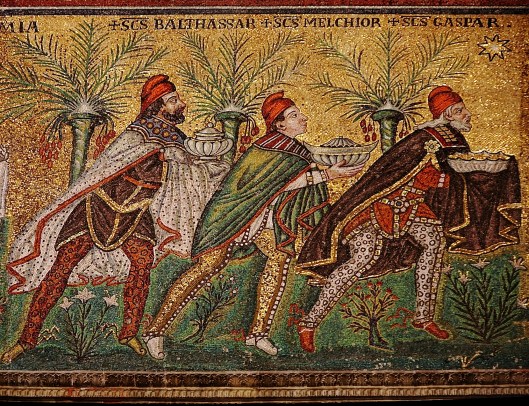
One of the earliest and most intriguing depictions of the Magi is a late sixth-century mosaic located at New Basilica of Saint Apollinaris (Basilica di Sant’Apollinare Nuovo) in Ravenna, Italy. The Magi appear dressed in Eastern clothing, carrying traditional gifts of gold, frankincense, and myrrh.16 Additionally, the three kings are portrayed as men of different ages: Jasper is depicted as an older man with white hair and beard; Balthazar is shown as a middle-aged man with dark hair and beard; and Melchior is represented as a beardless young man.  (In contrast, the Venerable Bede, writing in the 8th century, identifies Melchior as an “old man, with long beard,” Jasper as “young, beardless, [and] of ruddy hue,” and Balthazar as “with heavy beard” and “middle aged.”)

Mosaic of the Magi, Basilica di Sant'Apollinare Nuovo, Ravenna, Italy.  Courtesy of Nina Aldin Thune, Wikimedia Commons.

Mosaic of the Magi, Basilica di Sant’Apollinare Nuovo, Ravenna, Italy. Courtesy of Nina Aldin Thune, Wikimedia Commons.

In 2004, Egyptologist Bob Brier and The Learning Channel examined whether the bones in the Shrine of the Three Kings could possibly be the bones of the Magi, and their investigation revealed something remarkable.17 Scrutinizing the cranial sutures of the three skulls kept in the shrine, Brier’s team concluded that the skulls appeared to be from individuals of different ages: one older (the sutures were completely fused), one middle-aged (the sutures were mostly fused), and one younger (the sutures were incompletely fused). The relative ages of the skulls appeared to corroborate the depiction of the Magi in the Ravenna mosaic.

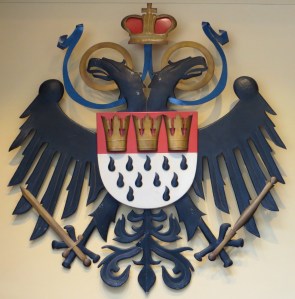
Coat of Arms of CologneThe three skulls in the shrine were also graced with golden crowns, apparently given to the church by King Otto IV of Brunswick in 1199. Incidentally, in recognition of the importance of the kings’ relics, three golden crowns appear on the coat of arms of the city of Cologne. As Gerald J. Brault explains in Early Blazon: Heraldic Terminology in the Twelfth and Thirteenth Centuries with Special Reference to Arthurian Heraldry, “Three crowns were frequently an allusion to the Three Wise Men whose relics were brought by Frederick I Barbarossa from Milan to Cologne in 1164. Commemorating this event, three crowns are featured in the arms of the City of Cologne dating from the end of the thirteenth century as well as on the seal of the University of Cologne from 1392 onwards.”18

King of Kings

For those who have visited Cologne Cathedral, the impressive and stately Shrine of the Three Kings serves as a visual reminder of events that transpired over two thousand years ago, when three men left the comfort of their homes to worship at the feet of an infant. Pope Saint Leo, writing in the fifth century, helps keep the meaning of their visit in perspective: “When a star had conducted them to worship Jesus, they did not find Him commanding devils or raising the dead or restoring sight to the blind or speech to the dumb, or employed in any divine action; but a silent babe, dependent upon a mother’s care, giving no sign of power but exhibiting a miracle of humility.”19 In the din of our modern world, this message of hope and faith may strike some as something of an epiphany.

Shrine of the Three Kings, Cologne Cathedral, Cologne, Germany

Shrine of the Three Kings, Cologne Cathedral, Cologne, Germany

. . .

To all our readers, we wish you a merry Christmas and a joyous and safe holiday season. We hope to see you back in 2014 and look forward to sharing further posts with you at Reliquarian.com in the new year.

. . .

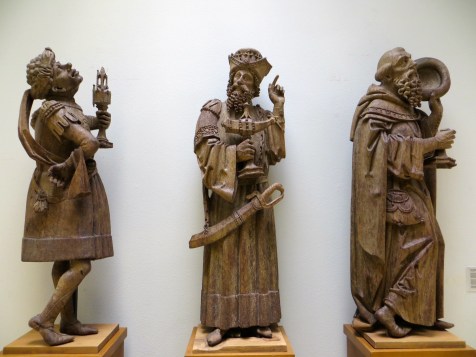
Three Kings Group - Nuremburg 1

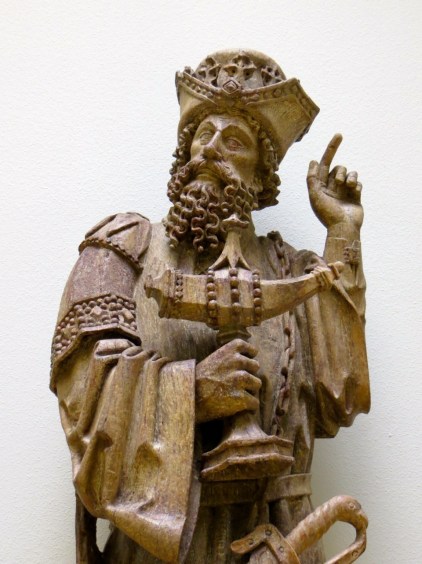
Die Heiligen Drei Könige (The Three Holy Kings), oak (originally polychromed) (1490), Nuremberg, Germany. These figures are rare examples of Dutch medieval sculpture and were originally displayed on the pillars of a church, along with the Virgin Mary. The physiognomy and lively pose of the sculpture on the left identify him as King Balthazar, who is often depicted as a dark complexioned, “exotic” figure from either Africa or Arabia.

Three Kings Group - Nuremburg 2

Die Heiligen Drei Könige (The Three Holy Kings) (detail), oak (originally polychromed) (1490), Nuremberg, Germany

Adoration - Cologne

Adoration of the Magi, oil on canvas, Wallraf-Richartz Museum, Cologne, Germany

Adoration of the Magi (detail), painted wood (late 15th century), Archdiocesan Musem, Krakow, Poland

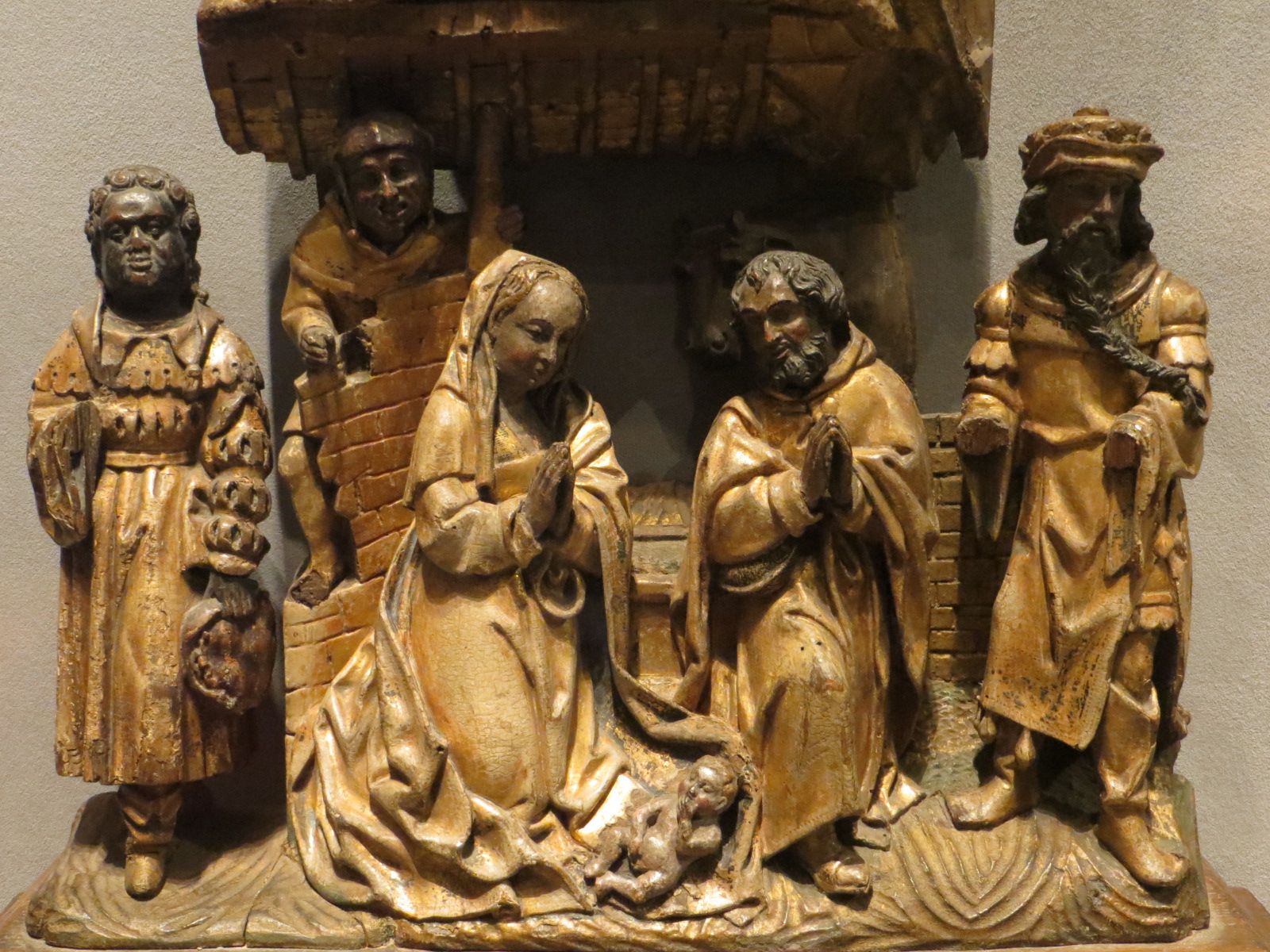
Poklon Trzech Króli (Adoration of the Magi) (detail), painted wood (c. 1450-1475), Archdiocesan Musem, Krakow, Poland. This sculpture was originally displayed in Saint Mary’s Church in Krakow and was probably the central scene of a lost triptych. According to the Archdiocesan Museum, it is an example of the “angular” late Gothic style of sculpture in Krakow that preceded the later, more “expressive” work of Wit Stwosz (Veit Stoss). See Andrzej Jozef Nowobilski, Origin Collection Activity 70 (2011).

Adoration of the Magi - Metropolitan Museum

Adoration of the Magi (detail), oak with paint and gilding, South Netherlandish (1520), Metropolitan Museum of Art, New York.

Shrine of the Three Kings, Cologne Cathedral

Shrine of the Three Kings, Cologne Cathedral, Cologne, Germany. During the Middle Ages, the shrine was kept in the crossing. Today, it is displayed above the high altar, at the rear of the inner choir.

1 Matthew 2:1–16.

2 See The Early English Text Society, The Three Kings of Cologne: An Early English Translation of the “Historia Trium Regum” by John of Hildesheim (C. Horstmann ed., 1886); Steph Mineart, The Three Kings of Cologne—A Legend of the Middle Ages, CommonPlaceBook.com (Mar. 3, 2004), http://commonplacebook.com/culture/the_three_kings/ (featuring a modernized translation of the story by H.S. Morris). John of Hildesheim was a Carmelite friar who lived in the Prince-Bishopric of Hildesheim in what is not present-day Germany.

3 Balthazar is sometimes spelled Balthasar.  “Jasper” sometimes appears as “Gaspar” or “Caspar.”

4 The Three Kings of Cologne—A Legend of the Middle Ages, supra note 2.

5 Id. The Hill of Vaws is also known as the Hill of Victory.

6 Id.

7 Id.

8 Id.

9 Id.

10 George Ferguson, Signs and Symbols in Christian Art 78 (1961). The Feast of the Epiphany was traditionally celebrated on January 6th, the twelfth day of Christmas.

11 The Three Kings of Cologne—A Legend of the Middle Ages, supra note 2.

12 Id.

13 Mark Rose, “The Three Kings & the Star,” Archeology, Dec. 21, 2004, available at http://archive.archaeology.org/online/reviews/threekings/.

14 The Three Kings of Cologne—A Legend of the Middle Ages, supra note 2.

15 See Der Kölner Dom, http://www.koelner-dom.de/ (last visited Dec. 21, 2013) (official website of Cologne Cathedral).

16 Ferguson, supra note 10, at 78. As George Ferguson points out in Signs and Symbols in Christian Art, the three gifts apparently hold a symbolic meaning: “gold to a King, frankincense to One Divine, myrrh, the emblem of death, to a Sufferer.” These gifts “represent the offering to Christ of wealth and energy, adoration, and self-sacrifice.” Id.

17 Mummy Detective: The Three Kings (The Learning Channel television broadcast Dec. 23, 2004); see also Rose, supra note 13.

18 Gerald J. Brault, Early Blazon: Heraldic Terminology in the Twelfth and Thirteenth Centuries with Special Reference to Arthurian Heraldry 45 (2nd ed. 1997).  The eleven black “tears” on the escutcheon of the coat arms, more formally known as gouttes of tar, have come to represent Saint Ursula (Cologne’s other patron saint) and the eleven thousand virgins with whom she was martyred.  In reality, they are likely representations of the black spots commonly found on ermine fur.  See Cologne Coat of Arms, Cologne Tourist Board, http://www.cologne-tourism.com/attractions-culture/city-history/coat-of-arms.html.

19 See 1 Butler’s Lives of the Saints 40 (Herbert J. Thurston, S.J. & Donald Attwater eds., 2d ed. 1956).

Saint Charles Borromeo: A Tale from the Crypt of Milan Cathedral

Tags

, , , , , , , , , , , , ,

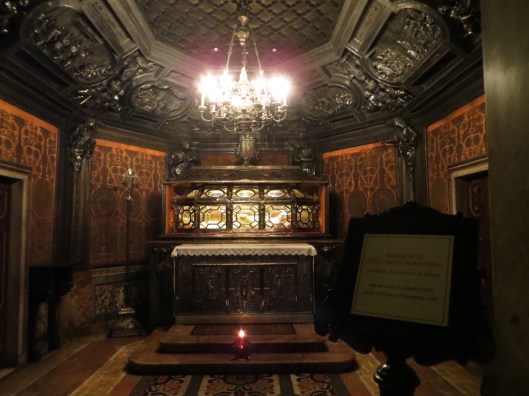
Sarcophagus of Saint Charles Borromeo, Milan Cathedral, Milan, Italy.  The sign to the right reads, "Reliquie di San Carlo Borromeo, Cardinale Arcivescovo di Milano."

Sarcophagus of Saint Charles Borromeo, Milan Cathedral, Milan, Italy. The sign to the right reads, “Reliquie di San Carlo Borromeo, Cardinale Arcivescovo di Milano.”

A Poem Wrought in Marble 

In 1867, Mark Twain spent several months touring Europe and the Holy Land aboard the steamship Quaker City.  He recorded his observations of the trip, which he later published as his first book, The Innocents Abroad, one of the great travelogues of the English language and one of the bestselling travel books of all time.  Among his impressions are those of Milan Cathedral (Duomo di Milano), the majestic seat of the Archbishop of Milan and currently the fifth largest cathedral in the world.  Milan Cathedral simply mesmerized him.  “What a wonder it is!  So grand, so solemn, so vast!  And yet so delicate, so airy, so graceful!  A very world of solid weight, and yet it seems in the soft moonlight only a fairy delusion of frostwork that might vanish with a breath! . . .  It was a vision!—a miracle!—an anthem sung in stone, a poem wrought in marble!”[1] 

Twain was awed by Milan Cathedral’s spires,[2] its luminous windows,[3] its sculptures,[4] and its sheer mass.  He called the cathedral “the princeliest creation that ever brain of man conceived”[5] and could imagine no greater church building in the world.[6]  “They say that the Cathedral of Milan is second only to St. Peter’s at Rome,” he remarked.  “I cannot understand how it can be second to anything made by human hands.”[7]

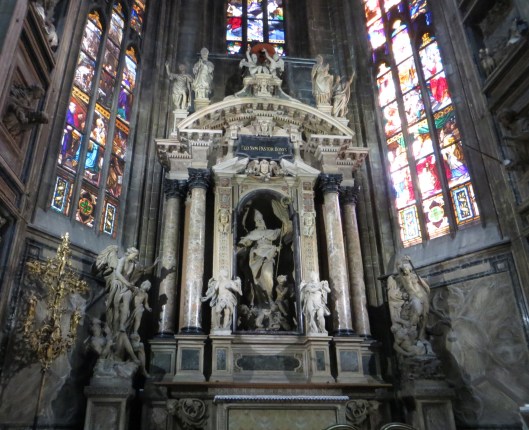
Altar of San Giovanni Buono, Milan Cathedral

Altar of San Giovanni Buono, Milan Cathedral

Nevertheless, despite his obvious and unbounded enthusiasm for the cathedral, Twain managed to devote nearly half his chapter on the cathedral to a subject unrelated to the aesthetic merits of the building—namely, saints and holy relics.  In particular, he dwelt on the earthly remains of Saint Charles (Carlo) Borromeo, a former Archbishop of Milan, who was displayed in the cathedral’s crypt in a “coffin of rock crystal as clear as the atmosphere.”[8]  “To us it seemed that so a good a man . . . deserved rest and peace in a grave sacred from the intrusion of prying eyes,” he rued, “but peradventure our wisdom was at fault in this regard.”[9] 

Twain on Saints and Relics

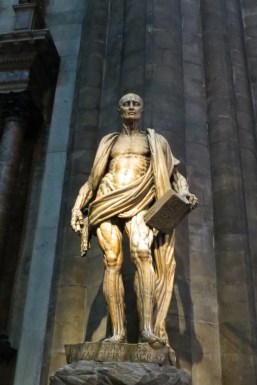
Twain did not have a particularly positive opinion of saints or relics.  In The Innocents Abroad, for example, he criticizes “coarse” depictions of saints as suffering martyrs[10] and he decries the veneration of relics as “Jesuit humbuggery.”[11]  In his book The Reverend Mark Twain, Joe B. Fulton explains that Twain questioned not only the “theological concept of a saint,” but also the “aesthetic practices of martyrology.”[12]  Twain found “visual depictions of the saints unintentionally grotesque, using his own ‘grotesque realism’ to undermine their reverential seriousness.”[13]  In Italy, for example, Twain complained of the “huge, coarse frescoes of suffering martyrs” he found painted on the facades of roadside inns.[14] Twain, who rejected the “ideology inherent in the martyrological form,”[15] wryly noted that “[i]t could not have diminished their suffering any to be so uncouthly represented.”[16]  Twain was similarly disturbed by the statue of Saint Bartholomew at Milan Cathedral (pictured below), which depicts the martyr with his skin flayed.  “It was a hideous thing,” he wrote, “and yet there was a fascination about it somewhere.  I am very sorry I saw it, because I shall always see it now.  I shall dream of it sometimes.”

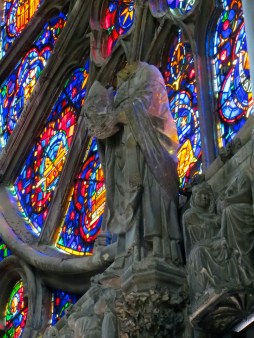
St Bartholomew - Milan CathedralStill, Twain complained “less about the idea of sainthood than about relics and the depictions of them.”[17]  To Twain, the veneration of relics was an irrational, antiquated practice, a holdover of the “peculiar devotional spirit of the olden time.”[18]  As Fulton observes, “[r]elics of the saints trigger comedy rather than reverence” for Twain, and relics are a frequent target of his irreverent humor in The Innocents Abroad.[19]  While recounting his visit to Genoa, for example, he paused to ruminate on the multiplicity of relics he had encountered.  “But isn’t this relic matter a little overdone?” he begins skeptically.[20]  “We find a piece of the true cross in every old church we go into, and some of the nails that held it together.  I would not like to be positive, but I think we have seen as much as a keg of these nails.  Then there is the crown of thorns; they have part of one in Sainte Chapelle, in Paris, and part of one also in Notre Dame.  As for the bones of St. Denis, I feel certain we have seen enough of them to duplicate him if necessary.”[21]  (Saint Denis, pictured below from Rheims Cathedral, is commonly depicted carrying his decapitated head in his arms.)
St Denis - Rheims Cathedral

Twain is not the only one to have expressed exasperation at the multitude of saintly relics displayed throughout Europe.  A French anti-clerical cartoon from the early 1900s, for example, “reconstructed” Saint Blaise—complete with five heads, six arms, and six legs—from “authentic” bones displayed in various cities.[22]  Twain’s avowed skepticism of relics, however, did not preclude a certain fascination with the sainted figures who supplied them.  Later in his career, in fact, Twain would actually engage in hagiography, although he arguably never really altered his view of saints, sainthood, or Catholicism generally.[23] 

Twain’s Personal Recollections of Joan of Arc, published in 1896, is a fictionalized account of Saint Joan of Arc’s life as retold in the (fictional) memoir of her page, Louis de Conte.  The book’s seriousness and the “air of absolute reverence” with which Twain portrays Joan of Arc represent such a stark break from his previous work that he initially published it anonymously.[24]  Years later, however, Twain fully acknowledged his authorship and embraced the book as his greatest work.  “I like the Joan of Arc best of all my books and it is the best,” he declared.[25]  “[I]t furnished me seven times the pleasure afforded me by any of the others; 12 years of preparation & 2 years of writing.  The others needed no preparation, & got none.”[26]  Twain valued Personal Recollections of Joan of Arc even more highly than Adventures of Huckleberry Finn.[27] 

Good Saint Charles Borromeo

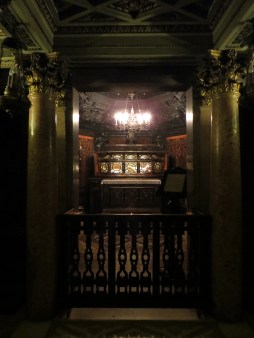
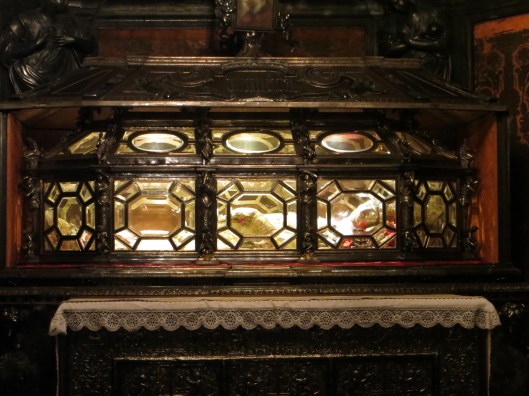
Twain manifested an interest in the life of another saint, Saint Charles Borromeo, in his much earlier The Innocents Abroad.  Twain described Saint Charles with reverence and admiration, characterizing him as “a good man, a warmhearted, unselfish man,” even though he bristled at the way the saint’s corpse had been placed on public display.[28]  Inviting readers to descend with him into the crypt, under the grand altar of Milan Cathedral, he prepared them to “receive an impressive sermon from lips that have been silent and hands that have been gestureless for three hundred years.”[29]

St Borromeo - Crypt3“The priest stopped in a small dungeon and held up his candle,” Twain begins.  He and his companions now stood in Saint Charles’s tomb.  Recognized as one of the great 16th century reformers of the Catholic Church, during a period known as the Counter Reformation, Saint Charles was responsible for, among other things, establishing seminaries to educate priests and ministering with great compassion to victims of the plague.[30]  He was born an aristocrat and could easily have taken advantage of the ease and luxury his station afforded.  Instead, he showed little interest in worldly goods and devoted his life to serving others.

Saint Charles was born on 2 October 1538 at Arona Castle on Lake Maggiore.  His father, Count Gilbert Borromeo, was a “man of talent and sanctity,” and his mother, Margaret, was a member of the Medici family, one of the most power and influential families of the Renaissance.[31]  He received the tonsure at the age of twelve and after his uncle’s election to the papacy in 1559, he served in various offices in Rome.  He was ordained a priest in 1563 and was subsequently appointed Archbishop of Milan in 1564.  

Milan Cathedral - Spires 3

Spires of Milan Cathedral, as seen from roof

After arriving in Milan, he immediately set to work reforming the diocese.  According to Butler’s Lives of the Saints, “[w]hen St Charles came first to reside at Milan he sold plate and other effects to the value of thirty thousand crowns, and applied the whole sum for the relief of distressed families.”[32]  Meanwhile, despite earning a considerable income from various sources, he chose to live modestly.  Francis Panigarola, Bishop of Asti, recounted how he once found Saint Charles on a very cold night studying “in a single tattered cassock.”[33]  He said, “I entreated him, if he would not perish with cold, to put on some better garment.  He answered me smiling, ‘What if I have no other?  I am obliged to wear a cardinal’s robes in the day; but this cassock is my own and I have no other, either for winter or summer.’”[34]

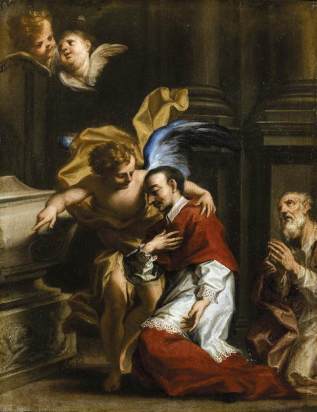
St Carlo Borromeo Tended by an Angel, by Francesco Caccianiga, oil on copper (early 18th century) (courtesy Wikimedia Commons)

St Carlo Borromeo Tended by an Angel, by Francesco Caccianiga, oil on copper (early 18th century) (courtesy Wikimedia Commons)

To curb the gross abuses he discovered in his diocese, Saint Charles established strict regulations governing the clergy, who he found “lazy, ignorant and debauched” upon his arrival.[35]  He also established seminaries to “remedy the disorders engendered by the decay of medieval life.”[36]  His broader reforms, however, were not always well received, and they created many enemies.

On 26 October 1569, a priest by the name of Jerome Donati Farina was sent to murder him while he attended evening prayers.  As Saint Charles kneeled before the altar and a choir performed a motet by Orlando di Lasso—“It is time therefore that I return to Him that sent me,” they sang—Farina fired an arquebus, striking Saint Charles in the back.[37]  Believing himself mortally wounded, Saint Charles “commended himself to God.”[38]  However, as the Lives of the Saints explains, “it was found that the bullet had only struck his clothes in the back, raising a bruise, and fallen harmlessly to the floor.”[39]  A painting titled Farina’s Assassination Attempt by Gian Battista della Rovere (Fiammenghino) located in the south transept of Milan Cathedral depicts the event.[40]

Reliquary (St Borromeo) - KrakowSaint Charles died many years later in Milan on 4 November 1584 at the age of forty-six.  He had celebrated his last mass at Arona, his birthplace, several days earlier, and arriving in Milan, he immediately took to bed and asked for the last rights.  After receiving the final sacrament, he whispered Ecce venio (“Behold, I come”), and expired.  He was canonized by Pope Paul V in 1610.[41]  (The reliquary, pictured left, contains a relic of Saint Charles.  It is located at the Archdiocesan Museum in Krakow, Poland.)
The Vanities of Earth

Twain was clearly familiar with Saint Charles’s story, and he alludes to several of the saint’s virtues, particularly his generosity and his compassion, in The Innocents Abroad.[42]  Twain writes, “His heart, his hand, and his purse were always open,” and he imagines the saint’s “benign countenance moving calmly among the haggard faces of Milan in the days when the plague swept the city.”[43]  In the presence of Saint Charles’s corpse, however, Twain’s thoughts turn to death and the impermanence of earthly things. 

Relics of Saint Charles Borromeo, Milan Cathedral

Relics of Saint Charles Borromeo, Milan Cathedral

The body, he states, was “robed in costly habiliments covered with gold embroidery and starred with scintillating gems.”[44]  Meanwhile, Saint Charles’s “decaying head was black with age, the dry skin was drawn tight to the bones, the eyes were gone, there was a hole in the temple and another in the cheek, and the skinny lips were parted as in a ghastly smile!”  After describing other treasures arrayed about the body, Twain declares, “How poor and cheap and trivial these gewgaws seemed in the presence of the solemnity, the grandeur, the awful majesty of Death!”[45]  Saint Charles’s “sermon,” delivered by silent lips and still hands, was this:  “You that worship the vanities of earth—you that long for worldly honor, worldly wealth, worldly fame—behold their worth!”[46]

In the end, the body of Saint Charles—the relics of Saint Charles—had greater power over Twain than perhaps he realized.

Post Script:  Charles Borromeo and Palestrina, the “Savior of Church Music”

View of the Roman Forum.  Palestrina's music has been called the "soundtrack" of Rome.  He composed over 100 masses and 250 motets here during his lifetime,

View of the Roman Forum. Palestrina’s music has been called the “soundtrack” of Rome. He composed over 100 masses and 250 motets here during his lifetime.

One of the issues taken up by the Council of Trent, the 16th century Ecumenical Council convened to debate and implement extensive reforms in the Catholic Church, was the future of sacred music.  By the mid-16th century, liturgical music had grown so elaborate and unintelligible in its complexity that the Council considered banning polyphonic music from the liturgy altogether.  According to popular legend, Cardinal Borromeo, then a member of the Council, commissioned Giovanni Pierluigi da Palestrina to compose a Mass to convince the Council otherwise.[47]  The result was the extraordinary Missa Papae Marcelli (Mass for Pope Marcellus).  Palestrina’s Mass demonstrated that polyphonic music could be simultaneously beautiful, pure, and textually clear, and it changed the minds of those on the Council, which ultimately abandoned the movement to ban sacred music from the liturgy. 

In reality, Palestrina likely composed the Missa Papae Marcelli years earlier, probably in 1555, eight years before the Council of Trent sought a resolution on the fate of sacred music.  Nevertheless, regardless of whether the Missa Papae Marcelli was commissioned for the purpose, Palestrina’s music, and the Missa Papae Marcelli in particular, were undoubtedly highly influential in saving polyphony.  As Will Durant has noted, “by its fidelity to the words, its avoidance of secular motives, and the subordination of musical art to religious intent” Palestrina’s music “played a part in leading the committee to sanction polyphonic music.”[48]

Milan Cathedral, as seen from roof

Milan Cathedral, as seen from roof

For a fantastic overview of Palestrina and his music, see the BBC’s extraordinary series Sacred Music, series 1, episode 2, on “Palestrina and the Popes.”  Presented by Simon Russell Beale with music performed by Harry Christophers and The Sixteen, the episode originally aired on 28 February 2008.


[1]Mark Twain, The Innocents Abroad 124 (Signet Classic 1980) (1869).

[2]Id.  (“Away above, on the lofty roof, rank on rank of carved and fretted spires spring high in the air, and through their rich tracery one sees the sky beyond.”).

[3]Id. at 125 (“We loitered about gazing aloft at the monster windows all aglow with brilliantly colored scenes in the lives of the Saviour and his followers.  Some of these pictures are mosaics, and so artistically are their thousand particles of tinted glass or stone put together that the work has all the smoothness and finish of a painting.”).

[4]Id. at 124 (noting that the bas-relief carvings on the cathedral’s doors were “so ingeniously carved out of the marble that they seem like living creatures—and the figures are so numerous and the design so complex that one might study it a week without exhausting its interest”).

[5]Id.

[6]Id. at 130.

[7]Id.

[8]Id. at 129.

[9] Id. at 128.

[10] See id. at 149.  During his journey through Italy, Twain observed, “Here and there, on the fronts of roadside inns, we found huge, coarse frescoes of suffering martyrs like those in the shrines.  Id. at 149.

[11] Id. at 43.

[12] Joe B. Fulton, The Reverend Mark Twain:  Theological Burlesque, Form, and Content 106 (2006).

[13] Id. at 105. 

[14] Twain, supra note 1, at 149.

[15] Fulton, supra note 12, at 106.

[16] Twain, supra note 1, at 149.  Twain concludes dismissively, “We were in the heart and home of priestcraft—of a happy, cheerful, contented ignorance, superstition, degradation, poverty, indolence, and everlasting unaspiring worthlessness.”  Id.

[17] Fulton, supra note 12, at 105 (internal citations omitted).

[18] Twain, supra note 1, at 179.  Twain described the veneration of relics as a belief in “the protecting virtues of inanimate objects made holy by contact with holy things.”  Id.

[19] Fulton, supra note 12, at 105.

[20] Twain, supra note 1, at 119. 

[21] Id. at 119–20.  Later, while exploring Milan Cathedral, Twain is shown, among other relics, “two of St. Paul’s fingers and one of St. Peter’s,” a “bone of Judas Iscariot (it was black),” “part of the crown of thorns (they have a whole one at Notre Dame),” and a “picture of the Virgin and Child painted by the veritable hand of St. Luke,” the second he had seen.  Id. at 129.

[22] See, e.g., Europski Dom Dubrovnik, Saint Blaise:  Veneration Without Boundaries 21 (2012) (featuring an illustration titled “Les Reliques Authentiques”).

[23] Fulton, supra note 12, at 107–08.  Twain published Personal Recollections of Joan of Arc, a novel about Joan of Arc, in 1896.  Fulton argues that since “Twain’s attitudes toward Catholicism remained negative before, during, and after the writing of the work, one must find some other, more reasonable, explanation to make sense of it.  Personal Recollections of Joan of Arc marks no sea change in Twain’s attitudes toward the Roman Catholic Church, or indeed toward religion generally.”  Id. at 108.

[24] See 17 The Cambridge History of English and American Literature 29 (A.W. Ward et al. eds., 1907–1921) (2000) (“Recognizing that the book was quite out of his customary vein, Mark Twain published it first anonymously . . . .”).

[25] Id. at 29.

[26] Id.

[27] Fulton, supra note 12, at 108 (explaining that Twain ranked Personal Recollections of Joan of Arc above Adventures of Huckleberry Finn). 

[28] Twain, supra note 1, at 127.

[29] Id.

[30]4 Butler’s Lives of the Saints 255–62 (Herbert J. Thurston, S.J. & Donald Attwater eds., 2d ed. 1956).   Butler’s Lives of the Saints declares that “with Pope St Pius V, St Philip Neri and St Ignatius Loyola, he is one of the four outstanding public men of the so-called Counter-reformation.”  Id. at 255.

[31] Id. at 255.

[32] Id. at 257. 

[33]Id.

[34] Id.

[35] Id. at 258.

[36] Id.

[37] Id. at 259. 

[38] Id. at 259–60.

[39] Id. at 260.

[40] See Ernesto Brivio, The Life and Miracles of St. Carlo Borromeo:  A Pictorial Itinerary in Milan Cathedral (2006), fig. 11.

[41]Butler’s Lives of the Saints, supra note 30, at 261–62.

[42] Twain, supra note 1, at 127. 

[43] Id.

[44] Id. at 128.

[45] Id.

[46] Id.

[47] Will Durant, 6 The Story of  Civilization:  The Reformation (1957).  Importantly, another major reason for the movement to ban sacred music was the realization that some composers drew inspiration for their compositions from common, often bawdy, popular songs of the day.  In addition to rejecting the unintelligibility of polyphonic compositions, which regularly resorted to overlapping melodies and multiple, interwoven lines of text, the Council sought to “exclude from churches all such music as . . . introduces anything of the impure or lascivious, in order that the house of God may truly be seen to be . . . the house of prayer.”  Id.

[48] Id.