• Index
  • News
  • About

Reliquarian

~ An exploration of saints, their relics, and their iconography in art

Reliquarian

Monthly Archives: March 2013

Saint Theodore: Warrior Saint and Dragon-Slayer

23 Saturday Mar 2013

Posted by Reliquarian in Sculpture

≈ 2 Comments

Tags

basilica, dragon, Italy, relic, reliquary, Saint George, Saint Mark, Saint Theodore, Venice


Statue of Saint TheodoreSaint Theodore Arrives in Venice

He arrived in Venice from the East in pieces: a torso and cuirass, a disembodied head, a crocodile.  The Sack of Constantinople in 1204 had devastated the city, but the Venetians, who had transported the army of the Fourth Crusade to Constantinople, managed to salvage an enormous horde of objects from the captured city. The Venetians systematically shipped these objects – statues, jeweled reliquaries, architectural columns, and marble pediments – back to Venice. Among the crates were several fragments of statuary that, when recombined, would become a statue of Saint Theodore, the great warrior-saint, dragon-slayer, and a patron saint of Venice.

Saint Theodore of Amasea

Saint Theodore of Amasea was a Roman recruit martyred in the early 4th century for professing his faith in Christianity.  As a new recruit, he is also known as Saint Theodore Tiro, tiro meaning “recruit” in Latin.[1]  Saint Theodore of Amasea is often confused with another Theodore – Saint Theodore of Stratelates, a Roman general – although most scholars believe the two Theodores were probably the same person.[2]  Butler’s Lives of the Saints notes that the stories relating to Saint Theodore of Amasea “cannot be relied on,” although they probably refer to “a real martyr who may or may not have been a soldier.”[3]  Butler’s Lives of the Saints continues, “So complicated and contradictory did his story become that, in order to make it less inconsistent, a second soldier St Theodore had to be posited and so we have the St Theodore Stratelates of February 7.”[4]  Saint Theodore of Amasea’s feast day is November 9.
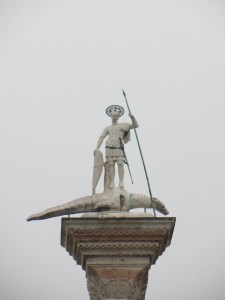
Saint TheodoreThe first known mention of Saint Theodore of Amasea derives from a panegyric delivered by Saint Gregory of Nyssa near Saint Theodore’s tomb in Euchaita, modern-day Turkey.[5]  According to various legends, when Saint Theodore refused to offer sacrifices to the Roman gods along with his legion he was brought before the governor of the province to explain himself.  He declared himself to be a Christian, and when asked why he would profess faith in an outlawed religion, the worship of which was a capital offense, he responded, “I know not your gods.  Jesus Christ, the only Son of God, is my God.”[6]  He was dismissed and, according to some sources, went into the city of Amasea near the Iris River and burned down the temple of Cybele.[7]  Not surprisingly, he was captured and was again brought before the Roman authorities who questioned and cajoled him, and then tortured him.[8]  When he was returned to his prison cell, he was comforted by visions of angels.[9]  Eventually, he was condemned to death and was burned alive in a furnace.[10]

Here Be Dragons

Notably absent from these stories is any mention of dragons or dragon slaying.  Why, then, is Saint Theodore frequently depicted slaying a dragon?  Saint Theodore’s identification as an heroic dragon-slayer may be related to the belief that by his intercession “devils were expelled and distempers cured.”[11]  In The Dragon in Medieval East Christian and Islamic Art, Sara Kuehn suggests that the belief in Saint Theodore’s power to vanquish evil probably inspired the dragon-slaying motif.[12]  Kuehn writes, “Dragon-slaying riders were progressively identified as warrior saints and can conclusively be interpreted as exercising an apotropaic or protective function.”[13]
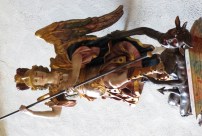
St. Michael and Dragon, Minster of the Holy Cross, Rottweil, Germany

In early Christian art, Saint Theodore is often depicted with fellow dragon-slayer Saint George, although portrayals of Saint Theodore slaying a dragon predate those of his more famous companion.  Kuehn states, “Among the military saints Theodore and George were predominantly associated with the miracle of dragon-slaying and often appear together.  In the hagiographical tradition, Saint Theodore clearly preceded Saint George in the role of dragon-slayer.”[14]  Early references to Saint Theodore slaying a dragon can be traced to the late 9th century[15] while the earliest known depiction of Saint George smiting a dragon is from the early 11th century.[16]  Before then, Saint George was sometimes shown killing a man rather than a dragon.[17]  Other saints frequently depicted with dragons include Saint Margaret, Saint Martha, Saint Sylvester, the Apostle Philip, and the Archangel Michael (pictured in the carved sculpture, above, located at the Minster of the Holy Cross, Rottweil, Germany).[18]

Saint George and the Dragon

Incidentally, the celebrated story of how Saint George vanquished a dragon and rescued a princess was likely a later embellishment to the legend of Saint George the martyr – and one that clearly captured the imagination of subsequent generations.  Most famously told in the Legenda Aurea (Golden Legend), Saint George was a Christian knight born in Cappadocia who, while out riding in the province of Lybia, arrived at the city of Sylene.  The city’s inhabitants were being terrorized by a terrible dragon, which they attempted to appease by providing two sheep every day.  When the inhabitants ran out of sheep, they substituted a human victim, who was selected by lot.  On the day of Saint George’s arrival, the king’s daughter had been selected to serve as the sacrifice.  Saint George ultimately rescued the princess, but before he would slay the dragon, the saint elicited the people’s promise to convert to Christianity.  This they promised, and once the dragon was killed, four oxcarts were needed to dispose of its carcass.[19]
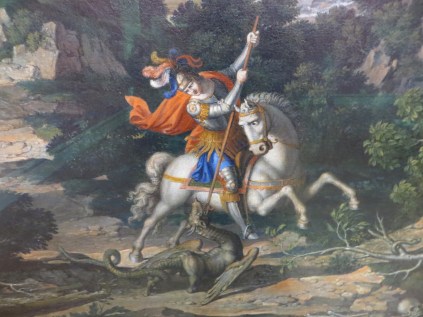
Heroic Landscape with St George, Joseph Anton Koch (1807).  Alte Pinakothek, Munich, German.

Joseph Anton Koch, Heroic Landscape with St. George (detail) (1807). Alte Pinakothek, Munich, German.

Butler’s Lives of the Saints observes that “the story of the dragon, though given so much prominence, was a later accretion of which we have no sure traces before the twelfth century.”[20]  The authors further comment, “There is every reason to believe that St George was a real martyr who suffered at Diospolis (i.e. Lydda) in Palestine, probably before the time of Constantine.  Beyond this there seems to be nothing which can be affirmed with any confidence.”[21]  Although Saint George is not mentioned in the Syriac Breviarium, he is mentioned in the Heironymianum, and various pilgrims of the 6th to 8th century identified Lydda or Diospolis as the site of his relics.[22]
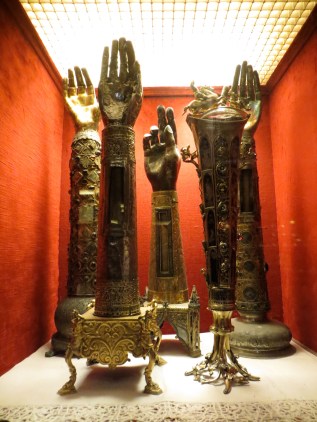
Arm Reliquaries

Arm Reliquaries, Basilica of Saint Mark

Coincidentally, the arm of Saint George was apparently one of four important relics taken from Constantinople to Venice following the sack of the city in 1204.[23]  Located today in the Treasury of Saint Mark’s Basilica, the Reliquary of the Arm of Saint George (pictured above, in the right foreground) features an unusual cone-shaped exterior, oval in cross-section, of silver gilt and enamel and a glass lid topped with a figure of Saint George on horseback spearing a dragon.[24]

Arm Reliquary of S George

Reliquary of the Arm of St. George (detail of lid)

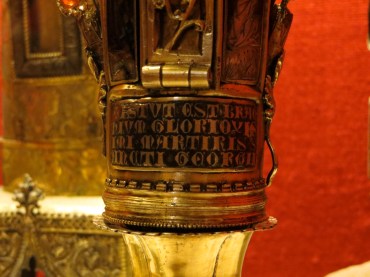
A plaque on the lowest part of the reliquary case, above the stems and leaves that form the base, reads in reserve against niello, “ISTVT · EST · BRAC/HIVM · GLORIOXIS/IMI · MARTIRIS S/ANCTI · GEORGEII” (“This is the arm of the most glorious martyr, Saint George”).[25]  This exterior, of Venetian design, dates to before 1325.[26]  The outer reliquary holds an earlier Byzantine reliquary made of silver that dates to before 1204.[27]  While the dragon is likely original, the equestrian figure of Saint George is probably more modern, dating to the 16th century.[28]  According to some sources, Saint George became Venice’s third patron saint – after Saints Mark and Theodore – sometime following the translation of his arm to the city.[29]
Plaque of S George Reliquary

Reliquary of the Arm of St. George (plaque in reserve against niello)

He Came in Pieces

As noted above, the statue of Saint Theodore arrived in Venice in various pieces, although the pieces were not, in fact, part of a single, unified work.  Edward Hollis, who writes about the evolution and transformation of buildings over time in The Secret Life of Buildings, explains how the Venetians recombined disparate sculptural fragments pilfered from Constantinople to create a single, monumental statute of their patron saint.[30]
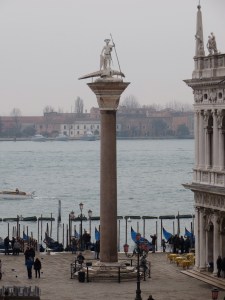
Saint Theodore in Saint Mark's SquareAfter the Venetians left Constantinople, some of the treasures they had appropriated were lost at sea and some were sold along the journey, but most of the objects arrived safely in Venice, where they were unloaded and unpacked at the Arsenale.[31]  After they were evaluated by various officials, they were eventually repurposed to enhance the beauty, status, and prestige of La Serenissima.  For example, building material and other decorative ornaments stripped from the churches of Constantinople were used to clothe the basilica of Saint Mark “in the borrowed raiment of vanished sanctuaries” so that “what had been an austere brick structure soon shone, and sparkled, and flashed in the sun.”[32]

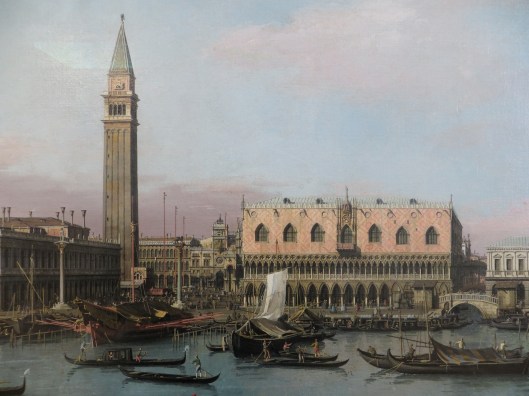
Hollis explains that a centurion’s cuirass, a crocodile, and a disembodied head “became the body of Saint Theodore.”[33]  Similarly, a pair of brazen angel’s wings and a lion were “welded together to make the emblem of Saint Mark.”[34]  Both of these new creations were hoisted atop a pair of Numidian granite columns, also taken from Constantinople, and set in Saint Mark’s Square.[35]  The two statutes, symbolizing two patron saints of Venice, remain in the square to this day.[36]
Antonio Canaletto, Piazzetta in Venice, Alte Pinakothek, Munich, German

Antonio Canaletto, Piazzetta in Venice.  Alte Pinakothek, Munich, Germany.


[1] 4 Butler’s Lives of the Saints 302, 301-303 (Herbert J. Thurston, S.J. & Donald Attwater eds., 2d ed. 1956).  Alternatively, Butler’s Lives of the Saints suggests that the surname Tiro more probably derives from his membership in the Cohors tironum.  Id.

[2] See, e.g., id.; Rosa Giorgi, Saints in Art 345 (Stefano Zuffi ed. & Thomas Michael Hartmann trans., 2002) (“Beginning in the tenth century, Theodore split into two figures in popular devotion, a general and a soldier that were really the same person.”).

[3] Butler’s Lives of the Saints, supra note 1, at 302.

[4] Id.

[5] See, e.g., id. at 301.

[6] Id. at 302.

[7] See, e.g., Giorgi, supra note 1, at 345; Butler’s Lives of the Saints, supra note 1, at 302.

[8] Butler’s Lives of the Saints, supra note 1, at 302.

[9] See, e.g., Giorgi, supra note 1, at 345; Butler’s Lives of the Saints, supra note 1, at 302.

[10] Butler’s Lives of the Saints, supra note 1, at 302

[11] Id. (citing the panegyric attributed to Saint Gregory of Nyssa).

[12] See Sara Kuehn, The Dragon in Medieval East Christian and Islamic Art 109 (2011).

[13] Id.

[14] Id. at 108.

[15] Id. at 108 n.215 (“His exploit of vanquishing a dragon with a spear only appeared in the second state of his Passio Prima (dated 890) . . . .”).  Kuehn also notes that the 7th century Passion of Marina of Antioch contains “antecedents” of Saint Theodore’s dragon-slaying.  Id.

[16] Id. at 108 n.216.  Kuehn identifies the church of Saint Barbara at Soganli as possessing the earliest identifiable portrayal of Saint George vanquishing a dragon.  Id.

[17] Id. at 108.

[18] See, e.g., George Ferguson, Signs and Symbols in Christian Art 16 (1954).

[19] See 2 Butler’s Lives of the Saints 148-50 (Herbert J. Thurston, S.J. & Donald Attwater eds., 2d ed. 1956).

[20] Id. at 149.

[21] Id.

[22] Id. at 150.

[23] See, e.g. Treasures of Heaven:  Saints, Relics, and Devotion in Medieval Europe 92 (Martina Bagnoli et al., eds., 2010).  The other three important relics were a relic of the Holy Blood, a piece of the True Cross, and the head of Saint John the Baptist.  Id.

[24] Id.  The lid was originally made of rock crystal.  Id.

[25] William D. Wixsom, Western Metalwork, in The Treasury of San Marco Venice 282 (David Buxton ed., 1984).

[26] Treasures of Heaven, supra note 23, at 92.

[27] Id.

[28] Wixsom, supra note 25, at 282.  Wixsom writes, “The horse and rider are probably directly based on Leonardo’s designs for the Sforza and Trivulzio monuments, dating respectively 1485-93 and 1506-13, even though the theme of a rearing horse goes back to the early Florentine Renaissance sculptor, Bertoldo (1420-91), to Paduan bronzes dating around 1510, and to ancient bronzes.” Id. (citations omitted).

[29] See, e.g., id.; Treasures of Heaven, supra note 23, at 92.

[30] See Edward Hollis, The Secret Lives of Buildings (2009).

[31] Id. at 55.

[32] Id.

[33] Id.

[34] Id.

[35] Id.

[36] The statute of Saint Theodore in Saint Mark’s Square, however, is a replica.  The original is now located in the Doge’s Palace.  A sign next to statue states that the marble statue “is a fourteenth-century sculpture with an ancient armoured bust and a young man’s head of different origins. . . . According to tradition, the saint’s face is a portrait of Mithradates of Pontus.”

Share this:

  • Share on Facebook (Opens in new window) Facebook
  • Share on X (Opens in new window) X
  • Share on Pinterest (Opens in new window) Pinterest
  • Share on Reddit (Opens in new window) Reddit
  • Share on Tumblr (Opens in new window) Tumblr
Like Loading...

The Way of Saint James: Pilgrimage to the Tomb of a “Son of Thunder”

09 Saturday Mar 2013

Posted by Reliquarian in Altarpiece

≈ 4 Comments

Tags

Altar of the Holy Blood, altarpiece, church, Friedrich Herlin, Germany, martyr, pilgrimage, relic, Rothenburg, Saint James, Santiago de Compostela, tomb

Twelve Apostles Altar

Twelve Apostles Altar, Church of Saint James (St. Jakobskirche), Rothenburg ob der Tauber, Germany. Photo by Reliquarian.

The Way of Saint James

According to tradition, Saint James, one of the twelve Apostles, was martyred by beheading in the year 44.  After the rediscovery of his relics in 814, pilgrimages to his tomb in Compostela, northern Spain, became extremely popular.  Compostela even rivaled Jerusalem and Rome as a destination for pilgrim travelers during the Middle Ages.  Consequently, routes to Saint James’s shrine, including one through Rothenburg, Germany, crisscrossed Europe, marking the path to the saint’s tomb.  Today, the Way of Saint James (Camino de Santiago) continues to direct travelers to the remains of the fiery-tempered Apostle whom Jesus once called a “Son of Thunder.”

Invitation to a Beheading

Saint James was beheaded in Jerusalem during the Christian persecutions of King Herod Agrippa I.  According to Clement of Alexandria, Saint James’s accuser was so moved by the courage and conviction James showed at his trial that he subsequently repented and declared himself a Christian.  As a consequence, the man was sentenced to be beheaded alongside Saint James.  As both men were led to execution, the accuser turned to James and begged for his forgiveness.  According to Butler’s Lives of the Saints, “St James, after pausing a little, turned to him and embraced him, saying, ‘Peace be with you’.  He then kissed him, and they were both beheaded together.”[1]

A Tomb by the Sounding Sea

Saint James - Colmar

Isenheim Altarpiece, Matthias Grunewald (sculptures by Nicolas of Hagenau) (detail), 1510-1515, Colmar, France. On the carved predella of the Isenheim Altarpiece, Saint James can be seen holding a large seashell in his right hand. His pilgrim’s cap is also adorned with a shell. Photo by Reliquarian.

Early chronicles suggested that after his death, Saint James’s remains were transported from Jerusalem to the northern coast of Spain where they were buried contra mare Britannicum, “close to the British sea.”[2]  The location of the tomb, however, remained a mystery until, centuries later, in about 814, the tomb was rediscovered under miraculous circumstances.[3]  According to legend, a local monk named Pelayo was guided by a star to a secluded spot in the woods near the Galician coast.[4]  There he discovered a marble sarcophagus that contained human bones, apparently very old.[5]  Bishop Teodomir, the local bishop, proclaimed the remains to be those of Saint James, long believed to have been buried in the region.  After learning of the discovery, King Alfonso II journeyed to the site to venerate the relics and ordered that a church be built on the spot.  The modest church established by King Alfonso II later grew into the Cathedral of Santiago de Compostela, the ultimate destination of pilgrims traveling the Way of Saint James.

King Alfonso II’s journey to the tomb of Saint James is considered the first pilgrimage to Santiago de Compostela, and it set the example for subsequent generations of pilgrim travelers.  Departing from Oviedo, the location of his royal court, King Alfonso II likely took the Roman road known as the Camino Primitivo to Compostela.  As the popularity of Saint James’s shrine grew, other routes gradually came into regular use, such as the Camino del Norte, another Roman road, which skirted the coast.  By the 11th century, the pilgrimage to Santiago de Compostela had become an international phenomenon, drawing visitors from all over Christendom and establishing Santiago de Compostela as a rival to Jerusalem and Rome for pilgrims.[6]  In a paper discussing the history of the pilgrimage, Laurie Dennett opines that interest in Saint James’s relics had begun to shift the “conceptual geography of Christian Europe, giving it a new pole in the west, a new focus for popular devotion, that balanced the Byzantine east with its spiritual centre at Jerusalem.”[7]  She further notes that “Santiago de Compostela even seemed to rival the pretensions of Rome,” at least for a time.[8]

St. Jakobskirche and the Twelve Apostles Altar

The St. Jakobskirche (Saint James’s Church) in Rothenburg ob der Tauber was once an important stop on the pilgrimage road to Santiago de Compostela.  Known more widely as the home of the Altar of the Holy Blood, the church also houses the impressive Twelve Apostles Altar (Zwölfbotenaltar), a carved altarpiece with a painted predella and painted wings, which incorporates several images of Saint James.

St Jakobskirche

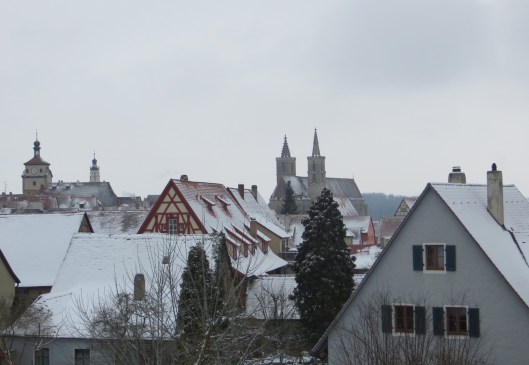
View of St. Jakobskirche from the city walls.  Photo by Reliquarian.

Completed in 1466, the altarpiece is the work of Hans Waidenlich and Friedrich Herlin with carvings in the Multscher tradition by an unknown sculptor.[9]  Herlin, who may have been from Rothenburg, moved to Nördlingen later in his career and is closely identified with the Twelve Apostles Altar, which he signed: “This work was made by Friedrich Herlin, painter, mcccclxvi.  Saint James pray to God for him.”[10]

In Carved Splendor:  Late Gothic Altarpieces in Southern Germany, Austria, and South Tirol, Rainer Kahsnitz identifies the Twelve Apostles Altar as “one of the best-preserved altarpieces from the Late Gothic period.”[11]  Although little is known about the origins of the altarpiece, Kahsnitz speculates that it must have replaced an earlier work at St. Jakobskirche.[12]

Twelve Apostles Altar - Detail

Twelve Apostles Altar (detail).  Photo by Reliquarian.

The corpus of the altarpiece depicts the Crucifixion, with Mary (to the left) and Saint John the Evangelist (to the right) below the cross, flanking the dying Christ.  Next to Mary stands Saint James wearing a pilgrim’s hat decorated with a scallop shell, a symbol of pilgrimage.  Two other shells dangle from his wrist, and he is shown with a pilgrim’s staff, another defining attribute of the patron saint of pilgrims.[13]  The other carved figures below the cross are Saint Elizabeth (to the far left), who is carrying a loaf of bread and a pitcher; Saint Leonard (next to Saint John), the patron saint of prisoners of war; and Saint Anthony the hermit (to the far right), who is shown with a bell.  According to Kahsnitz, the altar was kept permanently closed following Rothenburg’s adoption of the Reformation.[14]  This helped preserve the sculptures and the paintings on the inner wings.[15]

SS James and Peter

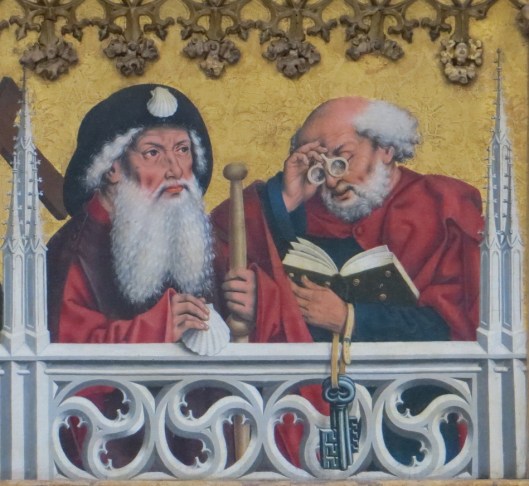
Saint James and Saint Peter. Friedrich Herlin’s predella depicts Saint James with his traditional attributes in art:  a pilgrim’s staff and a seashell.  To the right of Saint James is Saint Peter with several of his symbols:  a set of keys and a book.  Photo by Reliquarian.

Saint James appears again on Herlin’s predella with a shell in one hand and a pilgrim’s staff in the other.  To his left, Saint Peter carries two of his traditional attributes: a set of keys and a book, which he peers into with the aid of spectacles.  All twelve Apostles are represented on the predella, arranged in pairs behind a Late Gothic balustrade.[16]  In addition to other paintings, the back of the predella also features a depiction of the veil of Saint Veronica:  the image of Christ’s face with a crown of thorns imprinted on a veil or shroud.[17]

Sons of Thunder

Saint James is often known as “the Greater” to distinguish him from Saint James, son of Alphaeus, known as “the Lesser.”  He was the son of Zebedee and brother of Saint John the Evangelist, and he was the first Apostle martyred.  Saint James and his brother John apparently earned the epithet Boanerges, or “Sons of Thunder,” on account of their “impetuous spirit and fiery temper.”[18]  Nevertheless, as noted in Butler’s Lives of the Saints, James, John, and Peter, the Apostles “who from time to time acted impetuously, and had to be rebuked, were the very ones our Lord turned to on special occasions.”[19]  James, John, and Peter were the only Apostles to witness the agony in the garden of Gethsemani and were the only ones present for the Transfiguration.

Modern Pilgrims

The Way of Saint James continues to be a popular with pilgrims even today.  According to the Confraternity of Saint James, an organization founded “to bring together people interested in the medieval pilgrim routes through France and Spain to Santiago de Compostela,” the last several decades “have seen an extraordinary revival of interest in the pilgrimage to Santiago.”[20]  Once considered “one of the greatest of all Christian shrines” in the Middle Ages,[21] the route from the border of France and Spain known as the Camino Francés was inscribed as a UNESCO World Heritage Site in 1993.[22]

Twelve Apostles Altar 3

Twelve Apostles Altar, Church of Saint James (St. Jakobskirche), Rothenburg ob der Tauber, Germany. Photo by Reliquarian.

Still, some scholars question whether Saint James ever preached in Spain and whether the remains interred at Santiago de Compostela really are those of Saint James.  Butler’s Lives of the Saints states, “Outside of Spain almost all eminent scholars and critical students of history answer both questions in the negative.”[23]  Several authors have argued that Saint James’s visit to Spain is “improbable” because Saint James was martyred in Jerusalem in the year 44 and because he was “unheard of in Spain before the end of the seventh century.”[24]  Additionally, while it may be “quite possible that the relics recovered, after they had been lost, are identical with those which were venerated at Compostela in the middle ages, . . . the authenticity of medieval relics is always difficult to establish and in this case it is more than dubious.”[25]

Nevertheless, thousands of people continue to follow the Way of Saint James to Santiago de Compostela each year.  While there are “as many reasons for this revival as there are pilgrims,” the Confraternity of Saint James observes that “many people make the pilgrimage at a turning point in their lives, and . . . many are helped to come to terms with personal crisis by a period of separation from all that is familiar, and the shared hardship of the road.”[26]

Pilgrim's Hat

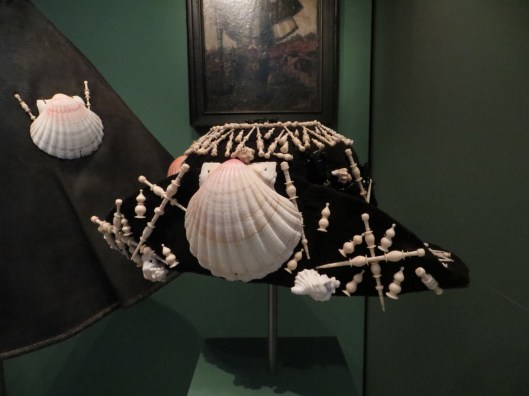
Pilgrim’s Hat, felt, silk braid, shell, bone, jet (c. 1571). This pilgrim’s hat is currently on display at the Germanisches Nationalmuseum, Nuremberg, Germany, along with a matching pilgrim’s cloak and staff.  The matching set of pilgrim’s garb belonged to Stephan Praun III, a pilgrim to Santiago de Compostela.  Photo by Reliquarian.

Saint James - Metropolitan Museum

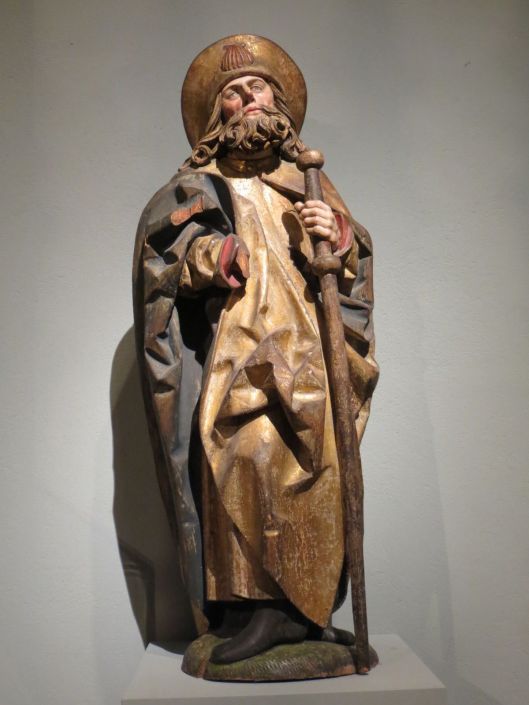
Saint James the Greater, pine with paint and gilding, South German (1475-1500), Metropolitan Museum of Art, New York. The influence of Veit Stoss, who worked in Nuremberg and Krakow, is evident in the carving of the statue’s robes and face.  Photo by Reliquarian.


[1] 3 Butler’s Lives of the Saints 183 (Herbert J. Thurston, S.J. & Donald Attwater eds., 2d ed. 1956).

[2] Laurie Dennett, “2000 Years of the Camino de Santiago:  Where Did It Come From?  Where Is It Going?,” The Confraternity of Saint James, http://www.csj.org.uk/2000-years.htm (citing martyrologies by Florus of Lyons and Usuard of St. Germaine-des-Prés).  Dennett observes that “by the late 8th century, a literary tradition had developed which held that the burial place of St James lay in Spain, even if the site had not yet been identified.”  She further notes, “Interestingly, it was not until after the purported discovery of the tomb in about 814 that a corresponding tradition evolved concerning the Apostle’s return to Palestine and death, and the transportation of his mortal remains back to Spain for burial.”  Id.  The mare Britannicum is the present-day English Channel.

[3] See id.

[4] Id.

[5] Id.

[6] Id.

[7] Id.

[8] Id.

[9] See Rainer Kahsnitz, Carved Splendor:  Late Gothic Altarpieces in Southern Germany, Austria, and South Tirol 58 (2006).  Kahsnitz explains that the sculptures “were executed by a carver from the circle around the Ulm sculptor Hans Multscher (active there from 1427 until his death in 1467).  In their compact three-dimensionality they are based more strongly on Multscher’s earlier works from the 1450s, at which time the sculptor was probably Multscher’s pupil.”  Id. at 61.

[10] Id. at 58.  A clever Latin inscription on the frame of the altarpiece also dates the work to 1466.  It begins, “Bis duo c quoque sexagintaque sex quoque mille . . . .”  Id.

[11] Id.

[12] Id.

[13] See George Ferguson, Signs and Symbols in Christian Art 112 (1959).  Ferguson observes that the pilgrim’s staff is “used alone and in combination with various other objects as an attribute of numerous saints who have been noteworthy for their travels and pilgrimages.”  Id.  Other saints commonly depicted with staffs include Saints Christopher, John the Baptist, Jerome, Philip the Apostle, Ursula, and Roch.  Id.

[14] Kahsnitz, supra note 9, at 58.

[15] Id.

[16] Id. at 60.

[17] See, e.g., Rosa Giorgi, Saints in Art 119 (Stefano Zuffi ed. & Thomas Michael Hartmann trans., 2002).

[18] Butler’s Lives of the Saints, supra note 1, at 182.

[19] Id.

[20] The Confraternity of Saint James, The Confraternity of Saint James, http://www.csj.org.uk/csj.htm; The Present-Day Pilgrimage, The Confraternity of Saint James, http://www.csj.org.uk/present.htm.

[21] Butler’s Lives of the Saints, supra note 1, at 183.

[22] The Present-Day Pilgrimage, supra note 20.

[23] Butler’s Lives of the Saints, supra note 1, at 183.

[24] Id.

[25] Id.

[26] The Present-Day Pilgrimage, supra note 20.

Share this:

  • Share on Facebook (Opens in new window) Facebook
  • Share on X (Opens in new window) X
  • Share on Pinterest (Opens in new window) Pinterest
  • Share on Reddit (Opens in new window) Reddit
  • Share on Tumblr (Opens in new window) Tumblr
Like Loading...

The Altar of the Holy Blood

02 Saturday Mar 2013

Posted by Reliquarian in Altarpiece

≈ 2 Comments

Tags

Altar of the Holy Blood, altarpiece, blood relic, Germany, Judas, pilgrimage, reliquary, Rothenburg, Saint James, Santiago de Compostela, Tilman Riemenschneider

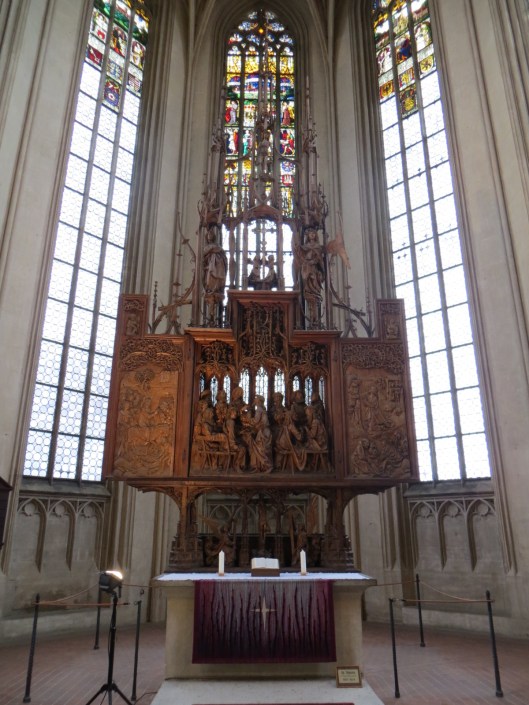
Altar of the Holy Blood

Altar of the Holy Blood, Tilman Riemenscheider, St. Jakobskirche, Rothenburg ob der Tauber, Germany, Limewood (1501-1505).  Photo by Reliquarian.

The Altar of the Holy Blood

The Altar of the Holy Blood, located at the church of Saint James (St. Jakobskirche), Rothenburg ob der Tauber, Germany, is named for the rare relic it contains:  a small sample of Christ’s blood.  The relic, encased in rock crystal, is set in a cross held aloft by two carved angels, enshrined above the corpus (central panel).[1]  The altarpiece itself is a masterpiece of woodcarving created by the Würzburg sculptor Tilman Riemenschneider between 1501 and 1505.  In the medieval period, the church of Saint James, named for the patron saint of pilgrims, was an important stop on the pilgrimage route to Santiago de Compostela in Spain, and the Holy Blood (Heilig Blut) relic was an object of intense devotion.  Today, the Altar of the Holy Blood, as well as the church’s other great altarpiece, the Twelve Apostles Altar, continue to draw visitors to the church of Saint James and the picturesque, medieval town of Rothenburg.

Tilman Riemenschneider

Rothenburg ob de Tauber

Street view of Rothenburg ob der Tauber, Germany. Photo by Reliquarian.

Tilman Riemenschneider (1460-1531), a sculptor and woodcarver who worked primarily in the prince-bishopric of Würzburg, is considered the “most famous of all German late-Gothic sculptors.”[2]  Although little is known of his early life, it is believed that he learned to sculpt while traveling in the Rhineland and Swabia, possibly in the cities of Strasbourg and Ulm.  In addition to the Altar of the Holy Blood, other celebrated works by Riemenschneider include the Assumption of the Virgin Altarpiece in the Herrgottskirche, Creglingen, Germany, and the Tomb of Emperor Henry II and Empress Cunigunde in Bamberg Cathedral, Bamberg, Germany.

Holy Blood Altar - Corpus 2

Altar of the Holy Blood (detail), Tilman Riemenscheider, St. Jakobskirche, Rothenburg ob der Tauber, Germany, Limewood (1501-1505).  This central panel of the altar depicts the Last Supper.  The central figure here, however, is Judas rather than Jesus.  Photo by Reliquarian.

Design of the Altar of the Holy Blood

The central panel of the Altar of the Holy Blood depicts the Last Supper, although the figure of Christ, who is normally portrayed at the center of such scenes, has been supplanted by Judas, the Apostle who would later betray Jesus in the Garden of Gethsemane.  In The Limewood Sculptors of Renaissance Germany, 1475-1525, Michael Baxandall writes, “Judas is Riemenschneider’s protagonist, displacing Christ from the centre of the Corpus. . . .  The emphasis on poor Judas invites meditation, though its significances are unlikely to be arcane:  Judas might, for instance, be taken to stand for the lack of discrimination with which God offers grace.”[3]  Citing a sermon from the 1490s by Johannes Pauli, a Franciscan writer, Baxandall observes, “Judas . . . can be a signal of hope to pilgrims poor in spirit.”[4]

The two side panels, or wings, flanking the corpus are carved in low relief and depict two other scenes from Jesus’ life: the Entry into Jerusalem and the Agony in the Garden.  Near the central pinnacle of the altarpiece is a carving of the Christ of Mercy, which is approximately 3 feet tall.

Relic of the Holy Blood (detail)

Relic of the Holy Blood.  The Altar of the Holy Blood (Heilig Blutaltar) is named for the relic it was designed to contain:  a small sample of Christ’s blood.  The relic is set in the center of the cross above, encased in rock crystal.  Photo by Reliquarian.

The relic of the Holy Blood, as mentioned above, is displayed just above the corpus and below the figure of the Christ of Mercy.  A contract between Riemenschneider and members of the Rothenburg city council from April 1501 describes how the relic was to be displayed.  It states, “[A]bove in the shrine in the Auszug he shall carve in the middle two Angels kneeling opposite each other and holding the Holy Cross, and also above the Cross two gliding Angels . . . ; and at the sides next to the Cross, on the right the image of the Virgin Mary and on the left the Angel Gabriel of the type announcing the angelic greeting to her virgin heart . . . .”[5]

Altar of the Holy Blood (sideview)

Altar of the Holy Blood, Tilman Riemenscheider, St. Jakobskirche, Rothenburg ob der Tauber, Germany, Limewood (1501-1505).  Photo by Reliquarian.

A Monochrome Altarpiece

Unusual for this time period, the Altar of the Holy Blood is not gilded or painted.  Rather, the wood has been left in its natural state, unfinished.  Some sources have argued that Riemenschneider eschewed paint because he preferred the natural beauty of wood.[6]  Alternatively, the altarpiece may have remained unpainted because it would have cost too much to paint.  Julien Chapuis of the Department of Medieval Art and The Cloisters at the Metropolitan Museum of Art notes, “Retables were costly undertakings that often resulted from the collaboration of several individuals: a sculptor, a joiner, an ironmonger, and, in the case of a polychrome altarpiece, a painter.”[7]  The Altar of the Holy Blood, meanwhile, was relatively inexpensive.  Baxandall observes, “The sculpture is cheap, monochrome, narrative work . . . .  It was very inexpensive work indeed, Riemenschneider being paid sixty Florins for the sculpture, Harschner fifty Florins for the shrinework, very little for a quite large retable in an important station . . . .”

Baxandall suggests that the absence of color “makes for a degree of alienation” and discourages “personal participation” and the “empathetic relation” one may feel toward other works.[8]  He states, “The monochrome medium is like black-and-white engraving in that it declares itself as a convention, not fully identifiable with the actual person or event.”[9]  In Baxandall’s opinion, the “altarpiece complements rather than abets the kind of pious attention aroused by a relic of the Holy Blood, for Riemenschneider is carving, to use Zwingli’s term, in Geschichteswyß, in a narrative way.”[10]

An Immersive Experience

Nevertheless, the opportunity to see an altarpiece in situ, especially one as significant as the Altar of the Holy Blood with its prized relic, is rare and should not be undervalued.[11]  As Chapuis observes, “very few carved altarpieces have survived intact” despite their ubiquity in the late 15th and early 16th century in Central Europe.[12]  “The destruction of religious images during the Protestant Reformation, along with neglect, changes in taste, fire, and the secularization of ecclesiastic institutions account for this loss,” he explains.  “Many figures and reliefs in museum collections are merely fragments of elaborate, monstrance-like structures, which served as a focus for liturgy, veneration, and pilgrimage.”[13]

Holy Blood Relic - Sign


[1] See generally Julien Chapuis, Late Medieval German Sculpture: Images for the Cult and for Private Devotion, The Metropolitan Museum of Art, http://www.metmuseum.org/toah/hd/grmn_4/hd_grmn_4.htm (describing the four main elements of an altarpiece).

[2] Tilman Riemenschneider, Encyclopedia of World Biography (2004), available at http://www.encyclopedia.com/topic/Tilman_Riemenschneider.aspx.

[3] Michael Baxandall, The Limewood Sculptors of Renaissance Germany, 1475-1525, at 179 (1980).

[4] Id. at 180.

[5] Baxandall, supra note 3, at 174.

[6] See, e.g., “The Reredos IV:  The German World – Tilman Riemenschneider,” The Society of St. Hugh of Cluny (Nov. 16, 2009), http://sthughofcluny.org/2009/11/the-reredos-iv-the-german-world-tilman-riemenschneider.html (“He was one of the German carvers of altarpieces to leave the carvings in the natural wood and abandon the gilt and painted surfaces of tradition.”); Encyclopedia of World Biography, supra note 2 (“Sensing the beauty of the wood itself, Riemenschneider frequently did not polychrome his altarpieces, a novelty at this time.”).

[7] Chapuis, supra note 1.

[8] Baxandall, supra note 3, at 186.

[9] Id.

[10] Id.

[11] See, e.g., Karen Rosenberg, At the Altar of Renaissance Tuscany, NY Times, February 14, 2013, at C32, available at http://www.nytimes.com/2013/02/15/arts/design/piero-della-francesca-in-america-at-the-frick.html?_r=0 (explaining how difficult it can be to “recreate the immersive experience” of a church setting).

[12] Chapuis, supra note 1.

[13] Id.

Share this:

  • Share on Facebook (Opens in new window) Facebook
  • Share on X (Opens in new window) X
  • Share on Pinterest (Opens in new window) Pinterest
  • Share on Reddit (Opens in new window) Reddit
  • Share on Tumblr (Opens in new window) Tumblr
Like Loading...

Recent Posts

  • Ex Indumentis:  Religious Medals and Relics of Saints
  • Green Alternative: When Saint Patrick Wore Blue
  • The Great Heart Heist: The Stunning Theft of Saint Laurence O’Toole’s Preserved Heart
  • The Column of the Flagellation: Relic of the Scourging of Jesus
  • Saint Roch: The Saint “Par Excellence” Against Disease

Top Posts & Pages

  • Saint Munditia: A Holy Skeleton Near the Rindermarkt in Munich
    Saint Munditia: A Holy Skeleton Near the Rindermarkt in Munich
  • The Altar of the Holy Blood
    The Altar of the Holy Blood
  • The Great Heart Heist:  The Stunning Theft of Saint Laurence O'Toole's Preserved Heart
    The Great Heart Heist: The Stunning Theft of Saint Laurence O'Toole's Preserved Heart
  • Saint Charles Borromeo:  A Tale from the Crypt of Milan Cathedral
    Saint Charles Borromeo: A Tale from the Crypt of Milan Cathedral
  • The Column of the Flagellation:  Relic of the Scourging of Jesus
    The Column of the Flagellation: Relic of the Scourging of Jesus
  • Saint Erasmus of Formiae (or Saint Elmo)
    Saint Erasmus of Formiae (or Saint Elmo)
  • Relic of the Holy Diaper:  The Swaddling Clothes of Jesus
    Relic of the Holy Diaper: The Swaddling Clothes of Jesus
  • The Shrine of the Three Kings:  Grand Reliquary of the Magi
    The Shrine of the Three Kings: Grand Reliquary of the Magi
  • The Way of Saint James:  Pilgrimage to the Tomb of a "Son of Thunder"
    The Way of Saint James: Pilgrimage to the Tomb of a "Son of Thunder"
  • Saint Silvan
    Saint Silvan

Tags

Aachen altarpiece Austria basilica cathedral Charlemagne church Croatia Dubrovnik Fourteen Holy Helpers Germany Hall in Tirol Italy Krakow Magi martyr mosaic Munich pilgrim pilgrimage Poland relic reliquary Rothenburg Saint Blaise Saint Denis Saint Helena Saint James Saint Mark Saint Mary Saints Cosmas and Damian Saint Theodore Santiago de Compostela sarcophagus shrine skeleton skull Tintoretto tomb Venice

Archives

Categories

Enter your email address to subscribe to this blog and receive notifications of new posts by email.

Join 91 other subscribers

Blog at WordPress.com.

  • Subscribe Subscribed
    • Reliquarian
    • Join 91 other subscribers
    • Already have a WordPress.com account? Log in now.
    • Reliquarian
    • Subscribe Subscribed
    • Sign up
    • Log in
    • Report this content
    • View site in Reader
    • Manage subscriptions
    • Collapse this bar
%d