Tags
church, Germany, martyr, Munich, reliquary, Saint Erasmus, Saint Munditia
 The Skeleton of Saint Munditia
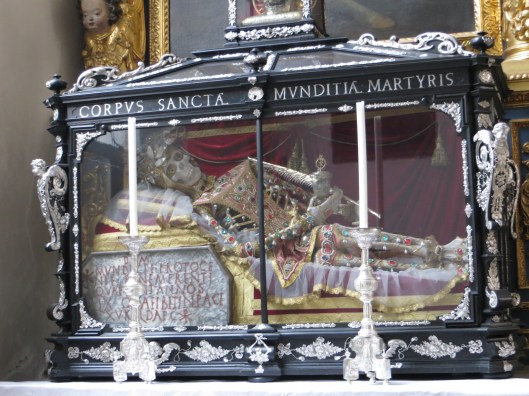
The skeleton of Saint Munditia rests in a glass ossuary, hidden in plain sight at the Peterskirche (Saint Peter’s Church) in Munich. Situated just steps from the church’s north entrance, the ossuary is ordinarily locked behind a wrought iron gate that partially 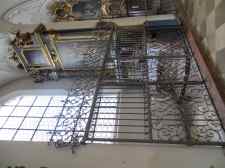 obscures it from view. Most visitors never notice she’s there, but those who catch a glimpse of her and pause to peer through the gate may be surprised to find a skeleton, bedecked in jewels and bound in gauze, staring back at them.
The skeleton is propped on cushions and rests at a slight angle to the viewer. Its arms and legs are adorned with alternating red and green jewels, the color of gumdrops. She holds a golden palm frond resembling a giant quill pen in her left hand, her thumb hooked around its stem. The palm frond is emblematic of martyrdom. In her right hand she holds what appears to be a small philatory with the Greek letters chi (X) and rho (P), surrounded by a radiance, extending from the lid. Chi and rho are the first two letters in the Greek word for Christ. Unfortunately, although the philatory is transparent, it is difficult to discern what it contains. Are they the relics of another saint?
The skeleton’s most striking feature are its glass eyes. Set securely in the saint’s skull, they stare out at the world in slightly different directions. The skull is also crowned with a metal laurel wreath, another symbol of martyrdom.
Who Is Saint Munditia?
Not much is known of Saint Munditia. She does not appear in the Roman Martyrology or even the Book of Saints, although the inscription above her tomb is unequivocal about her status as both a saint and martyr. The inscription reads CORPUS SANCTA MUNDITIA MARTYRIS (“Body of Saint Munditia, Martyr”). She is also purportedly the patron saint of spinsters.[1]
According to some sources, the relics of Saint Munditia were discovered in the Roman catacombs and were obtained by Franz Benedikt Höger, a Munich businessman, in 1675. The relics were translated to the Peterskirche on 5 September 1677, where they have remained ever since. In 1804, the skeleton was concealed behind a wooden shrine in an attempt to combat “Aberglaube” (superstition), but the relics were eventually uncovered again in 1883, which resulted in renewed interest in her cult.[2]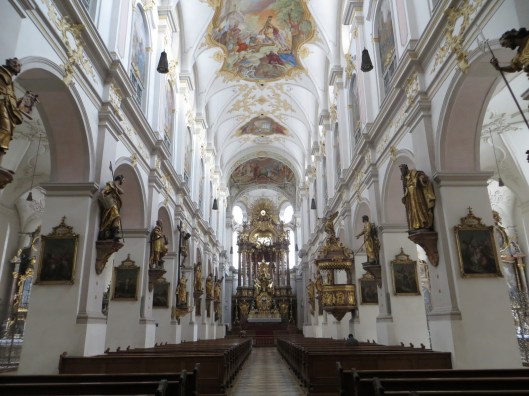
The inscription located inside the ossuary, beneath Saint Munditia’s head, is somewhat enigmatic, but it offers clues about the life and death of the mysterious saint. It reads:
DDM MUNDICIE PROTOGENIE BENEMERENTI QUAE VIXIT ANNOS LX QUAE IBIT IN PACE XV KAL D ZUM FROMMEN GEDENKEN AN MUNDITIA PROTOGENIA DIE WOHLVERDIENTE: SIE LEBTE 60 JAHRE UND GING EIN IN DEN FRIEDEN AM 15. TAG VOR DEN KALENDEN DES DEZEMBERS (17. NOVEMBER) – APC
The abbreviation “APC” appended at the end of the text is one of the most perplexing parts of the inscription. Some have interpreted it to mean “ASCIA PLEXA CAPITA,” 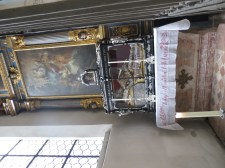 indicating Saint Munditia had been decapitated by an ax or hatchet. Others propose that “APC” stands for “ANDRONICO PROBO CONSULIBUS,” meaning “During the counsulship of [Tatius] Andronicus and [Pompeius] Probus.” Under this interpretation, Saint Munditia would have died in the year 310.
While Saint Munditia may not have the star power of more famous saints, like Saint Mark or Saint George, she continues to be celebrated every year[3] at the Peterskirche, and she even has a following on Facebook. A contemporary poem by the Trinidadian writer Vahni Capildeo offers further evidence of Saint Munditia’s ability to provoke and inspire, even today. “St. Munditia, centuries later,” he writes, “bewigged, bolted and belted with jewels, . . . glassed off like the snake room at the zoo.”[4]
The Skull of Saint Erasmus
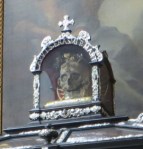 But Saint Munditia is not the only saint to share the small enclosure that contains her shrine. Above her glass ossuary and easily overlooked amidst the visual tumult of bones, jewels, and Baroque ornamentation surrounding her skeleton rests another, much smaller, glass reliquary. Peering out of the box with unnaturally blue eyes is a skull with a halo placed on a cushion. The inscription above it declares that it is the skull of Saint Erasmus: CAPUT S. ERASMI P. MART.[5] As I’ve written before, Saint Erasmus of Formiae is a patron saint of mariners and protector against intestinal ailments. He is incorrectly believed to have been martyred by disembowelment.
[1] Die Pfarrgemeinde von St. Peter, “Eine Katakombenheilige in St. Peter,” available at http://www.alterpeter.de/frameneu/mundi_frame.htm.
[2] Id.
[3] The Munditiafest takes place every November 17th.
[4] Vahni Capildeo, No Traveller Returns 163 (2003).
[5] “MART” is a shortened form of “Martyr.” The “P.” I believe stands for “Pius,” meaning dutiful.
 Reliquarian